
A year ago, most people I know were still using AI for goofy stuff. Writing captions. Summarizing emails. Maybe asking it what protein powder to buy.
Now it is… different. Not sci fi different. Just quietly, unavoidably baked in.
Your doctor might not “use AI” in the obvious way. But your radiology report might have been prioritized by an algorithm. Your insurance plan might be running risk models that decide which outreach messages you get. Your hospital might be using an ambient scribe that turns the whole visit into a neat note. And you might be wearing a sensor on your wrist that keeps hinting at sleep apnea without ever saying the words.
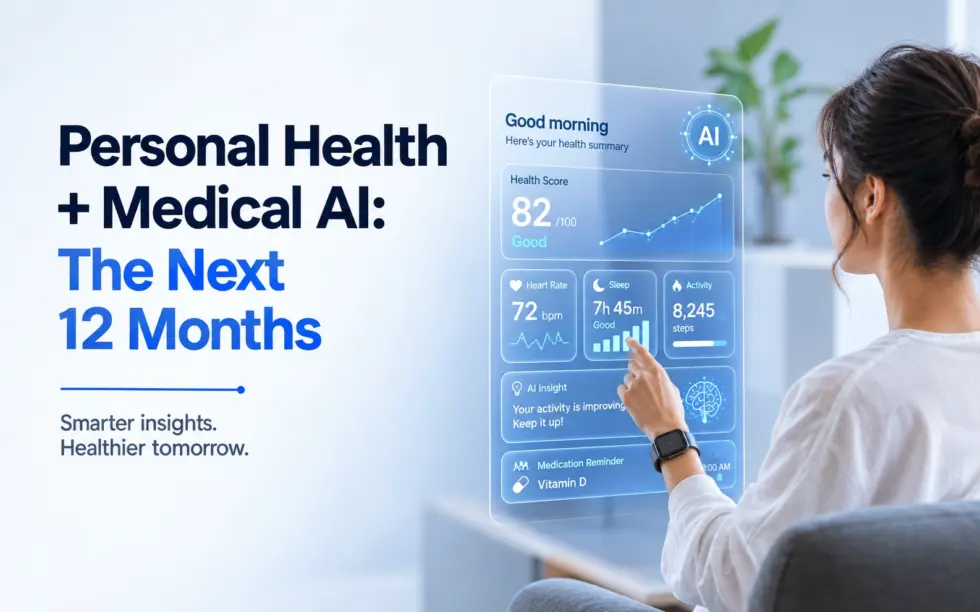
So when I think about the next 12 months for personal health plus medical AI, I think about one thing.
Not whether AI will arrive. It is already here.
The real question is: where will it become normal.
And where will it break, or overpromise, or freak people out.
This is my best, honest map of what’s likely to happen next. Not a ten year forecast. Not a research paper. Just the next year, the stuff that will show up in your life in small ways. A new feature in your health portal. A new workflow at your clinic. A new kind of “care” that is half human, half software, and still somehow billed like the old world.
Let’s get into it.
The biggest shift is not a new model. It is a new interface
Most people picture medical AI as some genius machine diagnosing diseases like a TV show.
But what is actually changing fastest is boring, and that is why it will win.
Interfaces.
The next 12 months are going to be full of medical AI that sits in between people and paperwork. Between clinician and chart. Between patient and portal. Between “I feel weird” and “do I need to do something”.
Less “AI doctor”.
More “AI layer”.
And this matters because healthcare is a workflow industry. Everything is forms, notes, codes, referrals, orders, prior authorizations, documentation, follow ups. Even good doctors spend ridiculous time clicking.
So the first wave that really sticks is going to be:
- AI that listens, drafts, and routes.
- AI that watches incoming data and flags.
- AI that helps patients navigate the system without bouncing off it.
Which leads to the most visible thing you’ll notice as a patient.
1) AI scribes become normal. Like… normal normal
Ambient clinical documentation is one of the few AI categories that has already proven it can save time without asking for permission from regulators in the same way a diagnostic tool would.
In plain English: the software listens to the conversation during your appointment and writes the note.
If you have not experienced this yet, you probably will soon. Especially in primary care, urgent care, and certain specialty clinics that are drowning in documentation.
Over the next 12 months, expect:
More clinics to ask for consent to record the visit, because the tool needs audio. Some will do it well. Some will do it in a rushed, awkward way at check in. You’ll hear stuff like, “We use a transcription assistant, is that okay?” and you will nod even though you have questions you do not have time to ask.
Cleaner notes in your portal. Ironically, notes might become more readable for patients because they’re drafted in more natural language. Then edited. Then stuffed into the same old templates. But still, less chaos.
More copy paste errors at first. This is the messy part. AI scribes can hallucinate. They can mishear. They can confidently state you denied chest pain when you never talked about chest pain. The clinician is supposed to review. Sometimes they will. Sometimes they will skim.
So one practical thing, for you, as a patient.
If your health system lets you see visit notes. Read them. At least the problem list, meds, allergies, and the “assessment and plan.” If something is wrong, message the clinic and get it corrected. Not because you want perfect paperwork. Because wrong notes become wrong care later.
Also, these systems will start doing more than notes.
They’ll propose orders. Draft referral letters. Generate after visit summaries. Create patient instructions in plain language. Translate.
And that’s where it gets interesting. Because now the “AI scribe” starts touching care decisions, even if indirectly.
2) Triage chatbots get sharper, and also more annoying
Every health system wants to reduce phone calls. Every insurer wants to reduce unnecessary visits. Every employer plan wants “virtual first” because it’s cheaper.
So we are going to see more symptom checkers and triage bots embedded in:
- patient portals
- urgent care apps
- telehealth intake flows
- pharmacy apps
The near term improvement is not that the bot suddenly becomes a perfect clinician. It won’t.
The improvement is that it becomes a better traffic cop.
Over the next 12 months:
Expect triage bots to ask fewer dumb questions and do more context gathering from your chart. Med list. Age. Diagnoses. Recent labs. Recent visits. The intake will feel less like a choose your own adventure nightmare.
Expect more bots to “hand off” cleanly to humans instead of forcing you to start over. This is huge. The worst part today is repetition. If AI can summarize your complaint and pass it to a nurse or clinician, that’s real value.
Expect more risk aversion. This is the annoying part. Medical systems hate liability. Bots will err on the side of “go to the ER” more than you think is reasonable. They will also push you toward visits when you wanted simple advice, because the business model is still visit based.
The practical upside is that if you are the kind of person who delays care, a triage bot can nudge you earlier.
The practical downside is alarm fatigue, and wasted visits, and people learning to game the intake so they can just talk to a human.
And yes. People will absolutely do that.
3) Your wearables will start “diagnosing” without calling it diagnosis
This one is already creeping in.
Watches and rings are getting better sensors and better models. But the key change in the next year is not a new sensor. It is interpretation plus integration.
Right now, wearable data mostly lives in consumer land. You see it. Maybe you show your doctor a screenshot once. They nod politely. End of story.
Over the next 12 months, expect more:
AFib and arrhythmia detection workflows that actually connect to care. Not just a notification, but a suggested next step, a telehealth consult, maybe even a mailed patch monitor.
Sleep apnea risk signals getting more direct. Sleep staging has been a mess, but trend detection is improving. Some companies will be bold and start pushing “possible sleep apnea” insights based on heart rate variability, breathing irregularity, oxygen trends if you have it. They will phrase it carefully. But you’ll know what they mean.
Cardiometabolic coaching that looks like a “gentle AI coach” but is basically a behavior change funnel. If your resting heart rate trends up, sleep worsens, activity drops, you might get nudged. Sometimes it’ll help. Sometimes it’ll be noise.
Fewer raw metrics, more composite scores. This is a big design shift. Most users do not want 30 graphs. They want one sentence. But one sentence can be wrong in a dangerous way. So the next year is going to be a tug of war between simplicity and safety.
If you want to use this stuff sanely, here is a good rule.
Wearables are great at trends. Terrible at certainty.
Use them to notice changes, then confirm with real medical evaluation when needed. Do not let a “score” talk you out of symptoms you actually feel.
4) Home testing gets paired with AI interpretation, for better and worse
At home tests are exploding. Some are legit and useful. Some are… marketing.
In the next 12 months, we’ll see more kits for:
- metabolic markers
- lipids
- HbA1c
- fertility hormones
- thyroid markers
- STI panels
- microbiome stuff (still messy)
- genetic risk add ons
What changes is the interpretation layer.
Companies will use AI to generate:
- “what this means” explanations
- personalized action plans
- supplement recommendations (of course)
- suggested follow up tests
- “talk to a clinician” escalation
This can be good. Patients often get labs with zero context. AI can explain, in plain language, what a marker generally correlates with. What is urgent vs not urgent.
But there are risks:
Over interpretation. Not every abnormal lab is meaningful. A slightly elevated something can be transient. AI can create a story where none exists.
False reassurance. Normal labs do not always mean you are fine. Early disease exists. Labs are snapshots.
Conflicts of interest. If the same company sells the test, the interpretation, and the supplements. Yeah.
What I think will become more common is hybrid models: at home testing plus a real clinician visit, with AI used to draft the note, draft the plan, and provide patient education.
While this model sounds promising and has potential benefits, it also raises significant ethical concerns regarding accountability in medical judgments. The reliance on AI for interpreting test results could lead to scenarios where over-interpretation occurs, resulting in unnecessary anxiety for patients or misleadingly reassuring normal results that overlook early signs of disease. Moreover, when a single entity controls both the testing and interpretation processes, it creates inherent conflicts of interest that could compromise patient care.
5) “Doctor in your pocket” apps will surge, then hit reality
There will be a lot of apps this year that promise something like:
“Upload your labs and symptoms, and our AI will tell you what’s going on.”
Some will market as wellness. Some as education. Some as “not medical advice” with tiny text. Some will partner with telehealth providers so they can claim it’s clinician supervised.
People will use them because:
- appointments are slow to get
- clinics feel rushed
- health anxiety is real
- and honestly it is comforting to talk to something at 2am
So yes, usage will surge.
But they will hit reality in a few ways over the next 12 months:
Regulatory pressure. If an app is making diagnosis or treatment recommendations, regulators will care. Even if the company tries to wiggle around it with disclaimers. The line between education and medical device is going to be tested.
Public failures. We will see screenshots of bad advice go viral. It always happens. And medicine is a high stakes domain where one confident wrong answer is a PR disaster.
Trust whiplash. People will bounce between “this is amazing” and “this is dangerous” depending on the week and the headline.
My practical take.
These tools can be useful as:
- question generators for your appointment
- explainers for your labs
- second eyes for medication interactions to ask about
- “what could this be” brainstorming, with caution
They should not be used as:
- permission to ignore red flag symptoms
- a replacement for clinical evaluation
- a source of medication dosing or treatment changes without clinician oversight
If you use them, keep them in the right role. Assistant, not authority.
6) Radiology and imaging AI will expand quietly, behind the scenes
This is one of the most mature areas of medical AI. Not because it is “solved”, but because imaging is data rich and patterns matter.
In the next year, you probably won’t log into an app and see “AI read your CT.”
But what you will see is:
Faster turnaround times for certain findings because AI triages the worklist. Suspected bleed goes up the queue. Normal studies might wait longer. This is already happening in many places.
More incidental findings detection. Lung nodules. Vertebral fractures. Coronary calcium estimates. These can be helpful. They also create cascades of follow up scans and anxiety.
More standard language in reports. AI can help structure reporting, reduce variability, and ensure key elements are included. As a patient, that might mean reports are easier to understand. Or they become even more templated. Depends on the system.
One subtle change.
As AI gets involved in imaging workflows, patients will start asking, “Was AI used?”
Hospitals will not always have a clear answer at the patient facing level. It will be embedded in the workflow like spellcheck. That transparency gap is going to get more noticeable.
7) Pathology and cancer care will get more AI assistance, mostly for clinicians
Digital pathology plus AI is advancing fast, but adoption varies because scanning slides at scale is expensive and operationally complex.
Still, in the next 12 months:
- More large centers will use AI to assist with cancer grading, counting mitoses, highlighting suspicious regions.
- More oncology teams will use AI for summarizing records, matching clinical trials, drafting prior auth letters, and synthesizing literature.
On the patient side, you may notice:
More personalized treatment discussions that are supported by AI summarization of guidelines and studies sourced from reliable databases like those found in this comprehensive article . But still, the clinician is the one deciding.
The risk is that “AI says” becomes a rhetorical crutch. Patients will need to feel comfortable asking, “Based on what evidence?” and “Is this standard of care or experimental?”
Not in an aggressive way. Just a clarity way.
8) Medication management gets a real upgrade (finally), but privacy gets weird
Medication errors are common. And medication lists are often wrong. Different pharmacies. Old prescriptions. Supplements. It’s chaos.
AI can help here because it can:
- reconcile lists
- flag interactions
- detect duplicate therapies
- suggest simpler regimens
- generate reminders and adherence coaching
In the next year, expect more:
Pharmacy apps with smarter counseling. More chat based “what is this medication for” and “can I take this with…” features. Some will be genuinely helpful. Some will just be fluff wrapped around a database.
Health systems doing proactive outreach when your data suggests nonadherence. This is sensitive. Helpful if you want support. Creepy if you didn’t consent in a meaningful way.
Insurers using AI to steer. Formularies, step therapy, prior authorization. AI will not fix the incentives, but it will optimize them. Which can be good for cost, bad for patient autonomy.
One thing I strongly suspect we’ll see more of.
AI generated messages that look like they came from your clinic. But they’re automated. And you cannot tell. That line needs to be clearly marked. Patients deserve to know if a human wrote it, reviewed it, or if it was machine generated with a clinician’s name slapped on top.
9) Mental health AI goes mainstream, and it will be messy
This is the category with the highest demand and the most risk.
In the next 12 months, mental health AI will keep exploding: chat based therapy, journaling companions, mood tracking, CBT style coaching, crisis detection.
Some people will be helped. Realistically. Especially people who have no access to a therapist and just need something supportive and structured.
But it is messy because:
- people form attachments to conversational agents
- mental health crises require careful escalation
- data privacy is deeply sensitive
- and the market is flooded with apps that do not have strong clinical grounding
Expect these trends:
More evidence claims. Apps will tout studies. Some will be legitimate, some will be shaky. Consumers will have a hard time telling.
More guardrails. More systems will implement crisis prompts and “seek immediate help” scripts. Necessary, but not sufficient.
More integration with employers and health plans. Which raises the uncomfortable question of who can see your data even if they claim it is anonymized.
If you use an AI mental health tool, treat it like any health service.
Read the privacy policy, at least the key parts: who they share with, whether they train on your data, and whether you can delete your history.
And if the tool ever makes you feel worse, stop using it immediately. That sounds obvious, but people often push through because the app feels authoritative; remember that it isn’t always reliable or beneficial.
10) The patient portal becomes a mini assistant, not just a PDF graveyard
This one is coming. Slowly. But it’s coming.
Patient portals today are mostly where information goes to die. Lab results posted with no explanation. Messages buried. Appointments hidden in odd tabs.
Over the next year, portals will start adding:
- AI summaries of visit notes
- “next steps” checklists
- plain language lab explanations
- draft replies to messages (for staff, and sometimes for patients)
- navigation help, like “how do I get my MRI scheduled”
This is the kind of change that sounds small but feels huge in daily life.
However, it introduces a new risk.
If the portal summary is wrong, patients may follow the wrong plan.
So the responsible implementation is: summaries that cite the source inside the chart. Like, “This is based on Dr. X’s plan in your visit note.” Not just a confident paragraph floating on its own.
We will see some portals do this well. Others will ship it fast and hope for the best.
The uncomfortable part: AI will amplify existing incentives, not replace them
People ask, “Will AI lower healthcare costs?”
Maybe. In some places. For some workflows.
But the more honest answer is that AI will first make the current system run faster.
If a system is optimized for billing, AI helps billing. If a system is optimized for documentation, AI helps documentation. If a system is optimized for minimizing time per patient, AI might help that too.
So in the next 12 months, you might feel both:
- more convenience
- and more pressure to fit into automated flows
Which is why patient agency matters a lot here.
You will want to know when you can opt out. When a recording is happening. When an AI drafted message is being sent. When a recommendation is coming from policy vs from clinical judgment.
What will actually change for you, specifically, in the next year
Let’s make this personal and concrete. Here are the most likely “you will notice this” changes.
You will hear more consent language around audio recording
Especially at clinics using ambient scribes. Sometimes it will be handled well, sometimes not. You can say no. You can ask, “If I say no, what changes?” A good clinic will still see you and take notes manually.
Your after visit summary will get clearer
And longer. Often with helpful links. Sometimes with generic filler. But overall, easier to read.
You will get more automated follow ups
Reminders to schedule labs. Reminders to refill meds. Nudges for preventive care. Some will be useful. Some will feel spammy. But the volume will increase.
You will see more “smart” interpretation of labs and imaging
In plain language. Sometimes with risk bands. Expect more “talk to your doctor” disclaimers too.
You will be tempted to use AI for self diagnosis
Because it is fast and feels smart. Use it, if you want. But use it like a flashlight, not a judge.
The biggest risks in the next 12 months (that nobody wants to talk about)
1) Quiet errors that look plausible
This is the scariest category. Not the obvious nonsense. The plausible mistake in a clinical note. The wrong side. The wrong medication dose. The missing allergy. The sentence that sounds right but isn’t what you said.
AI makes documentation easier, which means more documentation gets generated. And humans are bad at reviewing long text.
2) Data sharing creep
Health data is valuable. The more AI features you use, the more data flows through vendors. Some are HIPAA covered entities, some are not. Some are “business associates,” some are not. The legal categories matter, but they are invisible to patients.
3) Two tier care gets worse
People with better devices, better literacy, better access to AI enabled clinics get more proactive care. People without those things get more automated gatekeeping and less human attention.
4) Over medicalization
More detection means more follow ups. More follow ups means more scans, more biopsies, more anxiety, more cost. Some of it saves lives. Some of it is noise. The balance is hard.
How to use personal health AI without getting burned
This is the part I wish someone would just hand people as a checklist.
Keep a single source of truth
Maintain a simple document with:
- current meds and doses
- allergies
- diagnoses
- surgeries
- key test results and dates
- family history highlights
Because AI tools, portals, and even clinicians often have incomplete data. You bringing a clean summary helps everything.
Ask one direct question when AI is involved
Pick one, depending on the situation:
- “Is this note AI drafted, and did you review it?”
- “Is this message automated or did someone read my chart?”
- “What is this recommendation based on, a guideline or a policy?”
- “If I opt out of recording, what changes?”
You do not need to be confrontational. Just clear.
Treat AI explanations as education, not diagnosis
Use them to understand terms and possibilities. Then verify.
Watch for red flags
If an AI tool tells you any of these, do not debate it with the app:
- chest pain with shortness of breath
- stroke symptoms
- severe abdominal pain
- signs of sepsis, high fever with confusion
- suicidal thoughts
Get human help fast.
Protect your privacy by default
If an app is not clearly part of your healthcare provider, assume your data could be used for:
- product improvement
- marketing
- partnerships
Sometimes de identified, sometimes not as de identified as you think.
Use tools that offer:
- clear deletion
- no training on your data by default
- minimal collection
- transparent sharing policies
A realistic 12 month forecast, month by month-ish
Not exact months, but you get the idea.
The next 3 months
More clinics roll out ambient scribes. More portal features show up labeled “AI summary.” More employers add AI mental health benefits.
3 to 6 months
Triage bots get more integrated into scheduling. Wearables push more health insights and partner with telehealth pathways. More “AI assisted” imaging workflows expand quietly.
6 to 12 months
Regulators and health systems tighten language around what AI can claim. A few high profile failures make headlines. Patient expectations adjust. The tools that survive will be the ones that fit into workflows and don’t embarrass clinicians.
The biggest story won’t be a single breakthrough model.
It’ll be normalization.
The bottom line
In the next 12 months, personal health plus medical AI is going to feel less like a revolution and more like… a renovation. New drywall over the same old building.
You’ll see it in the note from your doctor. The way your portal explains your lab. The way scheduling works. The way your watch nudges you. The way your clinic follows up. The way mental health support becomes more available, and also more complicated.
Some of this will genuinely help people.
Some of it will be annoying.
A small part of it will be dangerous, in quiet ways, if nobody is paying attention.
So the best stance, in my opinion, is neither hype nor fear. Just informed usage.
Let AI make the system less painful. Let it help you understand. Let it draft, summarize, and organize.
But keep humans responsible for decisions. Keep transparency non negotiable. And keep your own common sense in the loop, even when the output sounds confident.
Because in medicine, confidence is cheap.
Care is not.
FAQs (Frequently Asked Questions)
How is AI currently integrated into everyday healthcare without being obvious?
AI is quietly embedded in many healthcare processes such as prioritizing radiology reports, running insurance risk models to tailor outreach messages, using ambient scribes to document clinical visits, and sensors on wearables that monitor health conditions like sleep apnea. It operates behind the scenes to enhance workflow and patient care without overtly appearing as ‘AI use.’
What is the most significant shift in medical AI expected in the next 12 months?
The biggest change is not a new diagnostic AI model but a new interface layer that integrates AI between people and paperwork, clinicians and charts, patients and portals. This ‘AI layer’ will streamline workflows by listening, drafting documentation, flagging important data, and helping patients navigate complex healthcare systems more efficiently.
What are AI scribes and how will they impact clinical documentation soon?
AI scribes are software tools that listen to clinical conversations during appointments and draft visit notes automatically. Over the next year, their use will become normal in primary care and other clinics overwhelmed by documentation. They will improve note readability but may introduce errors initially, so patients should review their visit notes carefully and communicate any inaccuracies to their clinicians.
How are triage chatbots evolving in healthcare settings?
Triage chatbots embedded in patient portals, urgent care apps, telehealth flows, and pharmacy apps are becoming smarter at gathering context from medical records like medication lists and recent labs. They will reduce repetitive questioning by handing off summarized complaints cleanly to human clinicians. However, they tend to be risk-averse, often recommending ER visits or office visits more frequently due to liability concerns and existing business models.
What practical advice should patients follow regarding AI-generated clinical notes?
Patients who have access to their visit notes should actively read key sections such as problem lists, medications, allergies, assessment, and plans. Since AI scribes can mishear or hallucinate information leading to errors in documentation that might affect care later, patients should promptly message their clinic to correct any inaccuracies rather than assuming perfect paperwork.
Why won’t medical AI replace doctors but will instead augment healthcare workflows?
Medical AI is less about replacing clinicians with automated diagnoses and more about enhancing workflows by reducing administrative burdens like paperwork, referrals, prior authorizations, and documentation. By acting as an ‘AI layer’ between humans and tasks, it supports clinicians in providing care more efficiently while maintaining human judgment where it matters most.