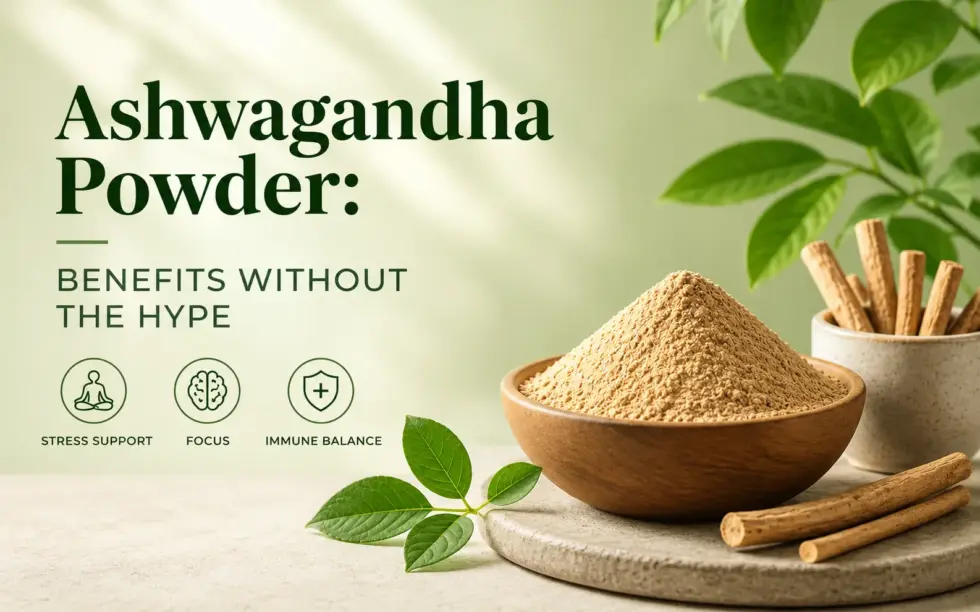

Ashwagandha is one of those supplements that somehow ends up everywhere.
A friend mentions it for “stress”. A podcast host says it’s the missing piece for sleep. TikTok calls it nature’s Xanax. Someone in your gym swears it’s the reason they’re “finally gaining.”
And then you look it up and the claims are… a lot. Anxiety, testosterone, muscle, thyroid, cortisol, focus, libido, blood sugar, inflammation, even aging. All from a beige powder that smells like dirt and horse feed. (Fun fact, the name is often explained as “smell of a horse”. Which, yeah. Checks out.)
So let’s do this in a calmer way.
This is an honest, grounded guide to ashwagandha powder. What it can do, what it probably cannot do, and how to use it without turning it into a personality.
No miracle language. No fear mongering. Just real benefits, real limits, and practical stuff you can actually apply.
What ashwagandha powder actually is
Ashwagandha is Withania somnifera, a plant used in Ayurvedic tradition for a long time, usually framed as a “rasayana” type herb (rejuvenation, resilience, etc). Modern supplement marketing translated that into one big word:
In plain English, an adaptogen is supposed to help your body handle stress better. Not by knocking you out. Not by “boosting dopamine” in a dramatic way. More like smoothing the stress response so you’re less spiky.
Ashwagandha supplements are usually made from:
- Root powder (traditional, common, usually milder)
- Root extract (concentrated, standardized to certain compounds)
- Leaf or root plus leaf (sometimes higher in withanolides, sometimes harsher side effects for some people)
The active compounds people talk about are withanolides. That’s the family of chemicals often standardized in extracts.
Powder is usually less concentrated than extracts. Which is not automatically bad. It just means dose and consistency matter more.
The real, evidence supported benefits (without overpromising)
Here’s the honest version: ashwagandha is not magic. But it does have a few areas where evidence is decent, especially for certain people.
1) Stress and anxiety symptoms (the most consistent use case)
This is the main reason ashwagandha became popular in the first place. Several clinical trials suggest it can reduce perceived stress and anxiety symptoms, often paired with reductions in cortisol.
Not “your life becomes easy” stress. More like:
- you feel less wired
- you recover faster after stressful days
- you get fewer stress spirals at night
- you’re not as irritable for no reason
If you’re the kind of person who runs tense all day and only realizes it when your jaw hurts. You’re the target audience.
What it’s not: an instant calm like a benzodiazepine, or a replacement for therapy, or something that fixes chronic life problems.
But as a nudge toward resilience, it’s one of the better researched herbs.
2) Sleep quality (especially stress related sleep issues)
Ashwagandha isn’t a sedative in the classic sense. It won’t necessarily “knock you out.”
What it can do, for some people, is help sleep indirectly by lowering stress arousal. People often report:
- falling asleep faster
- fewer middle of the night wake ups
- better sleep quality (less “I slept but I’m still tired”)
It’s not as predictable as melatonin for sleep timing. It’s more about sleep depth and calm.
Also. Not everyone gets sleepy from it. A small number of people feel more energized and take it earlier in the day.
3) Strength, performance, and recovery (some support, not superhero stuff)
There are studies showing improvements in strength and muscle gains when combined with resistance training, plus possible benefits for recovery and endurance markers.
This is where the hype gets loud. People start calling it “natural testosterone booster” and “anabolic adaptogen.” That’s when it gets messy.
A more accurate framing is:
- if stress is limiting recovery, sleep, or training output, reducing stress can help training outcomes
- there may be additional effects beyond that, but they’re modest
In other words, ashwagandha is not creatine. It’s not going to turn a mediocre program into a great one. But it may help you show up better, recover slightly better, and feel less run down.
4) Testosterone and fertility markers (mostly in specific contexts)
Ashwagandha has research showing improvements in testosterone and fertility parameters, but the strongest evidence tends to be in:
- men with fertility issues
- men under significant stress
- men with lower baseline testosterone
If you’re a healthy guy with normal hormone levels, the effect is usually smaller and sometimes basically irrelevant.
Also, if your testosterone is low because you sleep 5 hours, eat like a raccoon, and never go outside. Ashwagandha might help a bit, but it’s not the main lever. The main lever is you fixing the basics.
5) Cortisol reduction (real, but don’t obsess over cortisol)
Some studies show reduced cortisol levels, often alongside improved stress scores.
That’s cool, but the internet made cortisol into a boogeyman. Cortisol isn’t “bad.” It’s a normal hormone. You need it. It helps you wake up, respond to challenges, regulate energy.
The point isn’t “crush cortisol.” The point is: if you’re chronically stressed, cortisol patterns can get dysregulated, and ashwagandha may help normalize things.
Think “less stuck in fight or flight.” Not “turn off cortisol.”
6) Blood sugar and inflammation (promising, not definitive)
There’s some evidence suggesting potential benefits for blood sugar control and inflammatory markers. But this is not the primary reason to take it.
If you want metabolic improvements, start with food quality, fiber, walking, strength training, sleep. Then if you want to experiment with supplements, fine. But don’t start with ashwagandha and expect it to outwork your lifestyle.
Benefits people claim that are usually exaggerated
This is the part where the internet gets creative.
“It cures depression”
Some people feel better mood wise, especially if stress and sleep improve. But it’s not an antidepressant replacement, and clinical depression is more complex than “take this herb.”
“It fixes burnout”
Burnout is usually a mix of workload, boundaries, nervous system overload, and sometimes real health issues. Ashwagandha can support stress response. It can’t change your boss, your schedule, or your inbox.
“It boosts thyroid”
This one is tricky. There are small studies and lots of anecdotes. But thyroid stuff is sensitive, and ashwagandha can potentially **increase **thyroid hormones in some people. That might help someone with sluggish thyroid patterns, or it might push someone into feeling jittery.
Do not mess around with thyroid symptoms casually. If you have thyroid disease, talk to a clinician before experimenting.
“It’s basically a natural steroid”
No. Please.
Ashwagandha powder vs extract (and why most people get confused)
If you buy “ashwagandha powder,” you’re often buying ground root. It’s less concentrated, sometimes less standardized, and the withanolide content can vary.
Extracts like KSM-66 or Sensoril are standardized, typically to a specific withanolide percentage, and may be more consistent dose to dose.
So which is better?
Powder can be great if:
- you want a traditional format
- you want a milder effect
- you do well with gradual changes
- you prefer whole herb approaches
- you’re sensitive to extracts (some people are)
Extract can be great if:
- you want consistency
- you don’t want to take large scoops of powder
- you want a more “study aligned” dosing approach (many studies use extracts)
The downside of powder is you might need more of it, and it tastes… earthy. Bitter. A little funky. Mixing matters.
How to take ashwagandha powder (and not hate your life)
Let’s be real. The powder is not delicious.
But you can make it tolerable.
Common ways to take it
- Warm milk or plant milk: classic. Add cinnamon, honey, maybe a little cocoa.
- Smoothie: banana helps. Peanut butter helps more.
- Yogurt: mix thoroughly, add berries, add honey.
- Tea: works, but it doesn’t dissolve perfectly. Expect some grit.
If you’re trying it for the first time, don’t start with a huge amount. That’s how people end up saying “it made me nauseous” and swear it off forever.
Start small. Let your body react.
Dosage: a practical, non dramatic approach
I’m not your doctor, so I’m not going to pretend there’s one perfect dose for everyone.
But here’s a practical way people commonly approach root powder:
Typical powder range
- 1 to 3 grams per day is a common starting range for root powder.
- Some people go higher, like 5 grams, but that’s where GI upset becomes more common.
Timing ideas
- For stress during the day: morning or midday
- For sleep: evening, 1 to 2 hours before bed
- Split dosing: half earlier, half later, if you’re prone to feeling either sleepy or overstimulated
Start low
Try 1 gram daily for a week. See what happens. Then adjust.
If you jump straight to a high dose and feel weird, it doesn’t mean ashwagandha is “bad.” It might just mean you overdid it.
What it feels like when it’s working (and when it isn’t)
When ashwagandha works for someone, the effect is often subtle.
Not fireworks.
More like:
- “I’m handling annoying things better.”
- “My sleep feels deeper.”
- “I’m less tense in my body.”
- “I’m not as reactive.”
- “I feel steadier.”
When it’s not working, it’s usually:
- no noticeable change after 3 to 6 weeks
- changes are too mild to matter
- you feel off in some way (more on that next)
Side effects and who should be cautious
This section matters. Because people treat herbs like they’re automatically harmless. They’re not.
Common side effects
Some people experience:
- stomach upset or nausea (more likely with higher powder doses)
- diarrhea or GI discomfort
- drowsiness
- headaches (less common)
- vivid dreams (some people actually like this, others hate it)
These side effects can be similar to those experienced with certain medications, such as methotrexate, which can cause gastrointestinal distress among other symptoms. It’s important to remember that while herbs like ashwagandha are generally safe, they can still have side effects and should be used cautiously. For instance, taking high doses of ashwagandha may lead to gastrointestinal upset more frequently.
The “emotionally flat” effect
A weird but real report: some people feel emotionally muted. Not sad. Just… flat.
If that happens, stop. Or reduce dose. Or take breaks. You don’t need to power through emotional blunting.
Thyroid considerations
If you have hyperthyroidism, Hashimoto’s, Graves’, nodules, or you’re on thyroid medication, be cautious and talk to a clinician. Ashwagandha may shift thyroid hormone levels in some people.
Autoimmune conditions
Ashwagandha can interact with immune function. If you have autoimmune disease or you’re on immunosuppressants, don’t treat this like a casual wellness experiment.
Pregnancy and breastfeeding
Avoid unless your clinician specifically recommends it. Safety data is not strong enough for a casual yes.
Medications and interactions
Potential interactions may include:
- sedatives
- thyroid meds
- blood sugar meds
- blood pressure meds
- immunosuppressants
If you’re on meds and you’re unsure, don’t guess. Ask a pharmacist or clinician.
Quality matters more than people think
With herbs, quality control is not a minor detail.
Look for brands that provide:
- third party testing (heavy metals, microbes)
- clear labeling (root vs leaf, extract vs powder)
- standardized withanolide content if it’s an extract
- country of origin and batch testing if available
Ashwagandha is a root. Roots can concentrate heavy metals depending on soil. This is one of the reasons testing matters.
Also, if you’re buying “powder” from some random marketplace listing with no lab testing and a label that looks like it was made in Microsoft Paint.
Maybe don’t.
Cycling: do you need breaks?
Some people take ashwagandha continuously. Others do better cycling.
A simple, reasonable approach if you’re unsure:
- Take it for 6 to 8 weeks
- Then take 1 to 2 weeks off
- Evaluate how you feel without it
Why cycle?
Because tolerance, side effects, and emotional blunting can show up over time for some people. Cycling also helps you see whether it’s actually doing anything, or whether you just got used to the idea of taking it.
Who ashwagandha powder is most likely to help
If you’re trying to decide if it’s worth your time, here’s the honest shortlist.
Ashwagandha powder is most likely to be useful if you:
- feel chronically stressed and carry tension in your body
- have mild anxiety symptoms
- have stress related sleep issues
- are training hard and feel run down, not recovering well
- notice your mood and patience drop when stress rises
- want a gentle daily support rather than a strong “hit”
Who should probably skip it (or be extra cautious)
You might want to skip or be cautious if you:
- have thyroid disease or unexplained thyroid symptoms
- are pregnant or breastfeeding
- have autoimmune disease (unless guided by a clinician)
- are on multiple medications that affect sedation, hormones, blood sugar, blood pressure
- have a history of supplements making you feel weird, wired, or emotionally numb
Also. If you’re expecting it to fix your life. Skip it.
Not because you don’t deserve help. You do. But because that expectation will always disappoint you.
A realistic “no hype” way to try it for 30 days
If you want a clean experiment, do it like this.
- Pick one goal. Sleep quality, stress, training recovery, whatever. Just one.
- Start with a small dose. Around 1 gram of root powder daily.
- Keep everything else stable. Don’t start three other supplements, change caffeine, and overhaul your diet in the same week. You’ll have no idea what did what.
- Track 3 simple markers. For example: time to fall asleep, number of night wake-ups, and a daily stress rating from 1 to 10.
- Give it enough time. Many people notice effects in 1 to 2 weeks. Some take 3 to 6 weeks.
- Stop if you feel off. Nausea, emotional flatness, jittery thyroid-type symptoms, unusual fatigue. Listen to that.
At the end of 30 days, decide which outcome applies to you:
- Worth it
- Not worth it
- Worth it, but only at a lower dose
- Worth it only when life is extra stressful
All of those are valid outcomes.
Ashwagandha and the basics (the unsexy truth)
Here’s the part supplement companies don’t love.
Ashwagandha works best when the basics aren’t completely broken.
If you’re sleeping 4 to 6 hours, doomscrolling at midnight, drinking 3 coffees before noon, skipping real meals, and living in fight or flight… powder won’t save you.
It might help a little. But it won’t save you.
If you fix even one basic thing, the herb tends to work better because your body finally has room to respond.
Try pairing it with something simple:
- A 10 minute walk after dinner
- A hard caffeine cutoff time
- A consistent bedtime routine
- Strength training 2 to 3 times a week
- Protein and fiber with breakfast
Annoyingly. Those are still the real levers.
So, is ashwagandha powder worth it?
Sometimes, yes.
Not because it’s a miracle adaptogen that unlocks your “full potential” or whatever. But because for certain people it can genuinely take the edge off stress, help sleep quality, and support recovery.
The key is treating it like what it is.
A tool. Not a cure.
If you want the most grounded reason to try ashwagandha powder, it’s this:
When stress is high, your body gets loud. Sleep suffers, mood gets reactive, training feels heavier, small problems feel bigger than they are.
Ashwagandha, for some people, makes the volume lower.
Not silent. Just lower.
And honestly, that’s plenty.
FAQs (Frequently Asked Questions)
What is ashwagandha powder and where does it come from?
Ashwagandha powder comes from the plant Withania somnifera, traditionally used in Ayurvedic medicine as a ‘rasayana’ herb for rejuvenation and resilience. It’s considered an adaptogen, meaning it helps your body handle stress more smoothly without dramatic effects like sedation or dopamine boosts.
How does ashwagandha help with stress and anxiety?
Clinical trials suggest ashwagandha can reduce perceived stress and anxiety symptoms by smoothing the body’s stress response and lowering cortisol levels. It doesn’t eliminate life’s challenges or act like a sedative but helps you feel less wired, recover faster after stressful days, and experience fewer stress spirals or irritability.
Can ashwagandha improve sleep quality?
Ashwagandha isn’t a classic sedative but may enhance sleep indirectly by reducing stress arousal. Some people report falling asleep faster, fewer nighttime awakenings, and deeper, more restful sleep. However, effects vary; some individuals might feel more energized instead of sleepy.
Does ashwagandha boost muscle strength or testosterone levels?
Ashwagandha shows modest support for improving strength and muscle gains when combined with resistance training, mainly by helping reduce stress that limits recovery and performance. It may also improve testosterone and fertility markers in men under significant stress or with fertility issues but is not a magic anabolic booster for healthy individuals.
What forms of ashwagandha supplements are available and how do they differ?
Ashwagandha supplements typically come as root powder (traditional and milder), root extract (concentrated with standardized withanolides), or combinations of root plus leaf (sometimes higher in active compounds but possibly harsher). Powder is less concentrated than extracts, so dose and consistency are important.
Should I worry about cortisol levels when taking ashwagandha?
Some studies show that ashwagandha can reduce cortisol alongside improved stress scores. While this is beneficial, cortisol shouldn’t be feared excessively—it’s a natural hormone essential for many body functions. Ashwagandha helps balance cortisol rather than eliminating it.