
Cholesterol is one of those health topics that gets weird fast.
One day you hear “eggs are bad.” Next day it’s “eggs are fine.” Then someone tells you cholesterol in food doesn’t matter at all, and someone else tells you it absolutely does, and now you’re just standing in the grocery aisle staring at oatmeal like it might explain everything.
So let’s keep this simple and real.
If your LDL cholesterol is high (the stuff most people call “bad cholesterol”), food can help. Not in a magical, cure overnight way. But in a measurable, boring, reliable way. The kind that shows up on your next blood test if you stick with it.
And the foods that help the most tend to work for a few specific reasons:
- They contain soluble fiber, which literally helps pull cholesterol out of your body through digestion.
- They have unsaturated fats, which can lower LDL when they replace saturated fats.
- They contain plant compounds like sterols, stanols, and polyphenols that affect absorption and metabolism.
- They help you feel full, so you end up eating fewer ultra processed foods that quietly push cholesterol up.
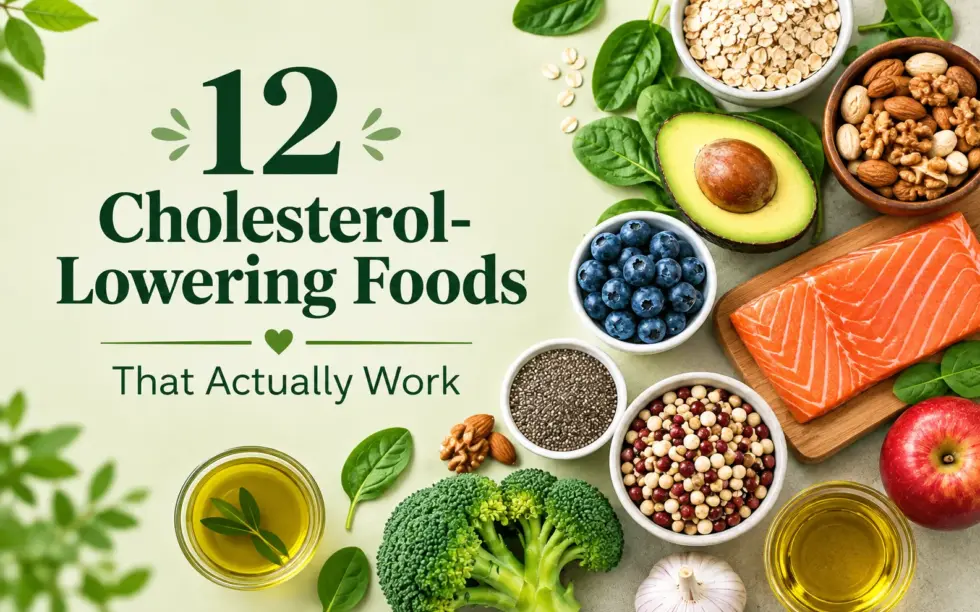
Below are 12 foods that actually move the needle for a lot of people. Not “superfoods.” Just foods with strong evidence and a very practical path into your day.
Quick note before we start: if you’re on a statin or other lipid medication, these foods still matter. Think of them like the foundation. Meds and food can work together. Also, if you have very high LDL or a family history of early heart disease, don’t use diet as a delay tactic. Use it as support.
Alright.
1. Oats (and oat bran)
If you only pick one cholesterol lowering food to become annoyingly consistent with, pick oats.
Oats are packed with a type of soluble fiber called beta glucan, and beta glucan is kind of a celebrity in cholesterol research for a reason. It forms a gel like substance in your gut that binds to bile acids. Your body then has to use cholesterol to make more bile acids. That’s the basic loop.
What it looks like in real life:
- A bowl of oatmeal at breakfast most days
- Overnight oats if you hate cooking in the morning
- Adding oat bran to yogurt or smoothies
- Using oats in pancakes or homemade granola
How much helps? A common target in studies is around 3 grams of beta glucan per day, which you can often get from a couple servings of oats or oat bran.
Small tip that matters: watch the “oatmeal” packets that are basically dessert. The oats help, sure. But 15 to 20 grams of added sugar every morning is not helping the overall picture.
2. Beans and lentils
Beans do two big things for cholesterol.
First, they’re loaded with soluble fiber, which helps reduce LDL. Second, they’re a really easy swap. If beans replace some red meat or processed meat in your week, that’s a double win. You lower saturated fat and you increase fiber. That combo is powerful.
Good options:
- Lentils (red lentils cook fast and don’t need soaking)
- Chickpeas
- Black beans
- Kidney beans
- White beans
- Split peas
Ways to sneak them in without turning your life into a meal prep project:
- Add lentils to soup, chili, or pasta sauce
- Use chickpeas in salads, wraps, or curry
- Make a bean based dip (hummus, white bean dip)
- Toss beans into rice bowls
If beans upset your stomach, you’re not alone. Start smaller, rinse canned beans well, and build up slowly. Your gut bacteria adapt. It usually gets better.
3. Barley
Barley is like oats’ underrated cousin. Similar story, similar effect.
It’s rich in soluble fiber, including beta glucans, and tends to be really filling. Some people also find it easier to eat than oats because it works in savory meals.
Try it like this:
- Replace rice with barley in soups or stews
- Use pearl barley in a salad with vegetables and olive oil
- Add it to chili to make it thicker and more satisfying
Barley is also a good “crowding out” food. You eat barley and suddenly there’s less room for refined carbs or high saturated fat stuff. Not because you’re disciplined. Just because you’re full.
4. Nuts (especially almonds and walnuts)
Nuts are one of those foods people avoid because “they’re high calorie.”
Yes. And also, they’re consistently linked with better heart markers when eaten in reasonable amounts. They contain unsaturated fats, fiber, plant sterols, and a bunch of bioactive compounds.
Almonds are often studied for LDL reduction. Walnuts are also interesting because they contain ALA omega 3, a plant form of omega 3 fat.
Simple, realistic target:
- A small handful a day, roughly 1 to 2 ounces (about 28 to 56 grams)
Ways to use them that don’t feel like dieting:
- Add chopped walnuts to oatmeal
- Snack on almonds instead of chips
- Use crushed nuts on salads
- Mix nuts into plain yogurt with berries
One warning that matters: candied nuts, honey roasted nuts, chocolate covered nuts. Delicious. But now we are back in dessert territory.
5. Extra virgin olive oil
If your diet has a “main fat,” olive oil is a good one to choose.
Olive oil is rich in monounsaturated fat, and when it replaces saturated fats (butter, ghee, fatty meats, a lot of baked goods), LDL often drops. Extra virgin olive oil also has polyphenols that may help with inflammation and oxidation, which matters for cardiovascular risk beyond LDL alone.
Use it like a normal person:
- For salad dressing
- Drizzled over vegetables
- For sautéing (yes, you can cook with it)
- To replace butter on some foods, not all foods, just some
A small thing that adds up: if you’re eating toast with butter daily, switching to olive oil based spreads or avocado a few days a week is a simple lever.
6. Avocados
Avocados are basically built for cholesterol friendly eating.
They’re high in monounsaturated fat, they contain fiber, and they’re satisfying. When people add avocados, they often naturally reduce other fats that are less helpful. Again, “crowding out” at work.
Easy ways:
- Avocado on toast with salt and pepper
- Add slices to salads, burrito bowls, wraps
- Blend into smoothies if you like the texture
- Make guacamole and use it as a condiment (not a party only food)
Portion wise, a whole avocado is fine for many people, but you don’t need that much for benefits. Half is often enough.
7. Fatty fish (salmon, sardines, mackerel)
Fish doesn’t always lower LDL in a dramatic way, but it strongly supports heart health overall. It can lower triglycerides and provides EPA and DHA omega 3 fats. And importantly, it can replace higher saturated fat protein sources.
The “actually works” part here is often substitution:
- Fish instead of bacon
- Fish instead of sausage
- Fish instead of a big ribeye
Great options:
- Salmon
- Sardines (cheap, underrated, very omega 3 rich)
- Trout
- Mackerel
- Herring
Aim for 2 servings per week if you can. If you hate fish, don’t force it, but consider talking to a clinician about omega 3 options, especially if triglycerides are high.
8. Ground flaxseed and chia seeds
These tiny seeds punch way above their weight.
They add soluble fiber, and flaxseed in particular contains ALA omega 3 and lignans. Chia seeds form a gel in liquid, which is another “soluble fiber behavior” that tends to help cholesterol and also keeps you full.
Important detail: flaxseed should be ground to get the benefits. Whole flax often passes through… still whole.
How to use:
- 1 to 2 tablespoons ground flaxseed in oatmeal or yogurt
- Chia pudding (chia + milk + a little cinnamon, let it sit)
- Add to smoothies
- Mix into pancake batter or baking
Start with 1 tablespoon if you’re not used to fiber. Drink water. Fiber works best when you’re hydrated.
9. Fruits high in soluble fiber (apples, citrus, berries, grapes)
Not all fruit is equal when it comes to cholesterol.
Fruits that shine here tend to be higher in pectin, a type of soluble fiber. Apples and citrus are classic examples. Berries bring fiber plus polyphenols. Grapes get attention for polyphenols too.
What this looks like as a habit:
- An apple most days
- A bowl of berries with yogurt
- Orange slices as a snack
- Adding fruit to oatmeal instead of sugar
If you’re worried about sugar in fruit, I get it. But whole fruit comes with fiber and water and tends to behave very differently than juice or soda.
Which brings me to a small but important point: fruit juice is not the same thing. Juice removes most of the fiber and makes it easy to drink a lot of sugar quickly.
10. Vegetables, especially okra, eggplant, and leafy greens
Vegetables help cholesterol in a few ways.
They add fiber. They reduce overall calorie density. They support gut health. And they tend to replace foods that raise LDL when you build meals around them.
But if we’re naming cholesterol friendly standouts:
- Okra contains soluble fiber and has a gel like texture that’s doing similar work in the gut.
- Eggplant contains fiber and compounds that may support lipid metabolism.
- Leafy greens are not always “cholesterol lowering” in the dramatic way oats are, but they support heart health and dietary patterns that consistently improve cholesterol.
Ways to make vegetables actually happen:
- Roast a sheet pan of vegetables with olive oil and salt
- Add spinach to eggs, soups, pasta
- Make a big salad and make the dressing good, so you want it
- Use vegetables as the base of a bowl meal
Also, don’t punish yourself with plain steamed broccoli if you hate it. Add olive oil, garlic, lemon, spices. Make it edible.
11. Soy foods (tofu, tempeh, edamame, soy milk)
Soy has a pretty solid track record for improving cholesterol numbers, especially when it replaces higher saturated fat animal proteins.
Soy protein can modestly lower LDL, and soy foods are generally rich in polyunsaturated fats, fiber (depending on the form), and other compounds.
Good options:
- Tofu (very easy to season once you get the hang of it)
- Tempeh (firmer, nutty, great in stir fries)
- Edamame (easy snack, easy salad add on)
- Unsweetened soy milk
A practical swap:
- Use tofu or tempeh a couple times a week instead of processed meats
- Snack on edamame instead of crackers
One thing: if you try soy through ultra processed meat substitutes, results can vary. Some are fine, some are sodium bombs. Whole soy foods are the easiest win.
12. Foods fortified with plant sterols and stanols
This is the most “clinical” item on the list, but it works.
Plant sterols and stanols are compounds that can reduce cholesterol absorption in the intestines. They’re added to certain foods like fortified margarines, yogurts, and drinks.
For some people, this is an easy tool, especially if LDL is stubborn despite a pretty good diet.
Typical effective dose is around 2 grams per day of plant sterols/stanols, which often means using specific fortified products as directed.
Two cautions:
- These products help LDL, but they don’t automatically make your diet heart healthy if everything else is a mess.
- They’re not always necessary. If you’d rather focus on oats, beans, nuts, and olive oil first, do that.
The part people skip: what to eat less of
You asked for cholesterol lowering foods, and we covered them. But the “works” part often depends on what these foods replace.
If you add oatmeal in the morning but keep everything else the same, you might get a small improvement.
If oatmeal replaces sugary breakfast pastries, that’s a bigger improvement.
So here are the main dietary drivers of higher LDL for a lot of people:
- Saturated fat (fatty red meat, butter, ghee, cream, cheese, coconut oil, many baked goods)
- Trans fats (now less common, but still show up in some processed foods)
- Highly processed snack foods that combine refined carbs, saturated fat, and low fiber
- Low fiber intake overall
You don’t have to eat perfectly. But if you want your lab results to change, you usually need to do more than sprinkle chia seeds on a burger.
A simple “put it together” day (not a perfect day)
Here’s one realistic template that uses several of the foods above without feeling like a cleanse.
Breakfast
- Oatmeal with berries and 1 tablespoon ground flaxseed
- Optional: a few walnuts on top
Lunch
- Big salad with chickpeas or lentils
- Olive oil and lemon dressing
- An apple on the side
Snack
- A handful of almonds
- Or edamame
Dinner
- Salmon or tofu stir fry
- Barley or brown rice as the base
- Roasted vegetables or leafy greens
Not fancy. Not fragile. Repeatable.
How long does it take to see results?
Often, 4 to 12 weeks is enough to see meaningful movement in LDL if changes are consistent. Some people see it sooner. Some need longer. Genetics matter, thyroid function matters, body weight changes matter, medication matters.
But food changes usually don’t show up in three days. That’s the annoying part. You need enough time for your body to settle into the new pattern.
A few quick tips that make this easier
- Choose 2 or 3 “anchor foods” and repeat them. Oats, beans, olive oil. That’s a strong trio.
- Don’t overhaul everything at once. Start with breakfast and snacks. Dinner can come later.
- Track fiber for a week. Most people think they eat fiber. Then they track it and realize it’s like 12 grams a day. A good target for many adults is roughly 25 to 38 grams per day, depending on age and sex, but even moving up by 10 grams helps.
- Get a follow up lipid panel. Otherwise it’s all vibes and guesses.
Wrap up (the short, honest version)
If you want cholesterol lowering foods that actually work, focus on:
- Oats and barley
- Beans and lentils
- Nuts
- Olive oil and avocados
- Fatty fish
- Flaxseed and chia
- High fiber fruits
- Vegetables, especially the high fiber ones
- Soy foods
- Plant sterol fortified foods if you need an extra push
Most of the benefit comes from a pattern. Not one “miracle” ingredient. But the good news is this pattern is pretty normal food. Grocery store food. It’s not a supplement stack.
If you want, tell me your current LDL, HDL, triglycerides, and what a normal day of eating looks like, and I can suggest the simplest swaps that would likely make the biggest difference.
FAQs (Frequently Asked Questions)
What role does cholesterol in food play in managing high LDL levels?
Cholesterol in food can impact LDL levels, but not magically or overnight. Consistently eating foods rich in soluble fiber, unsaturated fats, and plant compounds can help lower LDL cholesterol in a measurable and reliable way that shows up on blood tests.
How does soluble fiber help lower bad cholesterol (LDL)?
Soluble fiber helps pull cholesterol out of your body through digestion by binding to bile acids in the gut. This process forces your body to use more cholesterol to make new bile acids, effectively lowering LDL levels.
Which foods are best for lowering LDL cholesterol?
Foods rich in soluble fiber like oats, beans, lentils, and barley; foods containing unsaturated fats such as nuts (especially almonds and walnuts); and those with plant compounds like sterols and stanols are effective for lowering LDL cholesterol.
Can I rely on diet alone if I have very high LDL or a family history of heart disease?
No. While diet is a crucial foundation for managing cholesterol, if you have very high LDL or a family history of early heart disease, you should use diet as support alongside prescribed medications like statins rather than as a delay tactic.
How much beta glucan from oats should I consume daily to help reduce cholesterol?
A common target supported by studies is around 3 grams of beta glucan per day, which can often be obtained from a couple servings of oats or oat bran daily.
Are nuts good for heart health despite being high in calories?
Yes. Nuts like almonds and walnuts contain unsaturated fats, fiber, plant sterols, and bioactive compounds linked with better heart markers. Eating a small handful (1 to 2 ounces) daily can help lower LDL cholesterol without negative effects when consumed in reasonable amounts.