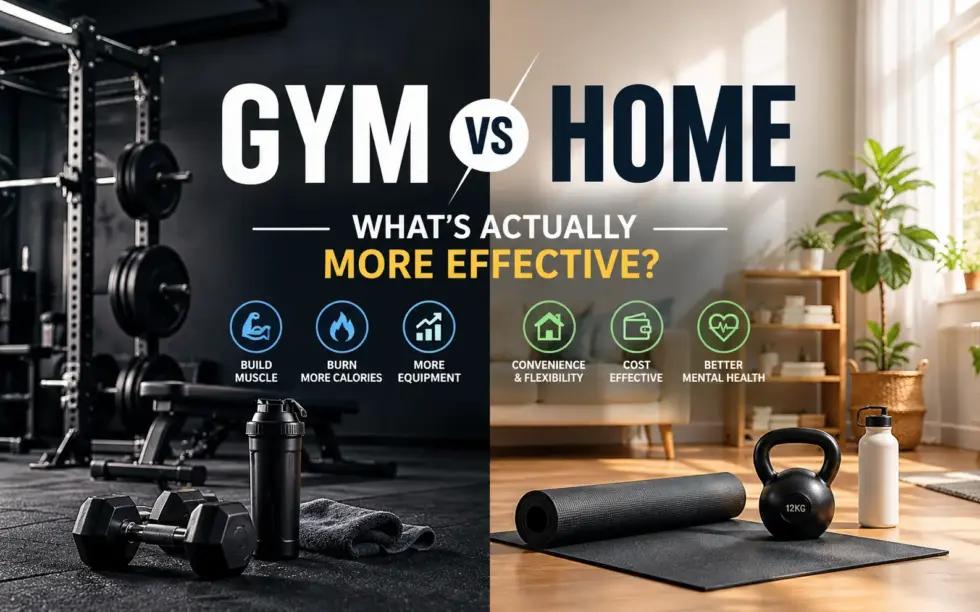

I used to think this question had a clean answer.
Like, gym is “serious” and home workouts are “better than nothing”. That kind of vibe. And sure, sometimes that’s true. But the more I trained (and the more I watched other people train), the more I realized the real answer is annoyingly simple.
The most effective workout setup is the one that lets you train consistently, progress over time, and recover well enough to repeat it. That’s it.
Still. That doesn’t mean gym and home workouts are equal in every situation. Not even close. They each win in different ways, and depending on your goal (fat loss, muscle gain, strength, health, sanity), one might be clearly better.
So let’s break it down like a normal person. No fitness industry hype. No “just do burpees” nonsense.
What “effective” even means (because people use that word weirdly)
When someone says “Is the gym more effective than working out at home?” they usually mean one of these things:
- Will I build more muscle?
- Will I get stronger faster?
- Will I lose fat quicker?
- Will I actually stick with it?
- Will I feel better day to day?
And here’s the catch.
A workout can be “effective” on paper, but useless for you if you hate it, can’t fit it into your life, or can’t recover from it. Or if you do it for two weeks and then vanish.
So in this article, I’m going to judge effectiveness using a few practical buckets:
- Results potential (muscle, strength, conditioning)
- Progressive overload (can you keep improving?)
- Consistency and adherence (will you actually do it?)
- Cost and friction (money, time, travel, setup)
- Injury risk and quality of movement
- Lifestyle fit (stress, social, privacy, flexibility)
Now we can talk like adults.
The gym’s biggest advantage: progressive overload is stupidly easy
If your main goal is building muscle and strength, the gym has one huge unfair advantage.
Options.
You have barbells, dumbbells that go up in small jumps, cables, machines, benches, racks, pullup bars, leg press, hamstring curl, lat pulldown. And if one movement irritates your joints, you can swap to a slightly different one without losing the point of the session.
Progressive overload is basically the engine of physique change. Over time, you need to do a bit more.
- More weight
- More reps
- More sets
- Better form
- More control
- Slightly harder variations
The gym makes this simple because you can micro-progress. Add 2.5 lbs. Add one rep. Add a set. Track it. Repeat.
At home, progressive overload is possible, but it can get messy faster. Especially if you have limited equipment. You end up doing things like:
- 30-rep goblet squats because the dumbbell is too light
- A million pushups with slightly different hand positions
- Bulgarian split squats until you see God
That can work. But it’s harder to standardize. And the fatigue cost gets weird.
So if we’re talking pure potential for strength and hypertrophy, the gym usually wins.
Usually.
Home workouts have a different advantage: they destroy excuses
Home workouts are brutally effective at one thing: removing friction.
No commute. No waiting for equipment. No “I don’t have time.” No “it’s raining.” No forgetting your headphones. No gym being packed like a concert.
You can roll out of bed and train. Or do a session between meetings. Or get in a quick lift while dinner’s in the oven.
This matters more than people admit. Because training isn’t a one time heroic event. It’s repetition.
When people fail at fitness, it’s rarely because their workouts weren’t optimal. It’s because they stopped. Or they were inconsistent enough that nothing accumulated.
So home workouts are often more effective for:
- Busy parents
- People with unpredictable work schedules
- Beginners with gym anxiety
- Anyone who needs “less hassle” to stay consistent
- People who hate being watched while they sweat
The best program in the world doesn’t beat the decent program you do 4 times a week for 12 months.
That’s the boring truth.
Muscle gain: gym vs home, what really changes?
Let’s talk muscle growth, since that’s what most people secretly want even if they say “toning”.
Muscle growth mostly comes down to:
- Training close enough to failure
- Enough weekly volume (hard sets per muscle)
- Good technique and range of motion
- Progressive overload over time
- Enough protein and calories (or at least not starving)
- Sleep and recovery
Where does gym vs home matter here?
If you have no equipment at home
Then muscle gain is limited by your ability to create enough tension.
You can build a lot with bodyweight at first. Especially:
- Pushups (and progressions)
- Pullups (if you have a bar)
- Rows (under a table, rings, etc)
- Split squats, lunges, step-ups
- Pike pushups, handstand work
- Core training
A beginner can change their body dramatically with this. Like, real change. Shoulders, chest, legs, posture, all of it.
But after a point, legs in particular become the problem. Bodyweight squats stop being hard. Lunges become endurance. You can do harder variations, sure, but you eventually hit the wall where you need load to keep progressing efficiently.
If you have some equipment at home (this changes everything)
If you have:
- Adjustable dumbbells or a few dumbbells
- A bench (even a simple one)
- A pullup bar
- Resistance bands
- Maybe a kettlebell
Then home workouts become way more comparable to gym workouts for hypertrophy. Not identical. But close enough that your results can be excellent.
You can hit:
- Dumbbell presses for chest
- Rows and pullups for back
- Overhead pressing for shoulders
- RDLs and split squats for legs
- Curls, extensions, raises for arms and delts
Is it as easy as the gym? No. But you can absolutely build a strong, muscular body at home with the right setup.
Gym still wins for easy leg development and total volume
In practice, the gym makes lower body and back training more straightforward because of:
- Barbells (squats, deadlifts, RDLs)
- Machines (leg press, hack squat, leg extension, ham curl)
- Cables and chest-supported rows (less lower back fatigue)
At home, a lot of lower body training becomes single leg dominant. Which is fine, but it can be mentally exhausting and form can break down when you’re grinding high reps.
So if your goal is maximizing muscle gain, especially in the legs and back, gym tends to be more “effective”.
But if you’re consistent at home, eat like an adult, and progress your lifts, you will still get results that most people would call impressive.
Strength: the gym has the clearest edge
If by strength you mean:
- Barbell squat strength
- Bench press strength
- Deadlift strength
- Overhead press strength
Then, yeah, you kinda need a gym. Or a home gym that is basically… a gym.
Strength is skill specific. If you want to be strong at barbells, you need barbells. And you need the ability to load heavy safely, ideally with a rack and safeties and proper plates.
You can get very strong at home with kettlebells and dumbbells, but it will show up as:
- Stronger single leg work
- Stronger pressing and pulling endurance
- Stronger core and grip
Not necessarily a 400 lb squat. Different game.
So for strength goals, the gym wins unless you have a legit home setup.
Fat loss: both work, and the real deciding factor is diet
Fat loss is where people get tricked the most.
They think:
“I need the gym to burn fat.”
You don’t. You need a calorie deficit, enough protein, and enough activity you can sustain.
Training helps fat loss mainly by:
- Preserving muscle while dieting
- Increasing energy expenditure a bit
- Improving insulin sensitivity and health markers
- Making you feel like a person instead of a hungry gremlin
But you can create a deficit with home workouts, walking, and diet adjustments just as effectively as you can with gym sessions.
In real life, fat loss comes down to:
- Can you control food intake most days?
- Can you keep your activity consistent?
- Can you manage stress and sleep enough to not binge eat like a raccoon?
Sometimes the gym helps because it creates structure. You show up, you train, you feel “on track”, and that spills into nutrition.
Other times, home wins because it saves time and mental energy. You train in 25 minutes, you’re done, you move on.
So fat loss is a tie. And honestly, walking is the quiet MVP either way.
Convenience vs motivation: the tradeoff nobody wants to admit
This is where it gets personal.
Home workouts are convenient. The gym can be motivating.
Why gyms motivate people
- You see other people training
- The environment feels “serious”
- There’s a psychological switch when you enter the space
- You’re less likely to scroll your phone for 25 minutes between sets (less likely, not impossible)
- You’re away from chores, kids, laundry, your couch whispering your name
Some people need that. They need the ritual. The separation. The “I am now doing the thing.”
Why home workouts help people stick long term
- Zero travel time
- Easy to do more often
- Less intimidation
- You can wear whatever, look however, be awkward in peace
- You can train even when life is chaotic
But home has its own motivation problems.
Your couch is right there. Your kitchen is right there. Your phone is right there. And if you live with other people, interruptions are real.
So effectiveness depends on what sabotages you more:
- Inconvenience? (gym)
- Distraction and low intensity? (home)
Be honest here. Like, actually honest.
Exercise quality: gym has more tools, home has more freedom
People assume the gym automatically means better workouts. Not always.
A gym also comes with:
- Ego lifting
- Trying to impress people
- Overdoing volume because you’re hyped
- Copying random workouts you saw on TikTok
- Poor form because you’re rushing or distracted
- Equipment constraints when it’s busy source
Home workouts can be calmer. More focused. Less comparison. Less “let me max out today for no reason”.
However, some people prefer working out at home due to the comfort and flexibility it provides. But gyms do offer something important: you can pick exercises that fit your body better.
Example: if pushups hurt your wrists, you can do dumbbell presses. If pullups are too hard, you can do assisted pullups or lat pulldowns. If squats bother your knees, you can try hack squats, leg press, split squats, step-ups, whatever works.
At home, you might be stuck forcing movements that don’t feel great.
So quality can go either way. But gyms do give you more ways to work around limitations.
Cost: gym memberships look cheap until they aren’t
Let’s talk money, because this matters.
Gym costs
- Monthly membership
- Sign-up fees sometimes
- Travel costs (gas, parking, public transit)
- Time cost (which becomes money if you’re busy)
- Extras (classes, personal training, nicer gyms)
A basic gym can be cheap. But it adds up.
Home gym costs
Upfront cost is the barrier. But long term, home can be cheaper.
A surprisingly solid home setup can be built with:
- Pullup bar
- Resistance bands
- Adjustable dumbbells (or a couple fixed pairs)
- Optional bench
- Optional kettlebell
- Optional rings or suspension trainer
You don’t need a full rack to get fit and muscular. You just don’t. It’s nice, but not required.
If you do want a serious strength setup, though (rack, barbell, plates), the upfront cost jumps. But then you basically own your gym forever.
So cost depends on timeframe:
- Short term: gym often cheaper
- Long term: home equipment can win
Time: the gym session is never just the session
A “45 minute gym workout” is rarely 45 minutes.
It’s more like:
- 10 to 20 minutes commute each way
- Changing, locker room stuff
- Waiting for equipment
- Chatting or getting distracted
- Then the workout
Home workouts are time efficient in a way that feels almost unfair.
You can do:
- 30 minutes lifting
- 10 minutes shower
- Done
That time savings often leads to more weekly training volume, which can make home workouts more effective in the real world.
Injury risk: not where people think it is
People assume home workouts are safer. Not automatically.
At home, people tend to:
- Skip warmups
- Rush
- Use bad DIY setups
- Train without feedback
- Push to failure with sloppy form because nobody’s watching
At the gym, people tend to:
- Lift heavier
- Use more complex movements
- Ego lift
- Try one rep maxes randomly
- Train through pain because “no pain no gain” nonsense
So injury risk is mostly about behavior, not location.
That said, gyms do allow you to scale more precisely. If 20 lb dumbbells are too light and 30s are too heavy, the gym might have 25s. Small jumps help.
At home, you might make bigger jumps and compensate with bad form. Or you might go too light and waste sessions. That can create issues too.
The social factor: for some people, it’s everything
Some people thrive in gyms because it’s social.
Not even in a “talk to everyone” way. Just being around humans. It creates accountability. It gives you identity. You become “someone who goes to the gym.” That’s powerful.
Home workouts can feel isolating. Or, for introverts, they can feel like freedom.
So again, effective depends on your wiring.
If you know you’re the kind of person who disappears without external structure, the gym can be the difference between success and endless restarts.
Results comparison (straight answer time)
Here’s the cleanest way I can put it.
Gym workouts are usually more effective for:
- Maximizing muscle gain (especially legs and back)
- Maximizing strength (barbell numbers)
- Having lots of exercise options
- Long term progressive overload with small jumps
- People who need structure and a dedicated training environment
- Athletes who need specific tools (sleds, platforms, heavy loading)
Home workouts are usually more effective for:
- Consistency (especially busy people)
- Beginners building a base without intimidation
- People who hate commuting or crowded gyms
- Maintaining fitness long term with lower friction
- People who do better with privacy and flexibility
- Anyone who can train more often because it’s easier to start
The funny part is the best option for many people is not either or.
It’s both.
The hybrid approach (quietly the best for most people)
If you asked me what’s “actually more effective” for a normal adult with a job and a life, I’d say this:
A hybrid setup.
Something like:
- 2 gym sessions per week (heavier, more equipment dependent lifts)
- 1 to 3 home sessions per week (shorter, focused, repeatable)
Or the reverse:
- Home workouts as the default
- Gym once a week for heavy lower body or back work
This removes the all-or-nothing thinking that kills progress.
You don’t need the perfect setup. You need a setup that survives your life.
What about cardio? (another area people overcomplicate)
Cardio effectiveness has less to do with gym vs home and more to do with:
- What you will actually do consistently
- Injury risk
- Enjoyment
Gym cardio pros:
- Treadmills, bikes, rowers, stair climbers
- Easier to control intensity
- Weather proof
Home cardio pros:
- Walking outside is free and underrated
- You can do quick jump rope, step ups, follow along workouts
- You can do “micro cardio” like short brisk walks after meals
If you hate cardio machines, a gym membership won’t magically change that.
And if you love walking and podcasts, you can get ridiculously fit without stepping on a treadmill.
A simple way to decide (ask yourself these questions)
If you’re stuck, answer these honestly.
- Do I have the time and willingness to commute to a gym 3 to 5 times a week?
- Do I need heavier weights to reach my goals, especially for legs and back?
- Will I train hard enough at home, or will I half-do it while checking my phone?
- Do I feel anxious in gyms, to the point I avoid training?
- Do I want training to be a lifestyle thing, or a “get in, get out” habit?
- Do I have space at home for basic equipment?
- Which option feels easiest to repeat for the next year? Not the next week. The next year.
Most people know the answer after that. They just don’t want to admit it because the “right” answer is often the boring one.
Home workouts that are genuinely effective (not fluff)
If you go home route, don’t rely on random circuits forever.
You still want progression. You still want structure.
A very simple, effective home training week could look like:
Day A (Full body)
- Pushups or dumbbell press: 3 to 5 sets
- One arm dumbbell row or pullups: 3 to 5 sets
- Split squats or goblet squats: 3 to 5 sets
- Plank or hanging knee raises: 2 to 4 sets
Day B (Full body)
- Overhead press (dumbbell) or pike pushups: 3 to 5 sets
- Pullups, band pulldowns, or rows: 3 to 5 sets
- RDLs (dumbbell) or hip thrusts: 3 to 5 sets
- Curls or lateral raises (optional but useful): 2 to 4 sets
Alternate A and B three times a week. Progress reps, then load, then sets. Keep a log. Don’t freestyle every session.
That’s where “home workouts don’t work” comes from. People doing random stuff with no plan.
Gym workouts that are effective (and not five hour bro splits)
If you go gym route, you don’t need to annihilate yourself.
A simple 3 day full body plan works for a lot of people:
Day 1
- Squat or leg press
- Bench press or dumbbell press
- Row or pulldown
- Optional arms or shoulders
Day 2
- Deadlift variation or RDL
- Overhead press
- Pullups or pulldown
- Hamstring curl or split squat
Day 3
- Squat variation or hack squat
- Incline press
- Row variation
- Lateral raise, curls, triceps
Keep it basic. Add weight slowly. Leave 1 to 2 reps in the tank most sets. Do that for months and you will look different.
The thing nobody wants to hear: effort level matters more than location
I’ve seen people in gyms doing workouts that barely count.
A few machine sets, half reps, scrolling between sets, leaving before anything gets hard. Technically they “went to the gym.” Practically they did nothing.
And I’ve seen people at home doing brutal, focused sessions with pullups, dips, split squats, and loaded carries, getting stronger every month.
So if you’re asking gym vs home because you want the magic answer…
There isn’t one.
The “more effective” choice is the one where you:
- Train hard enough (close to failure sometimes, with good form)
- Train often enough (2 to 5 days a week depending on your life)
- Track progress in some way
- Eat enough protein
- Sleep like it matters
Do that, and both environments can work.
Wrap up (so what’s actually more effective?)
If your goal is maximum muscle and strength, and you can realistically go, the gym is usually more effective. It just makes progressive overload and exercise selection easier.
If your goal is consistency, sustainability, and getting in great shape without the hassle, home workouts are often more effective in real life. Because you’ll do them more.
And if you want the answer I’d give a friend?
Pick the option you can repeat for the next 12 months. Then build the program around that choice, instead of constantly switching setups and starting over. That’s the loop people get stuck in.
If you want, tell me your goal (fat loss, muscle gain, strength, general health), your schedule, and what equipment you have at home. I can suggest a simple plan that matches your situation.
FAQs (Frequently Asked Questions)
Is the gym more effective than home workouts for building muscle and strength?
The gym generally offers a bigger advantage for muscle gain and strength because of the wide variety of equipment that allows for easy progressive overload, such as barbells, dumbbells with small weight increments, machines, and cables. This variety makes it simple to increase intensity gradually by adding weight, reps, or sets, which is key for physique changes. However, home workouts can still be effective, especially if you have some equipment and use creative progressions.
Can I build significant muscle at home without any equipment?
Yes, beginners can achieve real muscle growth at home using bodyweight exercises like pushups, pull-ups (if you have a bar), rows under a table or rings, split squats, lunges, pike pushups, handstand work, and core training. These can dramatically improve shoulders, chest, legs, and posture initially. However, after some time, especially for leg training, bodyweight exercises may become less challenging and limit further progress without added load.
What makes home workouts highly effective despite limited equipment?
Home workouts excel at removing common barriers such as commuting time, waiting for equipment, scheduling conflicts, bad weather, or gym anxiety. This convenience reduces friction and excuses that often cause people to skip workouts. Being able to train anytime—like right after waking up or between meetings—helps maintain consistency over the long term, which is crucial for lasting results.
How should I judge the effectiveness of a workout setup: gym vs home?
Effectiveness depends on multiple practical factors including results potential (muscle gain, strength), progressive overload capability (ability to improve over time), consistency and adherence (will you stick with it?), cost and friction (money/time/effort required), injury risk and quality of movement, and lifestyle fit (stress levels, social environment, privacy). The best setup is the one that aligns well with your goals and life circumstances to keep you training consistently.
Why is progressive overload easier to achieve in the gym compared to home workouts?
The gym provides many tools like barbells with small incremental weights (e.g., 2.5 lbs plates), adjustable dumbbells, machines targeting specific muscles, and various accessories. This variety allows precise control over increasing difficulty step-by-step by adding weight or reps. At home with limited equipment, progressive overload often relies on high-rep sets or harder variations which can be less standardized and more fatiguing.
Who benefits most from home workouts rather than going to the gym?
Home workouts are particularly beneficial for busy parents, people with unpredictable work schedules, beginners who feel anxious about gyms, anyone seeking less hassle to stay consistent with training, and those who dislike being watched while exercising. The ease of access helps maintain regular exercise habits which is often more important than having the most optimal workout environment.