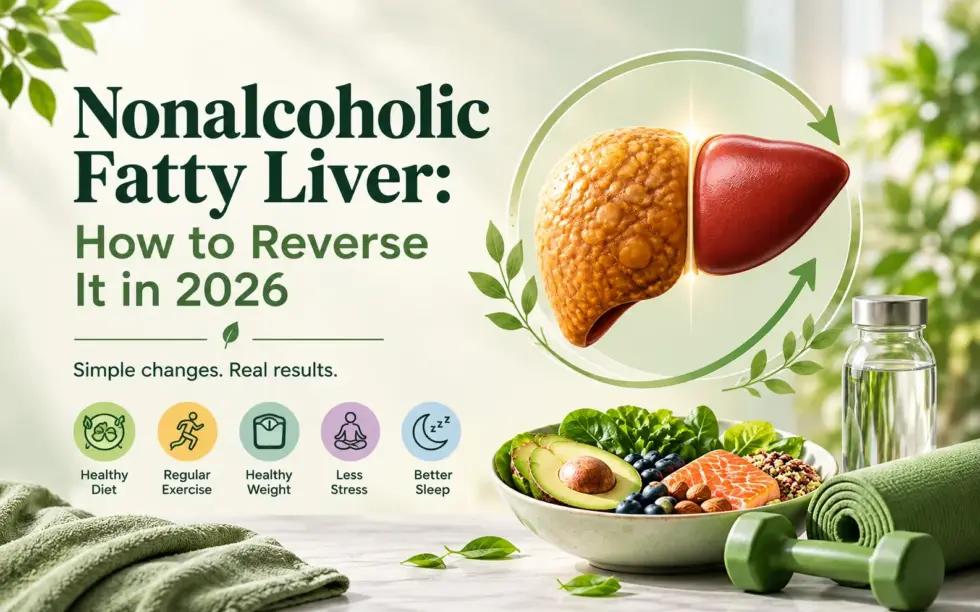

A lot of people still think fatty liver is something you “get” only if you drink heavily.
And yeah, alcohol can absolutely wreck the liver. But that is not what we are talking about here.
Nonalcoholic fatty liver disease, or NAFLD, is the one that sneaks up on regular people. Office jobs. Busy parents. Gym sometimes. “I eat pretty normal” people. Then a blood test comes back weird. Or an ultrasound casually mentions “fatty infiltration.” And suddenly you are Googling at 1:00 a.m. wondering if your liver is basically done.
It is usually not done.
In 2026, the conversation is finally more practical. Less panic. More, ok, what actually moves the needle?
This post is that. Not a miracle cleanse. Not a supplement stack that costs more than rent. Just the stuff that tends to reverse fatty liver in real life. With a few important medical notes along the way, because some of this depends on how far it has progressed.
First, what “nonalcoholic fatty liver” really means
NAFLD basically means excess fat stored in liver cells, in someone who does not drink enough alcohol to explain it.
There are levels to it:
- Simple steatosis (fatty liver): fat is there, but inflammation and scarring are minimal or absent.
- NASH (nonalcoholic steatohepatitis): fat plus inflammation and liver cell injury. This is where risk climbs.
- Fibrosis: scarring begins. Can be mild, moderate, advanced.
- Cirrhosis: severe scarring and impaired function. Harder to reverse, but progression can still be slowed a lot.
In 2026 you will also see doctors and research papers using the newer umbrella term MASLD (metabolic dysfunction associated steatotic liver disease) and MASH (for the inflammatory version). Same general problem, updated naming. If your report says NAFLD, do not stress about the label. Focus on the metabolic drivers.
How do you know if you can reverse it?
Most people with NAFLD can improve it significantly. Many fully normalize liver fat and labs.
What matters is:
- How much fibrosis you have (scarring is the big deal).
- Whether you have NASH or not.
- Your metabolic risk: insulin resistance, type 2 diabetes, obesity, high triglycerides, sleep apnea, etc.
- Consistency: because the liver responds fast, but it also relapses fast.
If you do not know your fibrosis status, that is step one. More on that in a minute.
The “2026 approach” in one sentence
You reverse fatty liver by improving insulin sensitivity and lowering liver fat through sustainable weight loss (if needed), better food quality, regular movement including resistance training, better sleep, and targeted medical help when appropriate.
Not exciting. But it works.
And when people fail, it is rarely because they did not know “eat healthy.” It is because they tried to do everything at once, burned out, then did nothing for months. So we are going to make this doable.
Step 1: Confirm where you are starting (do not skip this)
Fatty liver can be suspected from:
- ultrasound
- CT or MRI
- elevated ALT and AST
- “incidental” imaging notes
But you also want to know if scarring is present. Because “reverse it” means different things if you have advanced fibrosis.
In 2026, a common pathway looks like this:
1) Basic labs
Ask your clinician for a set like:
- ALT, AST, GGT, alkaline phosphatase, bilirubin
- platelets (important for fibrosis scoring)
- fasting glucose, A1c, fasting insulin (if they will)
- lipid panel (triglycerides matter a lot)
- hs CRP (optional but helpful)
2) Calculate a fibrosis score
A simple one is FIB-4, which uses age, AST, ALT, and platelets. It is not perfect, but it is a good triage tool.
If FIB-4 is elevated or borderline, the next step is often…
3) FibroScan (transient elastography) or equivalent
This estimates liver stiffness (fibrosis) and often gives a fat score (CAP). Noninvasive and quick.
4) Rule out other causes
Sometimes it is not “just NAFLD.” Thyroid issues, viral hepatitis, certain meds, genetic conditions. Your clinician will guide this, but it is worth mentioning because people get stuck assuming it is lifestyle when it is not only lifestyle.
Ok. Once you know your rough stage, you can apply the right level of urgency and follow up.
Step 2: The one lever that changes everything (weight loss, but in a specific way)
If you are overweight or obese, weight loss is the strongest evidence based lever for improving fatty liver.
But the exact amount matters.
Research consistently shows a kind of dose response:
- 3 to 5 percent body weight loss: can reduce liver fat.
- 7 to 10 percent: more likely to improve inflammation (NASH).
- 10 percent or more: best odds of improving fibrosis (scarring), especially if maintained.
You do not have to “crash diet.” In fact, please do not. Very rapid weight loss can sometimes worsen liver inflammation or gallstone risk. Slow and steady tends to stick.
A good target for most people is 0.5 to 1.0 percent of body weight per week, or simply 1 to 2 pounds per week if you want an easy number.
But here is the part people miss.
If you lose 15 pounds and gain back 12, repeatedly, your liver is not celebrating. It likes stability. So pick a plan you can live with.
Step 3: Food changes that actually reverse fatty liver (without perfect dieting)
There is no single “NAFLD diet.” But there are consistent patterns that help.
What tends to help the most
1) Mediterranean style eating (as a baseline)
This is not a brand, it is a pattern:
- vegetables, beans, lentils
- fruit (yes, fruit)
- fish and lean proteins
- olive oil, nuts, seeds
- whole grains if tolerated
- less ultra processed food
This approach improves insulin sensitivity and triglycerides, and it tends to reduce liver fat even without extreme restriction.
2) Reduce added sugar, especially sugary drinks
If you do one thing this week, do this.
Sugary beverages are one of the fastest ways to load the liver with excess energy, especially from fructose heavy sources.
So cut or massively reduce:
- soda
- sweet tea
- juice (even “natural”)
- fancy coffee drinks that are basically dessert
- energy drinks with sugar
If you still want something, go:
- sparkling water
- diet soda occasionally (not perfect, but often better than sugar)
- unsweetened tea
- coffee with minimal sweeteners
3) Raise protein a bit (most people are low)
Higher protein helps:
- appetite control
- preserving muscle during weight loss
- improving body composition
A simple target: 25 to 35 grams of protein per meal, depending on your size and goals. You do not need to be extreme about it. Just be consistent.
Examples:
- greek yogurt plus berries and nuts
- eggs plus cottage cheese
- chicken or tofu salad with olive oil
- lentil bowl with tuna or tempeh
4) Increase fiber, not just “eat salad”
Fiber helps with:
- glucose spikes
- gut health
- fullness
Easy wins:
- add beans or lentils 3 to 5 days a week
- choose whole grains sometimes
- add chia or flax to yogurt
- eat vegetables you actually like, cooked counts
What to limit (without turning your life into misery)
Ultra processed foods
Not because they are morally bad. Because they are engineered to be easy to overeat and often raise triglycerides and insulin resistance.
A good 2026 rule is the “weekday rule”:
- weekdays: mostly whole foods, simple meals
- weekends: flexible, but still mindful
Highly refined carbs in large portions
Bread, crackers, pastries, white rice, large pasta bowls. You do not have to ban them. Just shrink the portion and pair with protein and fiber.
Alcohol, yes even in “nonalcoholic” fatty liver
Even though NAFLD is defined by not having alcohol as the primary driver, alcohol can still worsen liver inflammation in people who already have fatty liver.
If your goal is reversal, consider:
- at least a 3 month alcohol break
- or strict limits (discuss with your clinician)
This is one of those “not fun but effective” moves.
Step 4: Exercise that works for liver fat, even if you hate cardio
You do not need marathon training. But you do need a baseline of movement that tells your body: we use energy, we build muscle, we handle glucose better now.
In 2026, the strongest practical combo is:
1) Resistance training 2 to 4 times per week
Because muscle is a glucose sink. More muscle, better insulin sensitivity.
Keep it simple:
- squats or leg press
- rows or pull downs
- push ups or chest press
- hip hinge movement like deadlift pattern
- overhead press
- core work
Even 30 to 45 minutes, 3 days a week, is meaningful.
2) Zone 2 cardio or brisk walking 150 minutes per week
This can literally be:
- 30 minutes, 5 days a week of brisk walking
- cycling
- incline treadmill
- swimming
If you are busy, break it up. Ten minutes after meals is underrated.
3) Steps matter more than people want to admit
If you sit all day, your liver and muscles basically become storage units. In fact, prolonged sitting can lead to serious health issues, including metabolic dysfunction.
A reasonable progression:
- week 1: find your average steps
- week 2: add 1000 steps per day
- repeat until you land around 7000 to 10000, depending on your body and schedule
Not magical. Just consistent.
Step 5: Sleep and stress, the boring section that still matters
Poor sleep increases insulin resistance and cravings. It also makes exercise feel harder and reduces willpower. Which is not a character flaw, it is physiology.
If you suspect sleep apnea (snoring, daytime sleepiness, high blood pressure, larger neck circumference), get evaluated. Sleep apnea is strongly linked with metabolic dysfunction and fatty liver.
Simple sleep upgrades:
- consistent wake time
- caffeine cut off by early afternoon
- reduce late night heavy meals
- dark, cool room
- 10 minute wind down, no phone if possible
Stress is trickier. You cannot “journal” your way out of a terrible job sometimes.
But you can lower the baseline:
- daily walk without headphones
- strength training (seriously)
- 5 minutes of breathing practice
- therapy if you can access it
Stress does not directly dump fat into your liver, but it absolutely pushes the behaviors that do.
Step 6: Medications and medical options (what is actually used in 2026)
Lifestyle is still the foundation. But in 2026, clinicians are more willing to use metabolic meds to help people who are stuck, especially with obesity, type 2 diabetes, or higher fibrosis risk.
Important: do not self prescribe anything here. This is a clinician conversation.
GLP-1 receptor agonists and related meds
These include medications used for obesity and diabetes that often lead to substantial weight loss and improved metabolic health.
They can significantly reduce liver fat, and many patients see ALT and AST improve. Some evidence also suggests improvement in inflammation and possibly fibrosis markers, though the exact degree varies and research is still evolving.
If you have NAFLD plus obesity or type 2 diabetes, this is worth discussing.
Pioglitazone
Sometimes used particularly in people with type 2 diabetes or biopsy proven NASH, under medical supervision. Can help liver histology in certain groups, but has side effects and is not for everyone.
Vitamin E (specific cases)
Vitamin E has been used in certain non diabetic patients with NASH, typically at higher doses, again under clinician guidance because long term high dose supplementation is not risk free.
Statins
People get scared of statins and the liver. In reality, statins are generally considered safe in NAFLD and may reduce cardiovascular risk, which is a huge deal because many NAFLD patients are more likely to have heart issues than liver failure.
This is a doctor decision, but do not assume “fatty liver means no statins.”
Bariatric surgery (for eligible patients)
For people with severe obesity, bariatric surgery can lead to major improvements in NAFLD, NASH, and even fibrosis. It is not the easy way out. It is a tool. And for some people, it is the tool that saves their future.
Step 7: Supplements. The honest truth.
Most supplements do not “reverse fatty liver” on their own.
Some have modest evidence, but they are not a substitute for the big levers: weight loss, diet quality, movement, sleep, and metabolic control.
Still, people ask. So here is the more grounded take.
Coffee (yes, coffee)
Regular coffee intake is associated in multiple studies with lower risk of fibrosis progression. This is observational data, but it is consistent enough that many clinicians mention it.
Aim: 2 to 3 cups per day if you tolerate caffeine and it does not wreck your sleep or anxiety. Avoid turning it into a sugar delivery system.
Omega-3s (fish oil)
Omega-3s can lower triglycerides and may reduce liver fat in some people. Effects can be modest.
Useful if you have high triglycerides. Talk to your clinician about dosing and product quality.
Avoid “liver detox” products
If a supplement claims it “flushes toxins,” be skeptical. Some herbal supplements can actually cause liver injury. If you already have liver issues, that is the last thing you need.
If you want to use supplements, treat it like medication: verify, choose reputable brands, and tell your clinician.
A simple 12 week plan (this is where reversal starts)
Twelve weeks is long enough to see real movement in liver enzymes and sometimes imaging markers. Not always, but often. And it is short enough to commit to without feeling like you signed your soul away.
Weeks 1 to 2: Remove the biggest offenders
- Cut sugary drinks completely.
- Protein at every meal.
- Walk 10 minutes after one meal each day.
- Sleep: consistent wake time.
Weeks 3 to 6: Build the base
- Resistance training 2 to 3 times per week.
- Brisk walking 30 minutes, 4 to 5 days per week.
- Beans or lentils 3 times per week.
- Aim for a calorie deficit gently if weight loss is needed, but do not starve.
Weeks 7 to 12: Tighten the feedback loop
- Track weight trend weekly, not daily obsession.
- Recheck habits: are weekends destroying the week?
- If you have diabetes, get serious about glucose control with your clinician.
- Consider a follow up liver panel (ALT, AST) with your clinician around week 12.
Most people who truly do this will see something improve. Energy. Triglycerides. Waistline. ALT. Something.
How to track progress without spiraling
A mistake is relying only on ALT and AST. They can improve even when fat is still present. Or they can be normal even with disease.
Better tracking includes:
- waist circumference (a big one)
- weight trend
- fasting glucose and A1c
- triglycerides and HDL
- repeat FibroScan if recommended (often after 6 to 12 months, not every month)
Also pay attention to how you feel, but do not let that be the only thing. Fatty liver is often silent.
When you should be more aggressive, faster
Talk to a liver specialist (hepatology) sooner if:
- FIB-4 or FibroScan suggests significant fibrosis
- you have persistently high ALT and AST for months
- platelets are low
- imaging suggests cirrhosis or portal hypertension
- you have type 2 diabetes plus suspected NASH
- you have symptoms like swelling, jaundice, confusion, or easy bleeding (urgent)
Not to scare you. Just to keep you from wasting time.
The most common mistakes I keep seeing
1) Doing a cleanse instead of changing the weekly routine
You can drink green juice for three days and still have the same liver next month.
2) Going too low calorie, then rebounding
If you are starving, you will quit. Almost always. Sustainable beats extreme.
3) Only doing cardio, no resistance training
Cardio helps. But strength training makes the whole metabolic system run better.
4) Ignoring sleep apnea
People will count macros and do HIIT but sleep 5 hours with untreated apnea. That is like trying to fill a bucket with a hole in it.
5) Treating it like a liver problem only
It is a metabolic problem that shows up in the liver. If you address insulin resistance, triglycerides, and visceral fat, the liver often follows.
Let’s wrap this up
Nonalcoholic fatty liver is common now, almost weirdly normal. But it is not something you just “watch” forever.
In 2026, reversal is usually built on a few unglamorous, high impact moves:
- modest, sustained weight loss if needed
- Mediterranean leaning meals, less sugar and ultra processed food
- resistance training plus regular walking
- better sleep, treat sleep apnea if present
- medical help when lifestyle is not enough, especially with diabetes or obesity
And the good news. The liver is resilient. It responds. It forgives, if you actually give it a reason.
If you want a starting point that does not overwhelm you, start with two things for the next 7 days: cut sugary drinks, and walk 10 minutes after dinner. Then build from there.
FAQs (Frequently Asked Questions)
What is Nonalcoholic Fatty Liver Disease (NAFLD) and how is it different from alcohol-related liver damage?
NAFLD refers to excess fat stored in liver cells in people who do not consume enough alcohol to explain the fat buildup. Unlike alcohol-related liver damage, NAFLD occurs in regular people including those with office jobs or busy lifestyles and is driven by metabolic factors rather than heavy drinking.
What are the stages of fatty liver disease I should be aware of?
Fatty liver disease progresses through stages: Simple steatosis (fatty liver) with minimal inflammation; NASH (nonalcoholic steatohepatitis) involving fat plus inflammation and liver cell injury; Fibrosis where scarring begins, ranging from mild to advanced; and Cirrhosis, which is severe scarring with impaired liver function. Knowing your stage helps determine treatment urgency.
How can I find out if my fatty liver condition is reversible?
Reversibility depends on factors like the amount of fibrosis (scarring), presence of NASH, metabolic risks such as insulin resistance or type 2 diabetes, and consistency in lifestyle changes. Confirming fibrosis status through labs and imaging is a critical first step to guide management.
What is the most effective approach to reverse fatty liver disease in 2026?
The proven approach focuses on improving insulin sensitivity and reducing liver fat through sustainable weight loss if needed, better food quality, regular physical activity including resistance training, improved sleep, and targeted medical care when appropriate. This practical strategy avoids quick fixes or expensive supplements.
How do doctors assess the severity of fatty liver and fibrosis without invasive procedures?
Doctors use basic blood tests including ALT, AST, GGT, platelets, fasting glucose, A1c, lipid panel, and sometimes hs CRP. They calculate fibrosis scores like FIB-4 using age and lab results. If scores are borderline or high, noninvasive imaging like FibroScan estimates liver stiffness (fibrosis) and fat content efficiently.
How much weight loss is needed to improve fatty liver disease effectively?
Weight loss has a dose-dependent effect: losing 3-5% of body weight can reduce liver fat; 7-10% can improve inflammation associated with NASH; and 10% or more offers the best chance to improve fibrosis (scarring). Slow and steady weight loss at about 0.5-1% body weight per week is recommended for safety and sustainability.