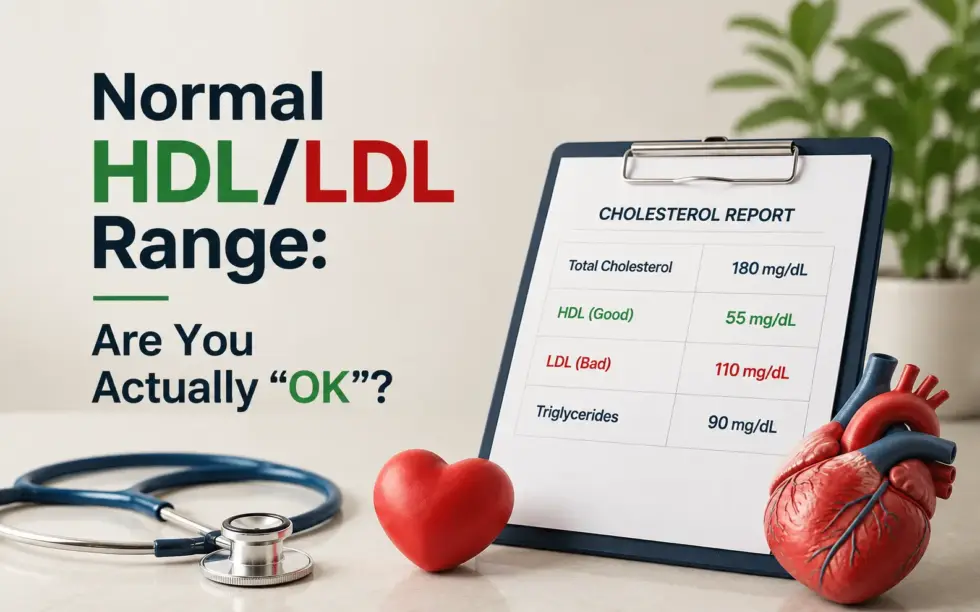

You got your cholesterol results back.
Total cholesterol, LDL, HDL, triglycerides. A couple numbers highlighted. Maybe one is a little high, one is “fine.” And then the lab prints those comforting words somewhere on the page.
Normal range.
So you shrug. Or your doctor shrugs. Or you both do. Because, hey, it says normal. You are “ok.”
But this is where people get tripped up. Badly. Because cholesterol is one of those health topics where “normal” can mean a bunch of different things at the same time, depending on who’s saying it and what problem they’re trying to prevent.
And the bigger issue is this.
You can have LDL that looks “normal” and still have significant risk. You can have HDL that looks “good” and not be protected the way you think. You can even have a decent looking panel and still be building plaque quietly for years.
So let’s talk about what a normal HDL and LDL range actually means. And what it does not mean. And how to tell whether you’re actually ok, or just… within the average of a pretty unhealthy population.
First, quick definitions (so the rest makes sense)
Cholesterol rides around in your blood inside particles called lipoproteins.
- LDL is low density lipoprotein. It’s often labeled “bad cholesterol,” not because LDL itself is evil, but because LDL particles deliver cholesterol into artery walls. That’s where plaque begins.
- HDL is high density lipoprotein. It’s often called “good cholesterol” because HDL participates in reverse cholesterol transport. In simple terms, it helps move cholesterol away from tissues and back toward the liver.
But here’s an important little detail that gets ignored in most casual cholesterol conversations.
LDL and HDL are not just numbers. They are proxies. They hint at what might be happening with particle count, particle size, inflammation, insulin resistance, genetics, and how aggressively your arteries are collecting gunk.
So, yes, ranges matter. But context matters more.
What is a “normal” LDL range?
Most labs still show a reference range like it’s a basic pass fail test. That’s not really how cardiovascular risk works.
Still, these are common LDL cholesterol (LDL C) categories used clinically.
LDL cholesterol (LDL C) categories
- Optimal: less than 100 mg/dL
- Near optimal: 100 to 129 mg/dL
- Borderline high: 130 to 159 mg/dL
- High: 160 to 189 mg/dL
- Very high: 190 mg/dL and above
If you grew up hearing “LDL under 130 is fine,” you’re not imagining it. That used to be a very typical cutoff.
Now the truth: for many people, especially anyone with additional risk factors, LDL under 100 is the more meaningful target, and some higher risk individuals aim for much lower.
Which brings us to the annoying answer everyone hates.
Your “normal” LDL depends on your risk.
If you have any of the following, the bar usually drops:
- diabetes or prediabetes
- high blood pressure
- smoking history
- strong family history of early heart disease
- chronic kidney disease
- known atherosclerotic cardiovascular disease
- inflammatory conditions (like rheumatoid arthritis, lupus, psoriasis)
- high coronary artery calcium score
- high ApoB or high Lp(a)
Same LDL number. Different meaning.
What is a “normal” HDL range?
HDL is where the conversation gets weird, because people love a single heroic number. Higher HDL equals safer, right.
Kind of. Until it’s not.
HDL cholesterol categories (typical)
- Low (higher risk) in men: less than 40 mg/dL
- Low (higher risk) in women: less than 50 mg/dL
- Acceptable: roughly 40 to 59 mg/dL
- “Protective” traditionally: 60 mg/dL and above
So yes, in general, low HDL is associated with higher cardiovascular risk. Especially when it shows up with high triglycerides and elevated waist size. That trio often points toward insulin resistance.
But also.
Very high HDL is not always a free pass. Some studies show a U shaped curve, where extremely high HDL might be associated with increased risk in certain populations. The “why” is complicated. Genetics, dysfunctional HDL particles, other underlying issues. The main point is simpler.
HDL is not a force field.
It is one piece of the story.
The number nobody pays attention to (but should): Non HDL cholesterol
If you want one cholesterol number that’s often more useful than LDL alone, it’s this.
Non HDL cholesterol = Total cholesterol minus HDL.
It represents all the “atherogenic” cholesterol carrying particles, basically everything that can contribute to plaque, not just LDL.
Non HDL categories (common)
- Optimal: less than 130 mg/dL
- Near optimal: 130 to 159 mg/dL
- Borderline high: 160 to 189 mg/dL
- High: 190 to 219 mg/dL
- Very high: 220 mg/dL and above
Non HDL is especially helpful when triglycerides are elevated, because LDL calculation can get less reliable in that situation.
If your lab report gives you non HDL, don’t ignore it. If it doesn’t, you can calculate it in five seconds.
“Normal” does not mean “low risk.” Here’s why.
This is the part that annoys people, but it’s also the part that can save you a decade of regret.
A lab reference range usually reflects what is common in the population. It is not always the same as what is optimal for long term disease prevention.
And cardiovascular disease builds slowly. You don’t feel plaque forming. You feel fine. Right up until you don’t.
So if your LDL is 128 and your HDL is 62 and your doctor says “looks ok,” that might be true for someone with no risk factors and a low lifetime risk.
Or it might be missing the bigger picture if you’re 45, prediabetic, have a family history, and your blood pressure is creeping up.
Same numbers. Different reality.
The panel is incomplete if you don’t look at triglycerides
People focus on LDL and HDL because those are the famous ones. Triglycerides are the quiet third wheel that often reveals what’s going on metabolically.
Triglyceride categories
- Normal: less than 150 mg/dL
- Borderline high: 150 to 199 mg/dL
- High: 200 to 499 mg/dL
- Very high: 500 mg/dL and above
What’s interesting is the pattern.
- High triglycerides plus low HDL often points to insulin resistance.
- High triglycerides can also correlate with higher ApoB and more small, dense LDL particles.
- Triglycerides can swing a lot based on alcohol, carbs, recent meals, and weight gain.
A single lipid panel is a snapshot. If something looks off, repeat it. Preferably fasting, unless your clinician is intentionally doing non fasting testing.
The ratio trap (HDL to LDL, total to HDL, etc)
You might have heard things like “my ratios are great, so I’m fine.”
Ratios can be useful. They can also give false reassurance.
For example:
- Total cholesterol to HDL ratio
- Triglycerides to HDL ratio
These can hint at insulin resistance and risk patterns. But they do not directly measure the number of atherogenic particles.
Someone can have a decent ratio and still have high ApoB. Or elevated Lp(a). Or a high calcium score. Or all of the above.
Use ratios as clues, not verdicts.
The big upgrade: ApoB (and why LDL can mislead you)
LDL C measures how much cholesterol is inside LDL particles. It does not directly tell you how many LDL particles you have.
And it’s the number of atherogenic particles that matters a lot, because each particle is a chance to enter the artery wall.
ApoB is a protein found on the surface of atherogenic lipoproteins. Each particle has one ApoB, so ApoB is basically a particle count proxy.
If you want a clearer picture of risk, ApoB is often more informative than LDL C, especially when:
- triglycerides are high
- HDL is low
- there’s insulin resistance
- LDL C is “normal” but risk seems high
- you have metabolic syndrome
Many cardiology and lipid experts consider ApoB one of the best single markers you can add.
Not everyone needs it. But if you’re asking “am I actually ok,” it’s one of the first places I’d look.
Another one: Lp(a), the genetic wildcard
Lipoprotein(a), written as Lp(a), is largely genetic and doesn’t change much with diet or exercise.
You can have a beautiful lipid panel and still have high Lp(a), which raises cardiovascular risk. It’s one of those things that tends to explain “my dad had a heart attack at 49 even though he was fit.”
Most people only need to test Lp(a) once in their life, because it’s pretty stable.
If you have early family history of heart disease or unexplained risk, ask about it.
So what HDL and LDL numbers mean you’re “actually ok”?
This is where I have to be careful, because I can’t diagnose you in a blog post. Also because “ok” is not a medical category.
But I can give you a more practical checklist than “the lab says normal.”
You’re closer to “actually ok” if…
- LDL C is under 100 mg/dL, and ideally lower if you have multiple risk factors.
- HDL is not low (above 40 for men, above 50 for women).
- Triglycerides are under 150, and often under 100 in metabolically healthy folks.
- Non HDL is under 130.
- Blood pressure is controlled.
- You’re not smoking.
- Blood sugar markers (fasting glucose, A1c) are solid.
- No strong family history of early events, or if there is, you’ve checked deeper markers like ApoB and Lp(a).
- You’re not carrying a lot of visceral fat around the waist.
- You can maintain basic fitness without feeling like your heart is trying to escape your body.
That’s “closer.”
But if you want to know whether your arteries are actually collecting plaque, there’s a more direct tool – blood tests that can help determine your risk of coronary artery disease.
Coronary artery calcium score: the reality check
A CAC score (coronary artery calcium) is a CT scan that measures calcified plaque in the coronary arteries.
It doesn’t measure soft plaque perfectly, and it’s not for everyone, but for many people in the gray zone, it’s clarifying.
- CAC = 0 often suggests low near term risk (not zero risk, but lower).
- CAC above 0 means plaque exists. The higher the score, the higher the risk.
If you’re 40 plus, have “normal” LDL, but strong family history or other risk factors, CAC can turn “I guess I’m fine” into an actual plan.
This is a conversation to have with a clinician, because it depends on age, symptoms, risk factors, and local guidelines.
Common situations where people think they’re fine but aren’t
1) “My LDL is 120 and my HDL is 65. I’m good.”
Maybe. But what if you also have:
- A1c creeping up
- triglycerides at 180
- fatty liver
- high blood pressure
- sleep apnea
- family history
Now that LDL might be too high for your risk profile, even if it’s “near optimal” on paper.
2) “My HDL is really high, so I don’t worry about LDL.”
HDL does not cancel out LDL. It does not erase plaque. It does not guarantee protection.
If LDL, ApoB, or non HDL are high, that still matters.
3) “I’ve been told my heart is healthy because of my lifestyle.”
While a healthy lifestyle can significantly reduce risks, it’s not a foolproof shield against heart disease. Factors like genetics and age play a crucial role. For instance, research has shown that even those with a healthy lifestyle can develop conditions like fatty liver disease, which could indirectly affect heart health. Therefore, regular check-ups and tests such as the CAC score are essential to get a clear picture of one’s cardiovascular health.
3) “My total cholesterol is normal.”
Total cholesterol is a blunt number. Someone can have total cholesterol of 190 and still have high ApoB, or high Lp(a), or a bad triglyceride HDL pattern.
Total cholesterol is not useless. It’s just not enough.
4) “My LDL is high but I’m lean and athletic.”
This one is tricky. Some lean people, including endurance athletes and people eating certain diets, can show elevated LDL C with normal triglycerides and high HDL.
Sometimes it’s benign. Sometimes it reflects high LDL particle numbers that still increase lifetime risk. This is where ApoB and possibly CAC can help separate vibes from reality.
5) “My numbers are normal but everyone in my family has heart disease.”
That’s exactly when you dig deeper. ApoB, Lp(a), CAC, and a serious look at blood pressure, sleep, and glucose.
What actually moves HDL and LDL in real life?
A few themes. Not magic tricks. Just the stuff that tends to work.
Lowering LDL (and non HDL)
- Reduce saturated fat for many people (not all respond the same, but plenty do).
- Increase soluble fiber (oats, beans, lentils, psyllium).
- Replace some saturated fats with unsaturated fats (olive oil, nuts, fatty fish).
- Limit ultra processed foods, especially those that drive overeating.
- Weight loss if you have excess body fat can improve multiple markers.
- Medications when risk is high enough: statins, ezetimibe, PCSK9 inhibitors, bempedoic acid. This is individualized.
Raising HDL (carefully, because it’s not the main target)
- Exercise can raise HDL modestly, especially aerobic activity.
- Smoking cessation often increases HDL.
- Weight loss can raise HDL in insulin resistant individuals.
- Moderate alcohol can raise HDL, but that does not mean it’s a recommended strategy. Alcohol has tradeoffs. Big ones.
Also, and this is important: medications that raise HDL have not reliably reduced cardiovascular events. That tells you HDL is more marker than lever in many cases.
Improving triglycerides (usually the easiest win)
- Cut back on added sugars and refined carbs.
- Reduce alcohol if triglycerides are elevated.
- Lose weight if needed.
- Increase activity.
- Address insulin resistance.
- Omega 3s in certain contexts, under medical guidance, can help.
Triglycerides respond fast. Like weeks, not years.
“What should my LDL be?” A more honest answer
If you want a rough way to think about it:
- If you’re low risk with no major risk factors, LDL under 100 is a solid general target.
- If you’re higher risk, you often want lower than 70, sometimes lower, depending on guidelines and personal history.
- If you have LDL 190 or above, that’s a red flag for possible familial hypercholesterolemia and typically warrants serious evaluation.
Again, not medical advice. Just how risk based targets usually work.
If you only remember one thing from this article, make it this:
LDL goals are not moral grades. They’re risk tools.
A quick “am I actually ok” checklist you can use today
Grab your lab report and answer these:
- What are my LDL C, HDL C, triglycerides, non HDL?
- Do I have any major risk factors (diabetes, hypertension, smoking, strong family history, kidney disease, inflammatory disease)?
- Do I know my A1c and blood pressure, or am I pretending those don’t exist?
- Have I ever checked ApoB?
- Have I ever checked Lp(a), especially if family history is strong?
- If I’m in the gray zone, would a CAC score change what I do?
If you look at this list and realize you’ve been using “normal range” as a calming mantra, you’re not alone. That’s how most of us were taught to read lab reports.
It’s just not the full story.
The frustrating part: you can do everything “right” and still have risk
Some people eat well, exercise, stay lean, and still have high LDL because genetics are loud.
Some people have normal LDL but high ApoB because of particle patterns.
Some people have high Lp(a) and don’t know it for decades.
None of that is a personal failure. It’s just biology.
The win is catching it early enough that you can actually do something about it. Lifestyle, meds, further testing, whatever fits your situation.
Let’s wrap this up (without pretending it’s simple)
A “normal” HDL or LDL range on a lab report is a starting point, not a verdict.
- LDL under 100 is generally better than LDL at 130, but your personal risk factors decide what “good” means.
- HDL is helpful information, but not a shield. Low HDL can be a warning sign, high HDL is not guaranteed protection.
- Non HDL and triglycerides add important context.
- ApoB and Lp(a) can reveal hidden risk.
- CAC scoring can show whether plaque is actually present, which is the whole point of worrying about cholesterol in the first place.
If you want the most practical next step, it’s this: take your numbers, match them against your risk factors, and if anything feels mismatched, ask for deeper markers like ApoB and Lp(a) or discuss whether CAC makes sense.
Because “normal” is nice. But “actually ok” is the goal.
FAQs (Frequently Asked Questions)
What do the terms LDL and HDL cholesterol mean, and why are they important?
LDL (low density lipoprotein) is often called “bad cholesterol” because it delivers cholesterol into artery walls, leading to plaque buildup. HDL (high density lipoprotein) is known as “good cholesterol” since it helps transport cholesterol away from tissues back to the liver. Both are proxies indicating particle count, size, inflammation, insulin resistance, genetics, and arterial health. Understanding these helps assess cardiovascular risk beyond just the numbers.
What is considered a normal or optimal LDL cholesterol range?
LDL cholesterol categories commonly used are: Optimal: less than 100 mg/dL; Near optimal: 100 to 129 mg/dL; Borderline high: 130 to 159 mg/dL; High: 160 to 189 mg/dL; Very high: 190 mg/dL and above. For many people, especially those with additional risk factors like diabetes or family history of heart disease, aiming for LDL under 100 mg/dL or even lower is more meaningful than just being ‘normal.’
How does my personal health risk affect what is a ‘normal’ LDL level for me?
Your ‘normal’ LDL target depends on your individual cardiovascular risk profile. Factors such as diabetes, high blood pressure, smoking history, family history of early heart disease, chronic kidney disease, inflammatory conditions, and others lower the acceptable LDL threshold. This means the same LDL number can have different implications depending on your overall health and risk factors.
What are typical HDL cholesterol ranges and what do they signify?
Typical HDL categories are: Low (higher risk) in men: less than 40 mg/dL; Low in women: less than 50 mg/dL; Acceptable: roughly 40 to 59 mg/dL; Traditionally “protective”: 60 mg/dL and above. Low HDL is linked with higher cardiovascular risk especially when combined with high triglycerides and increased waist size. However, very high HDL isn’t always protective due to possible dysfunctional particles or genetic factors.
Why should I pay attention to non-HDL cholesterol levels?
Non-HDL cholesterol equals total cholesterol minus HDL and represents all atherogenic particles that can contribute to plaque buildup—not just LDL. It’s especially useful when triglycerides are elevated because LDL calculations may be less reliable then. Common non-HDL categories range from optimal (<130 mg/dL) to very high (>220 mg/dL). Monitoring non-HDL gives a broader picture of cardiovascular risk.
Does having ‘normal’ cholesterol numbers mean I am safe from heart disease?
Not necessarily. ‘Normal’ ranges can vary based on population averages and individual risk factors. You can have ‘normal’ LDL or HDL numbers yet still have significant cardiovascular risk due to particle size, inflammation, insulin resistance, genetics, or silent plaque buildup over years. Context matters more than just hitting reference ranges—comprehensive assessment is key for true heart health evaluation.