
I used to think nutrition labels were boring. Like, technically useful, sure, but mostly just a tidy little box on the back of a package.
Then I started actually using them. Not “glancing at calories once and moving on”, but really reading them. And that is when you notice something kind of annoying.
A lot of food labels are not exactly lying. But they are definitely… performing.
The biggest performance trick of all is serving size.
Because serving size is the lever that changes everything else on the label. Calories. Sugar. Sodium. Even the percent daily values. If the serving size is tiny, the numbers look friendly. If the serving size is what you actually eat, the numbers suddenly get loud.
So let’s unpack it. What serving size really means, how brands use it to make products look healthier, and how to read labels like you actually want the truth.
First, what a nutrition label is actually telling you
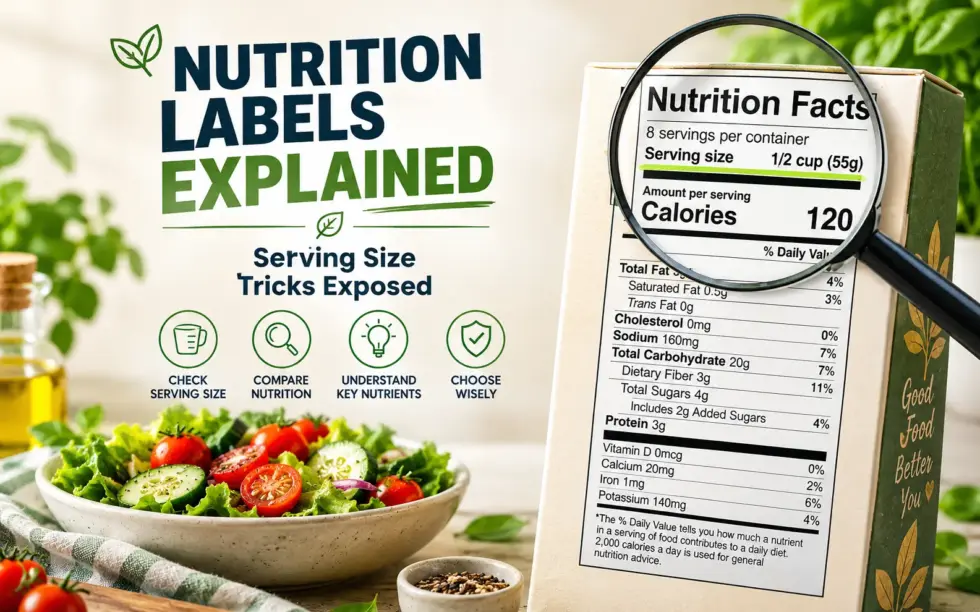
A standard Nutrition Facts label is supposed to do one thing: tell you what you’re getting if you eat one serving.
Not the whole bag. Not the whole bottle. One serving.
That “one serving” is where the games begin.
Here’s the core layout, basically:
- Serving size (and servings per container)
- Calories
- Macronutrients: fat, carbs, protein
- Key sub items: saturated fat, added sugars, fiber, etc
- Micronutrients: sodium, some vitamins and minerals
- % Daily Value: how much this serving contributes to a typical daily target diet (usually based on 2,000 calories)
Every number on that label depends on the serving size line. So if serving size is “2 cookies” but you eat 6, you have to do the math. The label will not do it for you.
And brands know most people won’t.
Serving size is not a recommendation. It is a measurement.
This is one of the most misunderstood parts.
Serving size is not telling you what you should eat. It is telling you what the company is using as the reference amount for the label.
In the US, serving sizes are guided by FDA reference amounts called RACC (Reference Amounts Customarily Consumed). That’s supposed to reflect what people typically eat, not what they “should” eat. Companies still have wiggle room with how they present it, especially when a package contains multiple servings.
So you get these weird situations where:
- a bottle looks like one serving, but the label says 2.5 servings
- a “snack pack” is somehow 3 servings
- a cereal serving is 3/4 cup, which no human pours without measuring
Serving size is a unit choice. A framing device.
The easiest serving size trick: shrink the serving, shrink the calories
Let’s say a product is calorie dense. Like cookies, chips, ice cream, sugary drinks, candy.
If you make the serving size smaller, the calories per serving drop. Same for sugar, saturated fat, sodium. Everything looks better, and the front of the package can brag with a straight face.
You’ll see stuff like:
- “Only 120 calories per serving!”
- “Just 8g sugar!”
- “Low sodium!”
But the serving might be:
- 1 cookie
- 13 chips
- 1/2 cup ice cream
- 8 oz drink, even though the bottle is 20 oz
This is not a fake number. It’s just… not the amount people actually consume in one sitting.
And the label’s job is technically done once it’s honest about the serving size. Even if the serving size is laughably small.
How to spot this fast
Ask one question:
Would I naturally stop at this serving size without thinking?
If the honest answer is “no”, then you should assume the label numbers are a best case scenario.
At that point, you read the label differently. You treat it like a math problem.
“Servings per container” is where the real story lives
This line is quietly one of the most important parts of the whole label.
Because it tells you if the company expects you to pretend you won’t finish the package.
Examples you will absolutely see in the wild:
- A “single” muffin package that is 2 servings
- A small bag of chips that is 2.5 servings
- A bottle of juice that is 2 servings
- A frozen meal that looks like a meal but is labeled as 2 servings
If you eat the whole container, you multiply everything.
Calories: multiply.
Added sugar: multiply.
Sodium: multiply.
Saturated fat: multiply.
This is also where people accidentally go way over daily sodium without realizing it. Sodium is sneaky because it is not emotionally loud like sugar. It does not taste “sweet”, it just makes everything taste better. So you don’t feel like you are overdoing it.
Until you check servings per container.
The “split package” trick: make it look like portion control
Some packaging is designed to look like a single portion. Like it’s meant to be eaten at once.
But the label says it’s multiple servings, so the numbers look nicer.
This is especially common in:
- bottled drinks
- trail mixes
- flavored nuts
- jerky
- “healthy” snack bars that are basically candy bars
- bakery items
It’s a psychological move. If it looks like one unit, your brain wants to treat it like one unit.
The nutrition label treats it like a fraction of a unit.
That mismatch is not an accident.
The “13 chips” problem, and why it matters
You’ve seen it.
Serving size: 13 chips (28g)
First of all, who is counting chips. Second, chips are not uniform. Some are tiny, some are broken, some are folded, some are weirdly thick. So “13 chips” isn’t even consistent. The grams matter more.
But the deeper issue is this: a serving size based on a count instead of the whole bag is encouraging underestimation.
People don’t want to do math while snacking. So they just accept the “160 calories” number and mentally file the chips as “not that bad”.
Then they eat 3 servings without noticing.
This is why brands love count based serving sizes.
What to do instead
Use the grams.
- Serving size is 28g
- If you eat roughly 84g, that’s 3 servings
If you don’t have a food scale, yeah, this is annoying. But you can still use rough logic:
- If you ate about a third of a normal bag, it probably wasn’t “one serving”
- If you ate until you felt done, it probably wasn’t “one serving”
- If you opened it during a movie, it probably wasn’t “one serving”
Not scientific. Still more honest.
Calories per serving vs calories per 100g (the cheat code some countries give you)
In many places outside the US, labels often include nutrition per 100g or per 100ml. That makes comparison way easier. Because serving sizes can be manipulated, but 100g is always 100g.
In the US, you mostly get “per serving”, which means you have to normalize mentally if you want to compare products.
Here’s a simple trick if you want to compare two snacks with different serving sizes:
- Look at calories per serving
- Look at grams per serving
- Do a quick estimate: calories per gram
Example:
- Snack A: 150 calories per 30g = 5 cal/g
- Snack B: 160 calories per 40g = 4 cal/g
Snack A is more calorie dense, even though per serving it looks similar. That density often tracks with added fat, added sugar, or both.
You do not need to do perfect math. You just need to stop letting serving size control the narrative.
Front of package claims: “100 calories” is usually a serving size trick
Any time you see:
- 100 calorie packs
- 90 calories per serving
- only 5g sugar
- low fat
- light
- made with whole grains
It is not automatically false. But it is almost always framed.
You flip it around. Check serving size and servings per container. That’s where the “but wait” moment usually happens.
Also, “low fat” is a classic one. A product can be low fat and still be high sugar. Or high sodium. Or both. Low fat is not a health halo. It’s just one variable.
The “added sugars” line is the one people should look at more
Modern labels (in the US) separate total sugars and added sugars.
That is huge. Because total sugar includes naturally occurring sugars in things like fruit and dairy.
Added sugars are what manufacturers put in during processing. Syrups, cane sugar, honey, dextrose, all of it.
Why does this matter?
Because a yogurt with fruit can have 12g total sugar and 0g added sugar. Another yogurt can have 20g total sugar with 14g added sugar. On the front, both might look “healthy”.
Added sugar is often where ultra processed food tells on itself.
Serving size makes added sugar look smaller too
This is one of the bigger label games.
If a cereal says:
- Serving size 3/4 cup
- Added sugars 8g
You might think, okay, not terrible.
But if you pour a normal bowl, maybe it’s more like 1.5 cups. That’s 16g added sugar before milk. And if it’s a sweetened milk or flavored creamer situation, it stacks.
The label didn’t lie. But it also didn’t match reality.
Percent Daily Value (%DV) is helpful, but only if you understand what it is
%DV tells you how much a nutrient in one serving contributes to an average daily target.
Some quick general guidelines people use:
- 5% DV or less is considered low
- 20% DV or more is considered high
This can be useful for things you want to limit, like:
- saturated fat
- sodium
- added sugars
And things you might want more of, like:
- fiber
- vitamin D
- calcium
- iron
- potassium
But again. It is per serving.
If you eat two servings, double the %DV.
Also, %DV is based on standardized assumptions, and your needs might differ. Larger bodies, athletes, certain medical conditions, pregnancy, all of that changes targets. So treat %DV as a guide, not a personal diagnosis.
Sodium is where serving size tricks hit hardest
Sugar gets the spotlight, but sodium is the silent killer on labels. Dramatic phrase, but you get the idea.
Sodium is everywhere in packaged food. Bread, sauces, frozen meals, deli meats, soups, snacks.
A label might show:
- Sodium 390mg (17% DV)
You think, okay, manageable.
Then you notice the package is 2 servings. And you ate the whole thing. Now it’s 780mg. Maybe you also had a sandwich that day. Some chips. A sauce. It adds up fast.
Serving size is how sodium gets disguised.
The “per serving” soup problem
Soups are notorious. One can is often 2 servings. People eat the whole can.
So the label can show sodium that looks “fine” per serving, even though the actual meal is a sodium bomb.
Always check servings per container on soup, ramen, broth, and frozen meals. Always.
Trans fat can be “0g” and still exist (yep)
This isn’t exactly a serving size trick, but it’s a cousin of it.
In some labeling rules, if trans fat is below a certain threshold per serving, it can be rounded down to 0g. So a product can claim 0g trans fat while still containing partially hydrogenated oils or small amounts per serving.
If you eat multiple servings, that rounding can become meaningful.
What to do:
- Check the ingredient list for partially hydrogenated oils (in places where they still show up)
- Also be cautious with “0g trans fat” claims when serving size is tiny
Again. Not lying. Just rounding and framing.
The ingredient list is the label’s lie detector
Nutrition Facts are numbers. Ingredient list is the reality of what the product is made of.
A few quick truths:
- Ingredients are listed by weight, descending
- If sugar shows up in the first few ingredients, it is a sugar heavy product
- If you see multiple types of sugar, that can be a way to distribute sugar across the list so “sugar” isn’t the first ingredient
Common added sugar names that people don’t always clock immediately:
- cane sugar, brown sugar
- corn syrup, high fructose corn syrup
- rice syrup, tapioca syrup
- dextrose, maltose
- fruit juice concentrate (often used like a sweetener)
- honey, agave (still added sugar, even if people argue about it)
If you want to get really practical, do this: compare two similar products, then read ingredients and serving sizes side by side. You will learn more in 2 minutes than in 2 hours of nutrition TikTok.
“Healthy” snacks and the serving size halo
This is where people feel betrayed.
You buy something marketed as:
- protein
- keto
- paleo
- plant based
- gluten free
- natural
- organic
All of those words can be true and still the product can be nutritionally messy. The label will often use small serving sizes to keep sugar and calories looking low.
And a lot of these “healthy” snacks are engineered to be easy to overeat. Soft texture, high palatability, low fiber, high flavor. You know the vibe.
So yes, check:
- serving size
- servings per container
- fiber (higher helps)
- added sugar
- protein (helps satiety, generally)
- ingredient list
No moral panic. Just information.
The cereal bowl fantasy: serving sizes that don’t match how humans eat
Cereal is maybe the best example of serving size theater.
Serving sizes like:
- 3/4 cup
- 1 cup
But most people pour 1.5 to 2 cups without trying. And if it’s a big bowl, even more.
So that “140 calories” cereal can become 280 or 350 before you even add milk. And many cereals have added sugars, so you are doubling that too.
A better way to think about it
If you eat cereal often, it might be worth measuring once. Just once.
Pour what you normally pour. Then measure it. That’s your personal serving size. Use that number going forward.
It’s kind of annoying, but it’s also weirdly freeing. No more guessing.
The “cooking instructions” trap: label is for the product as sold, not always as prepared
This one causes real confusion.
Sometimes the Nutrition Facts are for the food as packaged, not with what you add.
Examples:
- boxed mac and cheese label may assume prepared with certain ingredients, or show both “as packaged” and “prepared”
- pancake mix doesn’t include syrup, butter, etc
- instant oatmeal doesn’t include the toppings you add
- coffee creamer is per tablespoon, and people use… not one tablespoon
So if you are tracking intake or just trying to be aware, you have to include what you actually add.
Also watch for labels that show multiple columns:
- As packaged
- Prepared
Read which one you’re looking at. It is easy to misread.
Multi column labels: the best thing labels added, and people still miss them
Some products now include two columns, like:
- per serving
- per container
This is actually helpful. Especially for items that are realistically eaten in one sitting, like a pint of ice cream, or a bottle drink.
But not all products do this. And sometimes the “per container” numbers are shockingly high, which is why companies do not love highlighting them.
If you see a multi column label, use the per container column if you plan to eat the whole thing. That’s the honest one.
Quick math you should actually do (it’s not that bad)
If you want to beat serving size tricks, you really only need three basic moves.
1) If you eat the whole package
Use “per container” if listed.
If not listed:
Multiply per serving numbers by servings per container.
Yes, even if it’s like 2.5 servings. Multiply anyway. Your body does not care that the package is awkward.
2) If you eat “about half”
Multiply by 2. Easy.
3) If you eat more than one serving but not sure how much
Use grams.
Serving size is often listed in grams. That is your anchor. If you can eyeball that you ate about double, treat it as double. Not perfect, but much closer than pretending it was one.
Real world examples of serving size tricks (the patterns, not the brands)
Let’s talk about the most common categories where this happens.
1. Ice cream
Serving size might be 2/3 cup. People eat a bowl, not a measured 2/3 cup. Also some pints are “3 servings” which is hilarious in a dark way.
What to watch:
- saturated fat
- added sugars
- calories per container if listed
2. Soda and sweet drinks
A bottle might list 2 servings. People drink the bottle.
What to watch:
- added sugars (this one matters a lot here)
3. Chips and crackers
Serving is a small count or 28g. People eat by handful.
What to watch:
- calories per gram logic
- sodium
- saturated fat depending on oils used
4. “Healthy” granola and trail mix
Serving sizes are small because it’s calorie dense.
What to watch:
- added sugars
- serving size in grams
- how many servings per bag
5. Instant noodles and ramen
Often more than one serving per pack, but eaten as one.
What to watch:
- sodium, sodium, sodium
- saturated fat in some versions
6. Salad dressings
Serving size is usually 2 tablespoons. People pour more.
What to watch:
- calories add up fast
- sodium
- added sugars in some dressings
7. Cooking oils and sprays
Serving sizes are tiny. Especially sprays. The label might say 0 calories per serving due to rounding. But if you coat a pan thoroughly, you used more than the serving.
What to watch:
- ingredient list
- be realistic about how much you use
“Zero calorie” and “sugar free” labels, and the serving size loophole vibe
You will see claims like:
- 0 calories
- 0g sugar
- sugar free
Sometimes they are legit. Sometimes they are rounding.
If a serving size is super small, the label can round down to zero. This happens with sprays, some sweeteners, and some condiments.
Also, “sugar free” does not mean “sweetness free”. It might use sugar alcohols or non nutritive sweeteners. That’s a separate discussion, but the key here is:
Serving size can make the numbers look cleaner than your real intake.
If you use 5 servings of a “0 calorie” thing, you might still be consuming something. It might be small. But it is not nothing.
One more trick: the label can distract you from what matters by emphasizing what doesn’t
A product can be:
- low cholesterol (most people don’t need to focus on dietary cholesterol in isolation the way we used to)
- low fat (but high sugar)
- gluten free (but still ultra processed and low fiber)
- made with real fruit (tiny amount)
- contains whole grains (but mostly refined grains)
The Nutrition Facts panel and ingredient list are your anchor. Front of package marketing is vibes.
Useful sometimes. Mostly vibes.
How to read any nutrition label in under 30 seconds
If you want a simple routine, do this every time you pick up something new. It becomes automatic after a while.
- Serving size
- Servings per container
- Calories per serving
- Added sugars
- Fiber
- Protein
- Sodium
- Quick glance at saturated fat
- Ingredient list if you’re still unsure
That’s it.
You do not need to obsess over every vitamin. You do not need to become a macro accountant. You just need to stop being manipulated by serving size framing.
A few “green flags” that make labels less scammy
Not perfect, but generally helpful:
- The package is clearly one serving and the label reflects that
- Serving size matches what a normal person eats
- Higher fiber (relative to calories) for snack type foods
- Lower added sugar for everyday foods
- Ingredient list that is not a chemistry essay, especially for basics
And here is a subtle one: when the brand is not afraid to show per container totals, or uses multi column labels transparently. It suggests they’re not hiding the ball.
What if you are trying to lose weight (or gain muscle, or manage blood sugar)?
Serving size becomes even more important when you have a goal. Not because goals are moral. Just because the gap between “label serving” and “real serving” is where progress gets quietly derailed.
A couple practical notes:
- If you are watching calories, portion size matters. Serving size is your starting point, not your answer.
- If you are managing blood sugar, carbs per actual portion is the big number to track. And added sugar is worth watching.
- If you are trying to build muscle, protein per actual portion matters. Some “high protein” foods look good per serving but you’d need to eat multiple servings to hit meaningful protein.
- If you are managing blood pressure, sodium per actual portion matters more than almost anything on the snack label.
Same skill. Different goal.
So… are nutrition labels useless?
No. They are useful. They just require one extra step: don’t trust the serving size to match your life.
If you do that one thing, labels become a pretty powerful tool. You can compare products, spot sugar traps, avoid sodium overload, and basically make decisions with your eyes open.
It is not about being perfect. It is about being less confused.
Wrap up: the serving size trick in one sentence
Serving size is the dial that makes unhealthy food look reasonable.
So every time you read a Nutrition Facts label, start at the top. Ask, “Is this what I would actually eat?”
If not, adjust. Multiply. Estimate. Use grams if you can.
And suddenly the label stops being marketing. It becomes information again.
FAQs (Frequently Asked Questions)
What does the serving size on a nutrition label really mean?
Serving size on a nutrition label is not a recommendation of how much you should eat; it is a measurement that indicates the amount of food the nutritional information is based on. It reflects what people typically consume according to FDA guidelines, but companies have some flexibility in how they present it.
How do brands use serving sizes to make their products look healthier?
Brands often shrink the serving size to lower the calories, sugar, sodium, and other numbers per serving. This makes the nutritional values look more favorable on the label, even though people usually consume more than one serving at a time.
Why is ‘servings per container’ an important part of nutrition labels?
The ‘servings per container’ line reveals how many servings are actually in the whole package. If you eat the entire package, you need to multiply all nutritional values by this number to understand your true intake, which helps avoid underestimating calories, sugar, or sodium consumption.
What is the ‘split package’ trick on nutrition labels?
The ‘split package’ trick occurs when packaging looks like a single portion but the label states multiple servings. This makes each serving’s nutritional numbers appear smaller, creating a mismatch between what your brain perceives as one unit and what the label defines as fractions of that unit.
Why is counting items like ’13 chips’ as a serving size problematic?
Counting items such as ’13 chips’ is inconsistent because chips vary in size, thickness, and shape. This count-based serving size can be misleading since grams matter more for accuracy, and it encourages arbitrary portioning that doesn’t reflect actual consumption.
How can I read nutrition labels effectively to get accurate information?
To read nutrition labels effectively, focus on the serving size and servings per container first. Ask yourself if you’d naturally stop eating at one serving. If not, multiply all nutrients by how much you actually consume. Treat labels like math problems rather than trusting small serving sizes at face value.