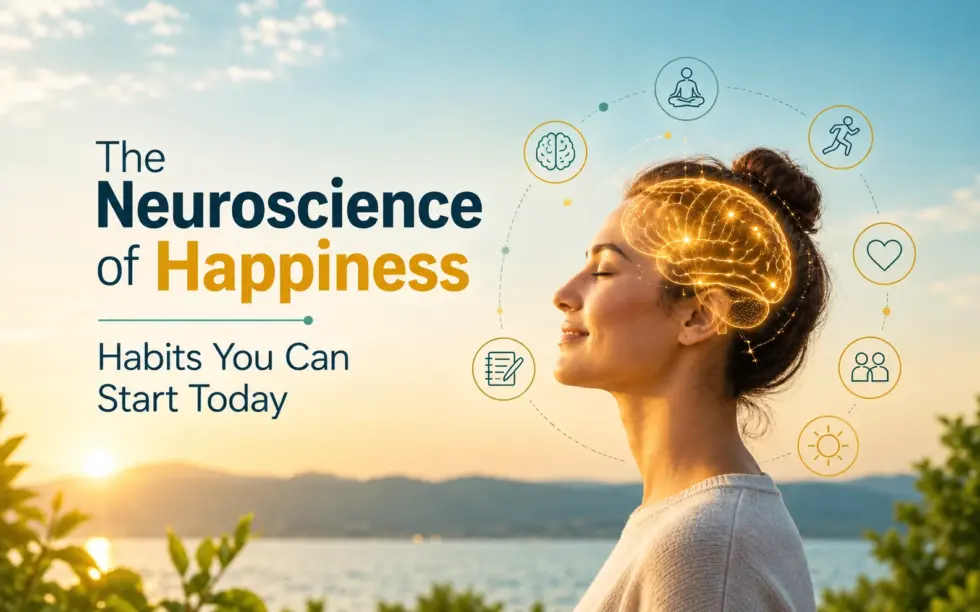

Happiness is a weird topic because the second you try to “get” it, it slips out of your hands. Like trying to fall asleep faster by concentrating really hard on falling asleep.
But here’s the good news. Neuroscience does not treat happiness like a mystical personality trait you either have or you don’t. It treats it like… a set of brain states. Patterns. Chemicals, sure, but also circuits, predictions, attention, habits, relationships, sleep, meaning, all mashed together.
So when people say “happiness is a choice” it sounds a bit annoying, honestly. But when you translate it into brain language, it becomes something more practical:
Your brain is trainable. Your nervous system is adaptable. Your attention is steerable. Your daily behaviors leave a trace.
And you do not need to move to a mountain and meditate for three hours a day to feel better. You can start today. Like, actually today.
This is a habits focused guide to the neuroscience of happiness, written for real life. Busy life. Slightly messy life. The one where you have emails, bills, people you love, people you avoid, and a brain that sometimes acts like an anxious raccoon.
Let’s get into it.
What happiness looks like in the brain (the simple version)
First, a quick reframe.
A lot of people think happiness is just dopamine. It’s not. Dopamine is more like “wanting” and “seeking” and “anticipation.” It is motivation juice. It’s why scrolling feels so compelling, and also why chasing goals can feel amazing until you get the thing and then… nothing. Quiet. Maybe even a weird emptiness.
Happiness, the kind that feels stable and human, usually involves a few systems working together:
- Reward and motivation circuits (dopamine related, but broader than that)
- Mood and well being regulation (serotonin systems play a role here, plus many others)
- Bonding and safety (oxytocin, endorphins, vagus nerve activity, social connection)
- Stress regulation (cortisol and the HPA axis, plus your autonomic nervous system)
- Executive control and meaning making (prefrontal cortex working with deeper emotional areas)
And then there’s a big meta piece: your brain is a prediction machine. It constantly guesses what will happen next, and it hates uncertainty. So a big part of happiness is not “feeling good all the time.”
It’s feeling safe enough, connected enough, and capable enough. Safe, connected, capable. That’s a nice trio to keep in your head.
Also, one more thing.
Your brain has a built in negativity bias. That is not you being broken. That is evolution. The brain learns faster from threats than from pleasant moments. If you miss one sign of danger, you die. If you miss one nice sunset, you… don’t die. So the brain prioritizes threat.
Which means happiness often requires gently, repeatedly, patiently training your attention. Not forcing positivity. Training attention.
Ok. Now the habits.
Habit 1: Start your day with sunlight and movement (yes, really)
This is one of those suggestions that sounds too basic to matter. Like, “drink water” basic. But it matters because it hits multiple systems at once.
Morning daylight, especially within the first hour or two of waking, helps set your circadian rhythm. Your circadian rhythm is basically the master schedule for sleep, hormone release, alertness, appetite, and mood regulation. When it’s off, everything gets harder. Your brain becomes more reactive. Less resilient. More snacky. More doom scrolly. More “why am I like this.”
So.
Do this today:
- Go outside within 60 minutes of waking.
- Get 5 to 10 minutes of daylight exposure. If it’s cloudy, stay longer.
- Add gentle movement at the same time. A short walk is perfect.
Why movement too? Because it helps regulate stress chemistry and increases brain derived neurotrophic factor (BDNF), which supports neuroplasticity. Basically, your brain becomes more capable of change. More flexible. Less stuck.
Also, movement improves mood through endorphins and through a subtler mechanism: it tells your brain, “We are not trapped.” It sounds dramatic, but the nervous system reads movement as agency. I can go somewhere. I can do something. That alone shifts the internal state.
If mornings are chaos, do the “minimum viable version.” Open a window, step outside, walk to the end of the street and back. That counts.
Habit 2: Use the “two minute nervous system reset” when you feel overwhelmed
A lot of happiness advice fails because it’s cognitive. It’s all “reframe your thoughts” and “practice gratitude” and “believe in yourself.”
Cool. But if your nervous system is in fight or flight, your thinking brain is not in charge. Your body is running the show.
So you need a body based lever.
Two simple options that work fast:
Option A: Physiological sigh (2 rounds)
The physiological sigh is basically a double inhale followed by a long exhale. It reduces carbon dioxide in a way that signals calm to the body.
Try it now:
- Inhale through your nose.
- Top it off with a second short inhale.
- Exhale slowly through your mouth.
- Do that twice.
This is not magic. It’s physiology. It nudges your autonomic nervous system toward parasympathetic activity (rest and digest). Less threat, more safety.
Option B: Longer exhale breathing (1 to 2 minutes)
Breathe in for 4 seconds, out for 6 to 8 seconds. The longer exhale matters more than the inhale. It’s like telling the brain, “We are safe enough to slow down.”
Do this before a difficult conversation. Or after reading something stressful. Or when your brain starts sprinting at midnight.
This habit is a happiness habit because chronic stress shrinks your window of tolerance. Everything feels harder, more annoying, more hopeless. Regulating your nervous system is not self help fluff. It’s maintenance.
Habit 3: Stop multitasking during your “happy moments”
This one is sneaky.
You can be doing objectively good stuff and still not feel happy because your attention is split. Eating dinner while scrolling. Talking to your kid while half reading Slack. Going for a walk while mentally composing an argument.
Your brain only consolidates a positive experience into memory if you are actually present for it. Otherwise it’s like… happiness keeps bouncing off you.
There is an old idea in neuroscience and psychology sometimes summarized as: neurons that fire together, wire together. If you pair a nice moment with distraction, you wire distraction into everything. The nice moment never fully lands.
So here is a small, practical habit:
Pick one daily pleasure and single task it.
- First coffee.
- A shower.
- A 10 minute walk.
- Petting your dog.
- Music while cooking.
During that time, no phone. No podcast if your brain is fried. Just… the thing.
At first this feels boring. That’s the withdrawal from constant stimulation. Then something changes. Your senses come back online. And the brain starts to register, “Oh. This is good.”
That’s real. That’s happiness training.
Habit 4: Do a daily “completion ritual” to calm your brain’s open loops
Your brain hates unfinished business. It keeps tabs. It ruminates. It wakes you up at 3 am to remind you about the email you did not send.
There is a cognitive science concept called the Zeigarnik effect. Incomplete tasks stick in memory more than completed ones. Which sounds useful. Until it becomes anxiety soup.
So give your brain closure, even if the work is not done.
Try this at the end of the workday (5 minutes):
- Write down the open loops: tasks, worries, reminders.
- Next to each, write the next tiny action. Not “finish taxes.” More like “find last year’s PDF.”
- Pick the top 1 to 3 priorities for tomorrow.
- Close the notebook. Literally close it.
That physical closure matters. The brain loves signals.
This habit improves happiness because it reduces background stress. It creates a feeling of competence and control, which is deeply regulating. Remember that trio: safe, connected, capable.
This builds capable.
Habit 5: Practice “micro gratitude” without forcing it
Gratitude gets a bad reputation because people try to use it as a weapon against their own pain.
Like, “I shouldn’t feel sad, I have so much to be grateful for.” That’s not gratitude. That’s self invalidation.
But gratitude done gently has solid neuroscience behind it. It can shift attention away from threat scanning and toward resource detection. It helps the brain notice safety and support, which lowers stress reactivity over time.
Here’s the version that actually works for most people:
The 10 second micro gratitude
Once a day, notice one good thing and stay with it for 10 seconds.
That’s it.
Examples:
- The bed is warm.
- Someone texted back.
- The sun hit the wall in a nice way.
- Your body carried you through the day.
- You heard a song that made you feel something.
The key is the 10 seconds. You are giving your brain time to encode the experience. This is sometimes called savoring. It’s like letting the good moment soak in instead of evaporating.
If you want a simple script:
“This is good. I’m letting it count.”
Not cheesy. Just direct.
Habit 6: Make happiness social on purpose (even if you’re introverted)
Humans regulate each other. We always have. Your nervous system is not just inside you, it’s shaped by other people.
When you feel seen, your brain reduces threat responses. When you feel alone, the brain often increases vigilance. Not because you’re weak. Because alone used to mean danger.
Social connection is associated with better mental and physical health outcomes across tons of studies, and loneliness is associated with increased stress and lower well being. Again, not a moral thing. A brain thing.
But most adults do not “accidentally” end up socially connected. It takes intention.
A habit you can start today:
- Send one message that is not transactional.
- Something like: “Hey, I thought of you. How are you really?”
- Or: “This made me laugh, had to send it.”
- Or: “Want to grab coffee this week?”
Even better, add voice. A 20 second voice note can feel more human than text.
And if social stuff is complicated for you, start smaller. Compliment the barista. Ask a coworker a real question. Smile at someone. Micro connections count, because your brain is tracking safety cues constantly.
This is not about becoming a social butterfly. It’s about not letting connection become an optional hobby you never get around to.
Habit 7: Protect your sleep like it’s mental health medication (because it is)
Sleep is the unsexy cornerstone. People want a supplement, a hack, a mindset trick.
But if your sleep is consistently off, your brain’s emotional regulation gets worse. The amygdala becomes more reactive. The prefrontal cortex has less control. Small problems feel huge. Neutral faces look hostile. You get more impulsive. More pessimistic. More “everything is awful.”
So yes, sleep is a happiness habit.
A realistic starting point, not perfection:
The 3 lever sleep reset
- Consistent wake time (even on weekends, within reason).
- Dim light at night (especially the hour before bed, and reduce overhead lights if you can).
- No caffeine after late morning or early afternoon (depends on your sensitivity, but caffeine has a long half life).
If you can only do one thing, do the wake time. Your circadian rhythm loves consistency.
Also, if you’re lying in bed feeling wired, don’t just keep wrestling the pillow. Get up, low light, boring activity, then return to bed when sleepy. You are training your brain to associate bed with sleep, not rumination.
Not glamorous. But it works.
Habit 8: Build “dopamine hygiene” so pleasure doesn’t become numbness
Let’s talk dopamine without making it sound like a TikTok biohack.
Your brain adapts to what you repeat. If you constantly hit it with high stimulation rewards (endless scrolling, porn, gambling like apps, constant snacking, doom news), your baseline can start to feel dull. Normal life stops sparkling.
This doesn’t mean dopamine is bad. Dopamine is great. It’s how you get motivated. It’s how you pursue goals. It’s part of joy.
The issue is constant artificial spikes.
So here’s a sane habit:
One daily low stimulation block (30 minutes)
Pick 30 minutes where you do something simple with no feeds.
Options:
- Walk without headphones.
- Cook without YouTube.
- Stretch in silence.
- Read a physical book.
- Clean one area with music but no scrolling.
- Sit with a notebook and let your brain wander.
At first, your brain will try to escape. That’s normal. You’re giving it space to settle.
Over time, this increases your sensitivity to ordinary pleasure. Food tastes better. Conversations feel more interesting. You stop needing the constant hit.
That’s happiness, too. The quiet kind.
Habit 9: Do something hard on purpose (small, but real)
This might sound like the opposite of happiness advice, but stay with me.
A big predictor of well being is not constant comfort. It’s the feeling that you can handle life. That you have agency. That your efforts matter.
When you do hard things, your brain updates its model of you. It learns, “I am capable.” That changes your stress responses. It changes your self story. And it builds resilience.
This isn’t about hustle culture. It’s about one small voluntary challenge.
Pick a daily “tiny hard thing”:
- A 2 minute cold rinse at the end of a shower.
- A short workout you don’t feel like doing.
- Cleaning the annoying corner you’ve avoided.
- Making the phone call you keep delaying.
- Saying no to something that drains you.
- Writing for 20 minutes even when you feel uninspired.
Then, after you do it, take 5 seconds to register it. Let it land. That’s important. Otherwise you rush past your own growth and your brain doesn’t encode it.
This creates earned confidence, which is a calmer kind of happiness. Not hype. Not fake. Earned.
Habit 10: Use “name it to tame it” when emotions get loud
When emotions surge, the brain can feel hijacked. Like you are inside a storm.
A simple neuroscience informed tool is affect labeling, often summarized as “name it to tame it.” When you put feelings into words, you recruit areas of the prefrontal cortex involved in language and meaning making, which can reduce activity in threat related circuits.
It is not about intellectualizing. It is about creating a bit of space.
Try this:
- “I’m feeling anxious.”
- “I’m feeling rejected.”
- “I’m feeling overstimulated.”
- “I’m feeling resentment.”
- “I’m feeling grief.”
If you want to make it even more effective, add a reason without turning it into a story:
“I’m feeling anxious because I don’t know what happens next.”
That sentence alone can reduce the chaos. Your brain likes clarity.
And if you’re not sure what you feel, start with body sensations:
“My chest is tight. My jaw is clenched. My stomach feels heavy.”
Still counts. Still helps.
Habit 11: Spend 20 minutes a week in “awe”
Awe is underrated. It’s not just a poetic emotion. It does something specific: it makes the self feel smaller, in a good way. It reduces rumination. It expands perspective. It can increase feelings of connection and meaning.
You do not need to go to the Alps.
Awe can be:
- A documentary about space or nature.
- A live concert.
- A museum.
- A huge tree.
- Looking at the night sky.
- Watching a storm roll in.
- Reading about someone who overcame something intense.
Habit version:
Once a week, schedule a 20 minute awe moment. Put it on your calendar like it’s a meeting.
Because it kind of is. A meeting with your brain, reminding it that life is bigger than your inbox.
Habit 12: Make your environment kinder to your brain
Your brain is shaped by cues. If your environment constantly signals chaos, your nervous system stays a little tense.
This doesn’t mean you need an aesthetic apartment. It means reduce friction and reduce threat cues.
Pick one:
- Clear one surface you see every day.
- Put your phone charger outside your bedroom.
- Set out your walking shoes the night before.
- Add one pleasant sensory cue: a lamp, a candle, a clean towel, a plant, a playlist.
This is behavioral neuroscience in disguise. You are designing defaults.
Happiness is easier when the environment supports regulation instead of fighting it.
Putting it together: a simple “happiness stack” you can start today
If you want the shortest version of everything above, do this. No perfection. Just start.
Morning (10 to 20 minutes)
- Daylight exposure + short walk.
- One intention: “What would make today feel like a win?”
Midday (2 minutes)
- Physiological sigh x2 or longer exhale breathing.
- Single task one pleasant thing for 5 minutes, even if it’s lunch.
Evening (10 minutes)
- Completion ritual: write open loops, pick 1 to 3 priorities for tomorrow.
- Dim lights, reduce screens.
- Micro gratitude: notice one good thing for 10 seconds.
That stack alone can change your baseline over a few weeks. Not because life becomes perfect. But because your brain becomes less stressed, more present, and more connected to what is already working.
A quick reality check (because life is still life)
Even with perfect habits, you will still have bad days. You will still get hit with grief, stress, conflict, health stuff, money stuff, existential dread at 2 am for no reason. That’s part of being human.
Neuroscience of happiness is not about erasing negative emotions. Negative emotions are information. They are signals. Sometimes they are even appropriate and wise.
Happiness, the durable kind, looks more like:
- faster recovery after stress
- more moments of genuine presence
- more connection
- more meaning
- less rumination
- a nervous system that feels safer inside your own body
That is trainable.
Start small. Pick two habits. Do them badly but consistently. Let your brain learn.
And if you want a personal recommendation, the highest leverage combo for most people is:
- Morning daylight and movement
- Sleep protection
- Social connection, even in tiny doses
Everything gets easier when those three are steadier.
That’s the work. Quiet work. But it adds up.
FAQs (Frequently Asked Questions)
Why is happiness described as a set of brain states rather than a fixed personality trait?
Happiness is viewed by neuroscience not as a mystical trait you either have or don’t, but as a combination of brain states involving patterns, chemicals, circuits, attention, habits, relationships, sleep, and meaning. This means your brain and nervous system are adaptable and trainable, allowing you to influence your happiness through daily behaviors.
What brain systems work together to create stable happiness?
Stable happiness involves multiple brain systems working in concert: reward and motivation circuits (including dopamine-related pathways), mood and well-being regulation (serotonin and others), bonding and safety mechanisms (oxytocin, endorphins, vagus nerve activity), stress regulation (cortisol, HPA axis, autonomic nervous system), and executive control with meaning-making (prefrontal cortex interacting with emotional areas).
How does the brain’s negativity bias affect our experience of happiness?
The brain has an evolutionary negativity bias which causes it to learn faster from threats than from pleasant moments because missing danger could be fatal. This means the brain prioritizes threat detection over positive experiences. To counteract this bias and cultivate happiness, one needs to patiently train attention gently rather than forcing positivity.
What simple morning habits can support happiness according to neuroscience?
Starting your day with sunlight exposure within 60 minutes of waking for 5-10 minutes helps set your circadian rhythm which regulates sleep, hormones, alertness, appetite, and mood. Combining this with gentle movement like a short walk helps regulate stress chemistry and increases BDNF for neuroplasticity. This signals agency to your nervous system enhancing mood and resilience.
What is the ‘two minute nervous system reset’ and how does it help when feeling overwhelmed?
The ‘two minute nervous system reset’ involves body-based techniques that quickly calm the nervous system when overwhelmed. One effective method is the physiological sigh: taking two inhales through the nose followed by a long exhale through the mouth. This reduces carbon dioxide levels signaling calmness to the body, helping shift from fight or flight to a more relaxed state.
Why doesn’t focusing hard on being happy or falling asleep work effectively?
Trying too hard to ‘get’ happiness or fall asleep often backfires because these processes involve complex brain states that don’t respond well to forced concentration. For example, concentrating intensely on falling asleep can keep you awake longer. Similarly, happiness requires training attention gently and adapting habits rather than forcing positivity or outcomes.