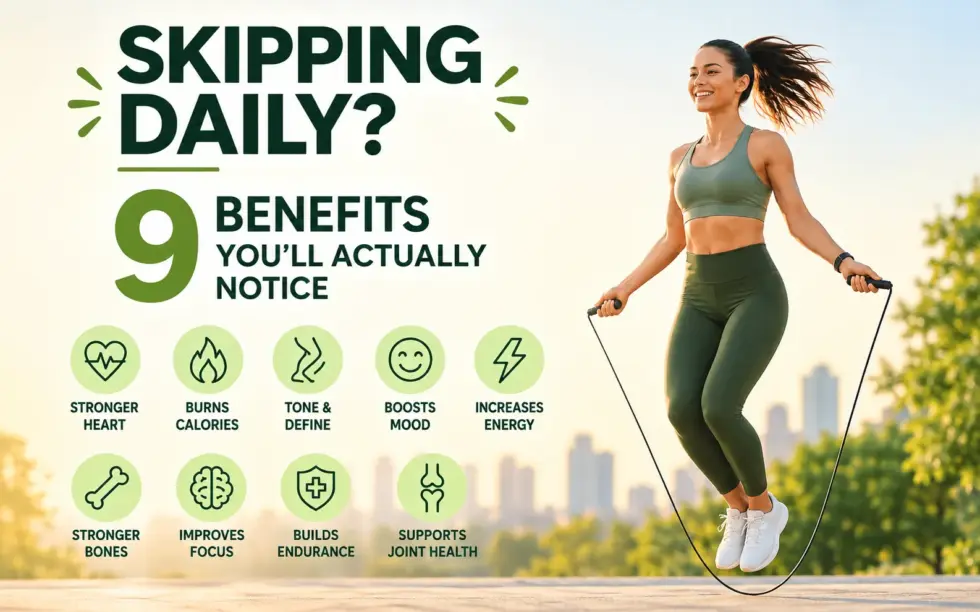

Skipping is one of those things you associate with kids in a schoolyard. Or boxers in old movies. Not something you, a grown adult with a calendar full of stuff, would do on purpose.
And yet. If you start skipping daily, even just a few minutes, it’s kind of shocking how fast your body goes, oh… we’re doing this now. And then it adapts. And then you start noticing little changes that feel oddly practical.
Also, it’s cheap. A rope costs less than most monthly subscriptions you forgot you’re still paying for.
Before we get into the benefits, a quick note so nobody twists an ankle and blames the internet.
If you have knee, ankle, hip, or back issues, or you’re pregnant, or you’re coming back from an injury. Talk to a professional first. And start ridiculously easy. Like, laughably easy. Your ego will survive.
Alright. Here are 9 benefits of skipping daily that you’ll actually notice, not just “in theory”.
1. Your cardio improves way faster than you expect
Most people think cardio has to look like a 45 minute jog where you hate your life halfway through. Skipping is different. It gets your heart rate up quickly. Like, within the first minute you’re already breathing differently.
And that’s the point.
Daily skipping tends to improve your cardiovascular fitness because it’s rhythmic, repeated impact plus sustained heart rate work. It’s basically interval training without needing a complicated plan.
What you’ll notice in real life:
- Stairs feel less dramatic.
- You recover faster after short bursts of effort.
- Your resting breathing starts to feel calmer, especially if you’re consistent.
It also teaches you how to settle your breathing while you’re still moving. That skill carries over into other workouts, and honestly into stressful days too.
2. Your calves and ankles get stronger, and your feet start feeling more “awake”
This is one of the first things you notice, and it’s usually the thing that makes you sore.
Skipping is a lot of repeated bouncing. Your calves, Achilles, ankles, and all those little stabilizer muscles in your feet have to work. Not in a slow strength training way. In a reactive, springy way.
If you sit a lot, or you wear super cushioned shoes all the time, your feet can get kind of sleepy. Skipping wakes them up.
What you’ll notice:
- Your calves get tighter, in a good way. More shape, more firmness.
- Your ankles feel more stable.
- Walking feels lighter, like you’re not dragging your feet.
Small warning: calf soreness is extremely common at the start. That doesn’t mean “push harder.” It means back off a bit and let your tissues adapt. Tendons take time.
3. Your coordination gets better, and it’s not subtle
Skipping looks simple until you do it.
Timing the rope, keeping your hands relaxed, landing softly, staying upright. It’s coordination, rhythm, and focus all at once. And because it’s immediate feedback, you improve quickly.
This is one of the underrated benefits. Better coordination doesn’t just mean you can do cute footwork. It means your body communicates better with itself.
What you’ll notice:
- You get less clumsy in general. Fewer weird stumbles.
- Your balance improves significantly due to the constant adjustments required while skipping. Incorporating some balance exercises into your routine can further enhance this benefit.
- Other exercises feel easier to learn because your brain is used to syncing movement.
And it’s kind of satisfying, too. You can feel yourself getting better. That’s a rare feeling as an adult.
4. It’s a sneaky full body workout, not just legs
People say skipping is “legs.” But once you’re doing it consistently, you realize your whole body is involved.
Your shoulders and arms keep the rope moving. Your core stabilizes you so you’re not collapsing. Your back posture matters. Even your grip and forearms get a little work.
No, it’s not a heavy strength workout. But it’s a full body activity. The kind of full body that makes you feel more athletic, not just tired.
What you’ll notice:
- Your shoulders stop feeling so stiff.
- Your posture improves a bit because you’re forced upright.
- Your core feels engaged, especially when you start doing faster rounds.
If you combine daily skipping with even basic strength training a couple days a week, it’s a really solid pairing.
5. You burn a surprising amount of calories in a short time
Let’s talk about the thing everyone cares about but pretends they don’t.
Skipping can burn a lot of energy quickly because it’s high intensity. Your body is repeatedly moving against gravity. Over and over. That costs fuel.
The exact calories depend on your weight, speed, and how long you skip. But most people notice the same thing: you can get a “worked” feeling in 10 minutes that might take 30 minutes of something else.
What you’ll notice:
- Your appetite might change. Some people get hungrier. Some people stop craving random snacks because they feel more regulated.
- Your body composition starts shifting if your diet isn’t chaotic.
- Your workouts feel more efficient, like you got more done in less time.
If fat loss is your goal, daily skipping can help. But the bigger win is that it’s sustainable for busy schedules. Ten minutes daily is easier to protect than an hour “sometimes”.
6. Your bone health gets a boost (yes, impact is not always bad)
Impact gets a bad reputation, and sometimes it deserves it. But controlled impact, done gradually, can be good for your bones.
Bone responds to load. When you do weight bearing activity with repeated impact, your body has a reason to maintain or improve bone density over time. That matters more than people realize, especially as you get older.
Now, this isn’t medical advice, and it doesn’t mean everyone should jump around daily. But for many healthy adults, skipping is a simple way to add that stimulus.
What you’ll notice isn’t “my bones are stronger” obviously. What you might notice is:
- Your joints feel more resilient once you adapt.
- You feel less fragile doing everyday movements.
The key phrase is “once you adapt.” Start light, progress slowly, and keep your landings quiet and soft.
7. Your mental mood and focus improve, in that clean post workout way
Skipping daily does something to your head. It’s hard to explain until you do it consistently.
Partly it’s the endorphin thing. Partly it’s the fact you have to focus. When you’re skipping, you can’t doomscroll. You can’t multitask. If you do, you trip. The rope forces you into the present moment.
It’s like moving meditation, except you’re sweating and occasionally swearing.
What you’ll notice:
- You feel calmer after, even if you were stressed before.
- Your brain feels sharper for a while.
- You get a small confidence boost from “I did the thing” every day.
Daily skipping is also an easy habit to stack with something else. Morning coffee, then 5 minutes skipping. Done. It sets the tone for the day.
8. Your body gets more “springy” and athletic
There’s a difference between being fit and being athletic.
Athletic is that bounce. That quickness. That ability to change direction, react, move with snap. Skipping trains that because it’s plyometric, even at a low level. It teaches your muscles and tendons to store and release energy.
What you’ll notice:
- You feel lighter on your feet.
- Short runs feel smoother.
- Your legs don’t feel as dead when you have to move fast, like catching a bus or playing with your kids.
It also builds a kind of “fitness readiness.” Like you could do stuff. Not just gym stuff. Life stuff.
9. You get better at consistency, because it’s hard to make excuses
This might be the biggest benefit. And it’s not physical, not exactly.
Skipping is portable. You can do it in a small space. You don’t need a gym. You don’t need a machine. You don’t need perfect weather.
So when you commit to skipping daily, you’re basically practicing consistency in a way that’s hard to wiggle out of.
And once you build that identity, I’m someone who moves daily, other habits become easier.
What you’ll notice:
- You stop overthinking workouts.
- You feel less guilt around fitness because you’re doing something every day.
- Your discipline muscle gets stronger, and it spills into other areas. Sleep. Food. Work.
Also, there’s something kind of satisfying about having a simple baseline. Even on bad days, you can do 3 minutes. Even that counts.
How to start skipping daily without wrecking your legs
If you’re new, the biggest mistake is trying to skip like a boxer on day one. Your heart might handle it. Your calves and shins might not.
Here’s a simple way to start that’s boring but works.
Week 1: micro sessions (seriously)
- 3 to 5 minutes total
- Do 20 to 30 seconds skipping, then rest 30 to 60 seconds
- Repeat until time is up
Yes, that’s it. You should finish feeling like you could do more.
Week 2: build volume gently
- 5 to 8 minutes total
- Same intervals, slightly longer work periods if you feel good
Week 3 and beyond: pick your “daily minimum”
A daily minimum keeps you consistent without turning it into a punishment.
Examples:
- 5 minutes easy pace
- 10 rounds of 30 seconds on, 30 seconds off
- 1000 total jumps, broken up as needed
If you want to get fancy later, you can. But the first goal is to make it a habit your body can tolerate.
A few form tips that save your knees and shins
These are small, but they matter a lot.
- Jump low. You’re not trying to leap. You’re trying to clear the rope by a tiny amount.
- Land softly. If you sound like a herd of animals, you’re jumping too high or too stiff.
- Use your wrists, not your arms. Hands slightly in front of your hips, wrists doing the turning.
- Stay tall. Chest up, shoulders relaxed, eyes forward.
- Skip on a decent surface. A rubber gym mat, wooden floor, or smooth concrete. Avoid super grippy surfaces that catch the rope and jerk your joints.
And shoes matter. You don’t need anything fancy, but you do want something that feels stable and not overly squishy.
Common issues, and what to do instead of quitting
“My calves are on fire”
Normal at first. Reduce volume, take an extra rest day, and build slower. Gentle calf stretching helps, so does walking.
“My shins hurt”
That can be a sign you ramped too fast or you’re landing too hard. Cut volume, focus on soft landings, and consider a softer surface. If pain persists, stop and get it checked.
“I keep tripping”
Everyone does. Shorten the rope if it’s too long, keep your hands closer to your sides, and slow down. It’s mostly rhythm.
“I get bored”
Try music, or set a timer and do short rounds. Or learn one simple variation like alternating feet. You don’t need a whole routine. Just enough to keep your brain engaged.
So… is skipping daily actually worth it?
If you want something simple that improves cardio, coordination, lower leg strength, mood, and general fitness. Yeah, it’s worth it.
Not because it’s magical. Because it’s practical.
Start small. Do it often. Let it be a little messy at first. You’ll trip, you’ll sweat, you’ll feel your calves complain. Then one day you’ll realize you just did five minutes without thinking about it.
And that’s usually when the benefits start showing up everywhere else.
FAQs (Frequently Asked Questions)
Is skipping a good cardiovascular workout for adults?
Yes, skipping is an excellent cardiovascular exercise that improves your heart health quickly. It raises your heart rate within the first minute and acts like interval training without needing a complicated plan, helping you recover faster after effort and feel calmer in your breathing.
How does skipping strengthen my calves and ankles?
Skipping involves repeated bouncing that works your calves, Achilles tendons, ankles, and foot stabilizer muscles in a reactive, springy way. This helps wake up ‘sleepy’ feet from sitting or cushioned shoes, resulting in tighter calves, more stable ankles, and lighter walking. However, calf soreness is common at the start, so it’s important to start easy and allow tissues to adapt.
Can skipping improve my coordination and balance?
Absolutely! Skipping requires timing the rope, relaxed hands, soft landings, and staying upright—combining coordination, rhythm, and focus. This immediate feedback helps you improve quickly, leading to less clumsiness, better balance through constant adjustments, and easier learning of other exercises due to enhanced body communication.
Does skipping work my whole body or just my legs?
While many think skipping is just leg work, it actually engages your entire body. Your shoulders and arms keep the rope moving; your core stabilizes your posture; your back posture improves; even grip and forearms get some exercise. This full-body involvement makes you feel more athletic rather than just tired.
How many calories can I burn by skipping daily?
Skipping is a high-intensity activity that burns a surprising amount of calories in a short time because you’re repeatedly moving against gravity. While exact calorie burn depends on weight, speed, and duration, many people experience a ‘worked’ feeling from just 10 minutes of skipping that might take 30 minutes of other exercises.
Are there any precautions I should take before starting daily skipping?
Yes! If you have knee, ankle, hip or back issues, are pregnant, or recovering from injury, consult a professional before starting. Begin with very easy sessions to avoid injury—your ego will survive! Proper progression helps prevent twisting an ankle or overloading tendons as your body adapts.