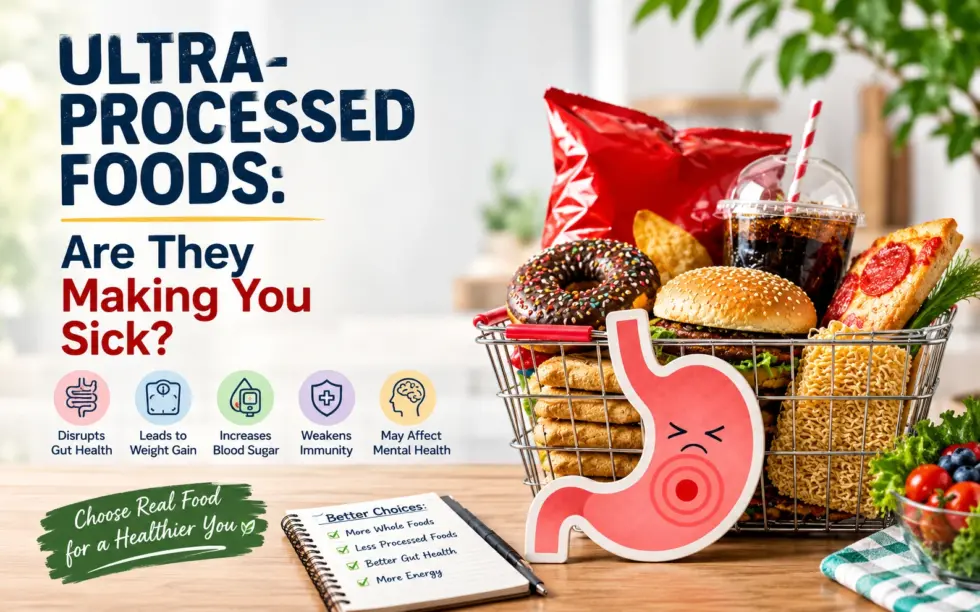

I used to think “processed” was basically a synonym for “lazy food”. Like, sure, it’s not ideal, but it’s not that deep. A frozen pizza here, a cereal bar there. Normal life stuff.
Then I started paying attention to how I felt after certain meals. Not in a dramatic, my-life-is-over way. More like… foggy. Weirdly hungry again an hour later. Bloated for no good reason. Random breakouts. A stretch of low mood that didn’t match what was going on in my life. And honestly, I kept trying to blame anything else first. Stress. Sleep. Hormones. Being “out of shape”. Aging. Mercury in retrograde, basically.
But the more I looked at my actual day to day eating, the more obvious the pattern got.
A lot of what I was eating wasn’t just “processed”. It was ultra-processed. And that’s a different category entirely.
So. Are ultra-processed foods making you sick?
Sometimes, yeah. Not always in a clear, immediate way. More like the slow drip of feeling a little worse than you need to. And then you get used to it. That’s the scary part.
Let’s unpack what these foods are, why they hit so many people badly, what the science is actually saying right now, and what you can do about it without turning your kitchen into a wellness monastery.
What counts as an ultra-processed food (UPF)?
A lot of people get stuck here, because “processed” can mean basically anything.
- Yogurt is processed.
- Olive oil is processed.
- Canned beans are processed.
- Bread is processed.
Ultra-processed foods are a different beast.
Most researchers use something called the NOVA classification, which groups foods by the degree and purpose of processing. Ultra-processed foods (NOVA Group 4) are typically:
- Made with industrial formulations (not just “food” but food-like components)
- Contain additives you wouldn’t use at home (or wouldn’t even have in your kitchen)
- Designed to be hyper-palatable, convenient, shelf-stable, and highly profitable
Common examples:
- Soda, energy drinks, sweetened iced teas
- Packaged snacks (chips, cheesy puffs, crackers with flavor dust)
- Candy, chocolate bars, gummies
- Most boxed cereals, especially the very sweet ones
- Instant noodles and many frozen ready meals
- Fast food burgers, nuggets, fries
- Packaged baked goods (donuts, pastries, cookies that last 3 weeks)
- “Protein” bars that taste like candy bars (some are fine, many aren’t)
- Flavored yogurts and “diet” desserts loaded with sweeteners and thickeners
- Many plant based meat alternatives (not all, but lots)
A quick rule of thumb that’s not perfect but helps:
If a food has a long ingredient list with things like maltodextrin, modified starches, hydrogenated oils, emulsifiers, gums, artificial flavors, flavor enhancers, colors, sweeteners, it’s probably ultra-processed.
And just to be clear. UPF doesn’t automatically mean “poison”. The issue is more about what these foods do when they become a big chunk of your diet, day after day, without you really noticing.
Why UPFs can mess with your body (even if calories are “fine”)
This is where it gets interesting, because a lot of us were taught one main thing:
Calories in, calories out. Everything else is just noise.
But the body isn’t a math worksheet. Two diets with the same calories can affect hunger, blood sugar, the gut, inflammation, and cravings very differently.
Here are the main reasons UPFs can make people feel lousy.
1. They’re engineered to override your appetite signals
Ultra-processed foods are often built around a specific goal: make you want more.
They usually hit a combo of:
- High refined carbs
- Added fats
- Added salt
- Strong flavors
- Soft texture (easy to chew fast)
- Low fiber
- Low water content compared to whole foods
That combo matters. It makes the food fast to eat, fast to digest, and easy to overshoot on without feeling physically full.
There’s also a well known (and kind of depressing) idea called the bliss point. Food companies test and optimize the exact sugar, salt, and fat levels that keep you reaching back into the bag. Not because they hate you. Because it works. Because people buy more.
2. Blood sugar swings and that “why am I hungry again?” feeling
Many UPFs use refined starches and sugars that digest quickly.
So you eat. Blood sugar rises. Insulin responds. Then sometimes you get a sharper drop later, and suddenly you’re not just hungry. You’re snack-hunting. You want something specific. Usually sweet, salty, or both.
People often call this “lack of willpower”. But a lot of it is just physiology.
Not everyone reacts the same way, but if you’ve ever eaten a big bowl of sugary cereal and felt hungry again in an hour… yeah.
3. They displace nutrients without you noticing
Ultra-processed foods can technically be fortified. Some cereals have added vitamins, for example. But there’s still a difference between:
- isolated nutrients added back in, and
- naturally packaged nutrients with fiber, protein, phytonutrients, minerals, and the food matrix intact
If a big chunk of your diet is UPFs, you often end up low on:
- fiber
- magnesium
- potassium
- omega 3 fats
- certain antioxidants and polyphenols
And when you’re short on these things, your body doesn’t always send you a neat notification. It just… runs worse.
Energy dips. Digestion gets weird. Sleep quality slips. Mood becomes flatter. Skin acts up. Immune system feels slower.
Little stuff. Until it’s not so little.
4. The gut gets involved (and the gut is dramatic)
This part is still evolving science, but it’s hard to ignore.
Some ultra-processed foods contain additives like emulsifiers, certain gums, and sweeteners that may affect the gut microbiome and gut barrier in some people. Not everyone. Not always. But enough that researchers keep investigating.
Also, separate from additives, UPFs are often low in fermentable fibers that feed beneficial gut bacteria.
So you get the double hit:
- less “good stuff” for your microbes
- more “weird stuff” that might not play nicely
And the gut is connected to immune function, inflammation, and even mood through the gut-brain axis. Which brings us to…
5. Inflammation and long term disease risk
This is where the conversation usually goes, and it’s not totally hype.
Large observational studies have consistently found that high UPF intake is associated with higher risk of things like:
- obesity
- type 2 diabetes
- cardiovascular disease
- certain cancers
- depression
- all cause mortality
Now, observational research can’t prove UPFs cause these outcomes on its own. People who eat lots of UPFs might also sleep less, exercise less, smoke more, be more stressed, have lower income, etc.
But there are also controlled trials that add weight to the idea that UPFs can drive overeating and metabolic issues beyond just “personal choices”.
One widely cited randomized controlled trial (conducted at the NIH) compared an ultra-processed diet to an unprocessed diet, matched for calories, sugar, fat, fiber, and macronutrients. People ate more calories on the ultra-processed diet and gained weight, largely because they ate faster and felt less satisfied.
That’s a big deal. It suggests the processing level itself changes eating behavior.
So… are they making you sick?
Here’s the tricky part: sickness doesn’t always look like a diagnosis.
Sometimes it looks like:
- You’re tired even when you sleep enough
- You have brain fog, especially mid afternoon
- You’re constipated or bloated a lot
- You crave snacks constantly and feel “never full”
- Your mood feels anxious or low for no obvious reason
- Your skin is inflamed, or you feel puffy
- Your blood work starts creeping (glucose, triglycerides, LDL, blood pressure)
- You get heartburn more often
- You have headaches you keep normalizing
And the most annoying thing is that each of these can have multiple causes. That’s why UPFs get away with it. It’s rarely a clean one-to-one.
But if you’re eating a lot of ultra-processed foods and you feel kind of off most of the time, it’s not crazy to suspect a connection.
The part nobody likes to admit: UPFs are convenient for a reason
It’s easy to write articles that basically say: “Just cook whole foods.”
Okay. Sure.
But real life:
- People work long hours.
- People are exhausted.
- People have kids.
- People live in food deserts.
- People have money stress.
- People have mental health stuff.
- Some people never learned to cook.
- Some people are dealing with chronic illness already.
Ultra-processed foods don’t dominate because everyone is stupid. They dominate because they’re cheap-ish, available everywhere, and they remove friction.
Also. They taste good. Like, really good.
So if you’ve been leaning on them, that’s not some moral failure. It’s a predictable outcome of how the food environment is built.
The goal isn’t purity. The goal is to notice when convenience turns into the default, and the default turns into feeling bad.
A more useful question: how much UPF is too much?
There isn’t one magic threshold for everyone. But research often looks at UPFs as a percentage of total calories. In many Western countries, UPFs can make up more than half of daily energy intake. Sometimes way more.
If UPFs are:
- most breakfasts (sweet cereal, pastries, flavored coffee drinks),
- most lunches (fast food, packaged snacks),
- most dinners (frozen meals),
- plus snacks and sugary drinks…
Then yeah, odds are good your body is dealing with a constant stream of low fiber, highly palatable, additive-heavy food.
If UPFs are more like:
- an occasional frozen pizza,
- a protein bar in a pinch,
- some chips at a party,
- a dessert now and then…
That’s a different situation.
A helpful target for many people is: make the foundation of your diet minimally processed. Then let the rest be flexible.
Not perfect. Just anchored.
“But I eat UPFs and I feel fine”
Some people genuinely do.
A few reasons why:
- They’re active and metabolically healthy, so they tolerate blood sugar swings better.
- They still eat enough whole foods and fiber overall.
- Genetics and microbiome differences.
- They’re young, or they haven’t hit the cumulative effects yet.
- They do feel bad, but they think it’s normal. (This one is surprisingly common.)
Also, feeling fine today doesn’t always mean the body is thriving long-term. But I don’t want to fear-monger either. The body is resilient.
Still, if you’re dealing with persistent issues, UPFs are a high leverage place to look.
What to do about it (without living on kale and sadness)
You don’t have to overhaul everything in one week. That usually backfires.
Instead, think in swaps. And think in systems. Make it easier to eat real food when you’re tired, because tired-you is the one making most of the decisions.
Here’s a practical approach that works for normal humans.
1. Start with drinks. It’s the easiest win.
Liquid calories and sweeteners are sneaky, and they don’t create fullness the way food does.
Try for two weeks:
- Replace soda with sparkling water plus citrus.
- Replace sweetened iced coffee drinks with unsweetened or lightly sweetened versions.
- If you do juice, dilute it or have whole fruit instead.
- Watch “healthy” drinks too: bottled teas, flavored milks, energy drinks.
This single change can reduce sugar spikes and cravings dramatically for some people.
2. Add breakfast protein (and don’t overcomplicate it)
A lot of UPF heavy days start with a breakfast that’s basically dessert.
If you shift breakfast even slightly toward protein and fiber, you often get:
- fewer cravings
- better energy
- less random snacking
Simple options:
- eggs plus toast plus fruit
- plain Greek yogurt plus berries plus nuts
- oatmeal with chia seeds and peanut butter (watch the sugar-loaded packets)
- leftovers (underrated)
3. Upgrade snacks. Keep the convenience, change the ingredients.
People snack because they’re hungry. Or bored. Or stressed. Or all of it.
So don’t pretend you won’t snack. Just make the default snacks less ultra-processed.
Easy snack ideas that still feel like snacks:
- fruit plus cheese
- nuts plus a piece of dark chocolate
- hummus with carrots or pita
- popcorn you pop yourself (or a simpler ingredient bag)
- beef or turkey sticks with decent ingredients
- cottage cheese with salt and pepper (or fruit)
- roasted chickpeas (store-bought can be fine, check ingredients)
4. Learn 3 to 5 “default meals” you can make half asleep
This is the real strategy. Not motivation. Defaults.
Examples:
- rice + canned beans + salsa + avocado + eggs
- pasta + olive oil + garlic + frozen spinach + parmesan
- rotisserie chicken + bagged salad + microwave potatoes
- stir-fry using frozen mixed veg + tofu/chicken + soy sauce
- lentil soup (lentils, broth, carrots, onion, spices) big batch
Notice what’s happening here. These are not gourmet. They’re just real food with some shortcuts.
Shortcuts are allowed. Frozen vegetables are great. Canned fish is great. Pre-cut produce is great if it makes the difference.
5. Read ingredients like a cynic (but don’t spiral)
You don’t need to obsess. Just get familiar.
If the ingredient list reads like:
“Corn syrup, wheat flour, soybean oil, modified corn starch, mono and diglycerides, artificial flavor…”
Okay. That’s a UPF.
If the ingredient list reads like:
“Oats, peanuts, dates, salt”
Better.
Also, watch for “health halo” marketing. Words like:
- natural
- gluten-free
- vegan
- keto
- high protein
- low sugar
These can be true and still ultra-processed. The label isn’t the food.
6. Don’t try to quit UPFs like they’re nicotine
The hard truth: going from 70% UPF to 0% overnight is miserable for most people.
A better move:
- Aim for one meal a day that is mostly whole foods.
- Then two.
- Then your snacks improve.
- Then the random cravings start calming down.
And if you slip. Fine. The next meal still counts. People mess up by turning one “off meal” into a week-long spiral.
What if you can’t avoid them (money, time, access)?
Then we aim for “less harmful UPFs” and better balance.
If your budget is tight, some of the most cost-effective whole or minimally processed staples are:
- oats
- rice
- potatoes
- dried or canned beans and lentils
- eggs
- frozen vegetables and fruit
- canned tuna or sardines
- peanut butter (look for peanuts, salt)
- plain yogurt
- whole chicken or rotisserie chicken
- seasonal produce
And if you rely on packaged foods, you can still improve the mix:
- choose bread with fewer ingredients and more fiber
- choose cereals with less added sugar and more whole grains
- choose frozen meals that are higher in protein and veg, lower in added sugars
- add a side of fruit or bagged salad to increase fiber and volume
This is not all-or-nothing.
A quick self-check (no apps, no tracking)
If you want to see whether UPFs might be affecting you, do a simple experiment:
For 14 days:
- Keep calories roughly similar.
- Don’t focus on weight.
- Just reduce ultra-processed foods significantly and replace them with minimally processed options.
- Prioritize protein and fiber at each meal.
Then watch:
- energy consistency
- hunger and cravings
- digestion and bloating
- sleep quality
- mood
- skin
- concentration
If you feel noticeably better, you learned something important. If you don’t, that’s also data. Maybe your issue is elsewhere. Or maybe you need longer than two weeks. Bodies vary.
The bottom line
Ultra-processed foods aren’t evil, but they are very good at becoming your entire diet without you realizing it. And when that happens, a lot of people start feeling worse in ways that are hard to pin down. More hunger. More fatigue. More cravings. More gut issues. Sometimes worse labs over time.
Are they making you sick?
If you’re living on them, there’s a decent chance they’re at least contributing. Maybe not as the only cause, but as a constant background stressor your body has to manage every day.
The fix doesn’t have to be dramatic. Start with one or two swaps that actually fit your life. Drinks. Breakfast. Default meals. Better snacks. Doable stuff.
And then give it a little time. Your body usually tells the truth once the noise drops.
FAQs (Frequently Asked Questions)
What are ultra-processed foods (UPFs) and how do they differ from regular processed foods?
Ultra-processed foods (UPFs) are products made with industrial formulations containing additives not typically found in home kitchens, designed to be hyper-palatable, convenient, shelf-stable, and highly profitable. Unlike regular processed foods like yogurt or canned beans, UPFs often include ingredients such as maltodextrin, modified starches, hydrogenated oils, emulsifiers, artificial flavors, sweeteners, and colors. They fall under NOVA Group 4 classification and include items like soda, packaged snacks, fast food, instant noodles, and many flavored yogurts.
Why can consuming ultra-processed foods make me feel foggy, bloated, or hungry soon after eating?
UPFs are engineered to override your body’s natural appetite signals by combining high refined carbs, added fats and salt, strong flavors, soft textures, low fiber, and low water content. This makes them fast to eat and digest but easy to overconsume without feeling full. Additionally, their refined sugars cause blood sugar spikes followed by sharp drops that trigger cravings and hunger soon after eating. This can lead to feelings of brain fog, bloating, random breakouts, and mood dips over time.
Are ultra-processed foods inherently harmful or ‘poisonous’ to my health?
Ultra-processed foods aren’t automatically ‘poisonous,’ but problems arise when they make up a large portion of your daily diet consistently without you noticing. They tend to displace nutrient-rich whole foods and can negatively impact hunger regulation, blood sugar balance, inflammation levels, and gut health over time. The slow accumulation of these effects often leads to feeling worse than necessary physically and mentally.
How does the NOVA classification system help identify ultra-processed foods?
The NOVA classification groups foods based on the degree and purpose of processing into four categories. Ultra-processed foods belong to NOVA Group 4 and are characterized by industrial formulations with additives uncommon in home cooking. This system helps distinguish between minimally processed items like canned beans or olive oil and highly processed products like sugary cereals or fast food meals that contain artificial ingredients designed for hyper-palatability.
Can fortified ultra-processed foods compensate for the lack of natural nutrients?
While some UPFs like certain cereals may be fortified with isolated vitamins and minerals, this doesn’t fully replace the benefits of naturally packaged nutrients found in whole foods that come with fiber and protein. Fortification can’t mimic the complex nutritional profile or health benefits of unprocessed or minimally processed foods that support digestion and satiety effectively.
What practical steps can I take to reduce the negative effects of ultra-processed foods without drastically changing my lifestyle?
Start by becoming aware of ingredient lists—avoid products with long lists containing maltodextrin, emulsifiers, artificial flavors or sweeteners. Opt for whole or minimally processed alternatives when possible. Balance convenience with nutrition by preparing simple meals using fresh ingredients. Gradually replace sugary snacks with fruits or nuts. You don’t need to turn your kitchen into a wellness monastery; small mindful changes can significantly improve how you feel day-to-day.