
I used to think recovery was simple.
You train hard, you rest hard. End of story.
Then I actually started paying attention. To my sleep, my mood, how my joints felt walking down stairs, the weird way a “rest day” sometimes made me feel more stiff, not less. And the way a light bike ride, almost embarrassingly easy, could make my legs feel brand new the next morning.
So yeah. Recovery is not just “do nothing” or “push through”. It’s a choice. And the choice usually looks like this:
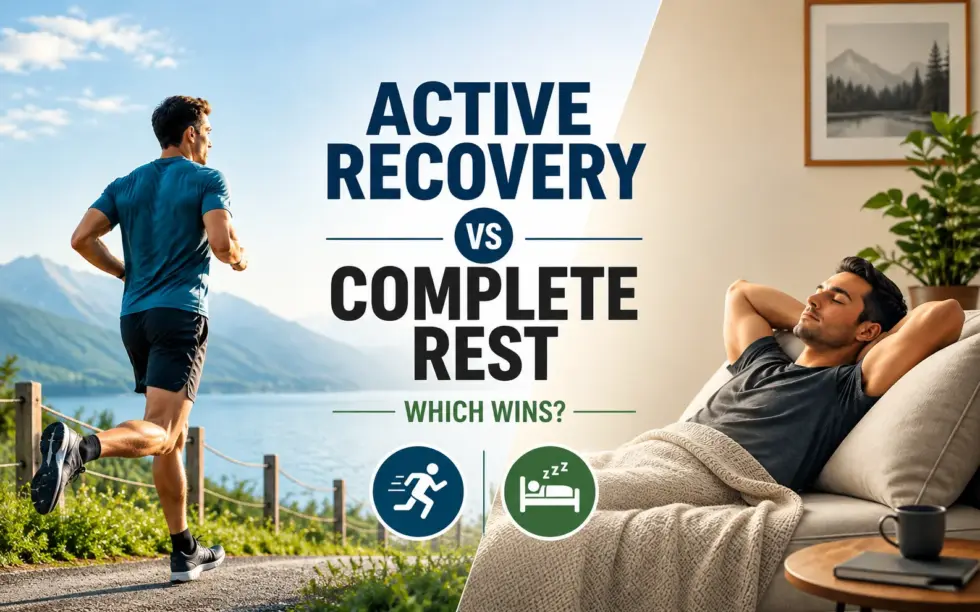
Active recovery vs complete rest.
Which one wins?
Annoying answer. Depends. Helpful answer. We can make it depend on you, your training, and what your body is obviously trying to say but you keep ignoring.
Let’s get into it.
What people mean by “recovery” (and why it gets messy)
Recovery is basically your body paying the bill for what you did in training.
Training is the stimulus. Recovery is the adaptation.
But the reason people fight about active recovery vs rest is because they’re talking about different kinds of tired.
There’s:
- Muscle soreness and local fatigue (legs feel cooked)
- Nervous system fatigue (everything feels heavy, even warmups)
- Joint and tendon irritation (sharp, specific, “uh oh” pain)
- General stress load (sleep is off, appetite weird, motivation low)
- Illness risk (scratchy throat, elevated resting heart rate, etc)
A “recovery day” that helps one of these can make another one worse.
So when someone swears active recovery is magic and another person says rest days saved their life, both can be right. They’re just recovering from different problems.
Active recovery, explained like a normal person
Active recovery is low intensity movement done with the goal of feeling better, not getting fitter.
Key phrase. Not getting fitter.
It’s not a sneaky extra workout. It’s not “I’ll do a quick 5k easy” when your easy pace turns into threshold pace because your ego has a steering wheel.
Active recovery is stuff like:
- 20 to 40 minutes easy cycling or walking
- Light swim, relaxed, no sets that turn into suffering
- Mobility work and light stretching (not painful)
- Easy yoga, the chill kind
- Very light technique work (barbell movement practice with nothing on the bar, form drills, that sort of thing)
It should feel like you’re doing almost nothing. Which is kind of the point.
Complete rest, explained without guilt
Complete rest is exactly what it sounds like.
No structured exercise. No “just to sweat a little.” No bonus core circuit.
You still move like a human. You walk around the house, you live your life. But you’re not deliberately adding training stress.
The problem is a lot of people hear “complete rest” and think it means “I’m being lazy.”
Rest is not laziness. Rest is training. It’s just the invisible part that nobody posts.
And if you’re the type who trains hard, works a lot, sleeps a little, drinks too much caffeine, and calls it discipline. Rest is probably the thing you’re missing.
So which wins?
If we’re choosing a universal winner, like one is always better, that’s not real life.
But we can absolutely say this:
- Active recovery wins when your main issue is soreness, stiffness, and mild fatigue.
- Complete rest wins when your main issue is deeper fatigue, injury signals, or stress overload.
Now let’s actually break down why.
Why active recovery works (when it works)
Active recovery has a few benefits that are pretty consistent.
1. It increases blood flow without adding much damage
Gentle movement increases circulation. More blood flow means more oxygen and nutrients, and faster clearance of metabolic byproducts.
Does it “flush lactic acid”? Not really in the way people say it. Lactate clears fairly quickly after exercise anyway.
But movement can reduce that heavy, sluggish feeling. Especially after high volume training, long runs, hard leg days. It’s like turning the lights on in your legs.
2. It reduces stiffness
A complete day off can sometimes make you feel like you aged ten years overnight. You stand up and everything creaks.
Light movement keeps tissues gliding. Keeps joints feeling normal. Particularly useful if you sit a lot for work.
3. It can help your nervous system chill out
This one surprises people.
A very easy session can actually downshift your stress response, especially if you do it outdoors, at a conversational pace, and you’re not timing splits like a psycho.
It’s not the movement alone, it’s also the mental signal. “We’re safe. We’re not fighting today.”
4. It keeps habits intact
This is not a physiology thing, but it matters.
Some people fall off the wagon if they take full rest days. They go from “rest day” to “rest week” to “I guess I’m not training anymore.”
Active recovery can keep the rhythm without burning you out.
If you’re that person, active recovery can be a cheat code. As long as you keep it truly easy.
5. You practice movement quality
Especially in strength training.
An active recovery day can be 20 minutes of technique. Squat patterning, shoulder mobility, light kettlebell swings, breathing drills. Stuff that helps you move better later.
No grind reps. No “one more set”.
Just cleaning up the edges.
Why complete rest works (when it works)
Rest is underrated because it’s boring. But it’s powerful.
1. It drops total stress load fast
Training stress is stress. Work is stress. Life is stress.
Sometimes your system is just full. Like a phone with 2 percent battery, and you’re trying to run heavy apps.
Complete rest is the fastest way to stop digging.
2. It’s protective when you’re on the edge of injury
If something hurts in a sharp or specific way, active recovery can turn into “I kept moving and now it’s worse.”
Tendons, joints, irritated soft tissue. These don’t always want movement. Sometimes they want nothing for a bit, then gradual reintroduction.
Rest is not weakness here. It’s damage control.
3. It improves sleep for a lot of people
Especially if you’re overreaching.
When you’re training too hard, sleep often gets worse. You feel tired but wired. Restlessness, early waking, shallow sleep.
A true day off, plus food and hydration, can reset that.
4. It gives mental recovery, not just physical
This one is massive.
If training is starting to feel like a job, if you dread it, if you’re forcing yourself every session. You’re not just physically tired.
You’re mentally cooked.
A full rest day, with no “should,” can bring back the want. And want matters.
5. It prevents the “active recovery creep”
Let’s be honest. A lot of people say “active recovery” and do a whole workout.
They go for an “easy run” that turns into tempo. They do a “light gym day” and hit 5 sets of 5. They do yoga and make it a sweating contest.
If you can’t keep active recovery easy, you’re better off resting completely.
The biggest mistake: treating active recovery like training
Here’s the rule I use.
If you finish an active recovery session and feel like you “earned” food.
It was too hard.
If you track it like a workout, post it like a workout, brag about it like a workout.
It was too hard.
Active recovery should feel like you could do it again immediately. Like it barely counts.
That’s why it works.
Quick self check: which one do you need today?
Not forever. Today.
Use this. It’s not perfect, but it’s practical.
Choose active recovery if:
- You’re sore, stiff, tight, but not injured
- Your energy is okay once you warm up
- You slept decent
- Your motivation is fine
- Your resting heart rate is normal for you
- You feel better after moving lightly
Choose complete rest if:
- You feel heavy and flat, even after a warmup
- You’re unusually irritable or anxious
- Your sleep has been garbage for a few nights
- You have a nagging pain that feels sharp or specific
- Your resting heart rate is elevated
- You feel run down, like you might be getting sick
- Your performance has been sliding for more than a few sessions
And if you don’t know.
Rest. One day of full rest almost never ruins progress. But one more “I’ll just push through” day sometimes does.
What the science vibe says, without making this a textbook
In general, low intensity movement can reduce delayed onset muscle soreness and improve subjective recovery, especially after endurance work or high volume resistance training.
But the effect size is not magic. It’s not like active recovery doubles your gains.
The bigger win is that it helps you show up tomorrow feeling more normal.
Complete rest, on the other hand, is often better when fatigue is systemic. When it’s not just legs, it’s you. Mood, sleep, performance, stress.
That kind of fatigue needs actual reduction in load.
If you’re always choosing active recovery because you’re scared of rest, you’re probably accumulating fatigue slowly, then wondering why you plateau.
Active recovery vs rest for different types of training
This is where it gets clearer.
If you lift weights (hypertrophy or strength)
After a brutal leg day, active recovery can help. Easy bike, incline walk, light mobility.
But if you’re deep into a high intensity strength block, heavy singles, low reps, high nervous system demand. Complete rest is often better.
Also, joints. If elbows, shoulders, knees are talking. Listen.
Good active recovery options for lifters:
- 20 to 30 min incline walk
- Light sled drag if you can keep it easy
- Mobility circuits, 15 to 25 minutes
- Technique only work, no strain
Good rest triggers for lifters:
- Tendon pain (biceps tendon, patellar, achilles)
- Sleep disruption
- Bar speed feels slow across the board
- Grip feels weak for no reason
If you run (especially distance running)
Active recovery is basically a cheat code in running culture. Easy jogs, recovery runs, shakeouts.
But there’s a line.
An “easy run” that is too fast is not recovery. It’s just more stress.
Sometimes the best run training is not running. A full rest day can save your tendons and your long term consistency.
Good active recovery options for runners:
- 20 to 45 min very easy jog, truly easy
- Easy cycling or elliptical to reduce impact
- Walking, lots of it
- Light mobility for hips, calves, ankles
Good rest triggers for runners:
- Foot pain, shin pain, achilles soreness that’s not fading
- Persistent tightness that worsens each day
- You feel beat up before you even start the run
If you do HIIT or CrossFit style training
This is the population that needs rest the most and takes it the least. Sorry, but it’s true.
Because your “normal” training is already intense. Your body doesn’t just need muscle recovery, it needs nervous system recovery.
Active recovery is great here, but it has to be low. Like, laughably low.
Good active recovery options:
- Easy bike, nasal breathing pace
- Mobility and breathing work
- Easy swim
- A long walk
Good rest triggers:
- Elevated resting heart rate
- Poor sleep, wired at night
- You feel smashed for more than 48 hours after sessions
- Small injuries stacking up
If you do sports (soccer, basketball, martial arts)
Sports have chaotic fatigue. Sprinting, cutting, collisions, adrenaline.
Active recovery works well between hard practices or games, especially to stay loose. This could include light activities such as stretching or yoga. However, after matches with a lot of impact, complete rest can be smart. If your ankles are swollen, if you took hits, if your nervous system is buzzing.
You can still do gentle mobility. But don’t force cardio.
The sneaky third option: complete rest with light movement built in
Most “complete rest” days still involve movement if you’re living a normal life.
And honestly, this is the sweet spot for many people.
- Take the day off training
- Go for a 20 minute relaxed walk
- Do 10 minutes of mobility if you want
- Eat well
- Sleep
That’s not “active recovery” in the structured sense as defined in this article about active recovery vs rest, but it’s not couch death either. It’s just a humane rest day.
For a lot of bodies, especially sore desk bodies, this works better than either extreme.
How to do active recovery correctly (so it actually recovers you)
If you want a simple formula, use this.
Intensity: 2 to 4 out of 10
You should be able to breathe through your nose most of the time and talk in full sentences.
If you need to psych up at any point, you’re doing it wrong.
Duration: 20 to 45 minutes
Longer is not always better. Don’t turn it into a 90 minute “easy” session and call it recovery.
Mode: low impact, repetitive, boring
Yes, boring.
Bike, walk, swim, row lightly. Stuff that doesn’t have a lot of eccentric muscle damage.
Goal: finish feeling better than when you started
Not tired. Not accomplished. Better.
If you finish feeling like you need a nap, that was training.
How to do complete rest correctly (because people mess this up too)
Complete rest doesn’t mean:
- staying up late scrolling
- eating like garbage because “I earned it”
- drinking more than usual
- turning the day into stress catch up
That’s not rest. That’s just a different kind of load.
A good rest day looks kind of plain:
- normal meal timing, enough protein
- hydration
- low stress movement like walking
- earlier bedtime if possible
This is the day you make tomorrow easier.
Common scenarios (and what usually wins)
Let’s make this real.
Scenario 1: You’re sore after a big leg workout
Active recovery usually wins.
Easy bike 20 to 30 minutes, light mobility, maybe a gentle walk later. You’ll likely feel less stiff.
Scenario 2: You have a sharp pain in your knee when going downstairs
Complete rest wins.
And beyond rest, you should probably stop guessing and figure out what’s going on. Sharp pain is not “soreness.”
Scenario 3: You slept 5 hours, work is chaos, and you feel wired
Complete rest wins.
Or at most a walk outside. Training stress on top of life stress is how people slowly break.
Scenario 4: You’re mentally fried and dreading the gym
Rest wins.
Not because you’re weak. Because you’re human. Take a day, do something else, come back with appetite.
Scenario 5: You’re in a good groove, but feel a little stiff
Active recovery wins.
A light session can keep momentum without digging a hole.
Scenario 6: You’re getting sick
Rest wins.
When you feel illness coming on, your immune system is already spending resources. Don’t compete with it.
The real answer: the best recovery plan uses both
Most good training weeks include a mix.
- A true rest day here and there
- A couple active recovery days that are actually easy
- And real hard days that are actually hard
The mistake is living in the middle. Medium hard every day. Not resting, not really training, just constantly tired.
So if you’re trying to build a simple structure, here are a few templates.
However, it’s essential to remember that some individuals may face unique challenges while trying to maintain an active lifestyle. For instance, those dealing with conditions like lupus might find it difficult to follow typical exercise regimens due to the symptoms associated with the disease. Therefore, it’s crucial to tailor your recovery and exercise plans according to your specific health needs and circumstances.
Template A: 3 to 4 training days per week
- 3 training days
- 1 optional active recovery day
- 3 rest days or light walking days
This is wildly effective for busy people. And it’s sustainable.
Template B: 5 to 6 training days per week
- 3 hard days
- 1 to 2 moderate days
- 1 to 2 active recovery days
- 1 complete rest day (yes, even here)
If you’re training that often, rest becomes non negotiable.
Template C: Endurance athlete in a heavy block
- Hard sessions spaced out
- Recovery runs truly slow
- At least one full rest day every 7 to 10 days, sometimes more
If your recovery runs creep upward in pace, you’re not doing recovery runs. You’re just stacking fatigue.
Signs you’re under recovering (and pretending you’re fine)
This part is uncomfortable. But useful.
- You need more caffeine than usual to train
- You’re always tight, always sore, always something
- Your warmups keep getting longer because your body feels stuck
- Your performance is flat for a week or more
- Your resting heart rate trends up
- You’re getting sick more often
- Small injuries keep appearing
- You feel like training is harder than it should be
If several of these are true, the question isn’t active recovery vs rest.
The question is: why is your baseline recovery so low?
Usually it’s sleep, food, stress, and training load. In some order.
One thing that matters more than either: sleep
If you’re sleeping poorly, arguing about active recovery vs complete rest is like rearranging furniture during a house fire.
Sleep is where the deep repair happens. Hormones, muscle protein synthesis, nervous system reset, immune function. All of it.
So yes, pick active recovery or rest. But also ask:
- Can I get 30 to 60 minutes more sleep tonight?
- Can I stop training late at night if it wrecks my sleep?
- Can I reduce screens before bed?
- Am I under eating and waking up at 3am starving?
Not glamorous. But it’s the real lever.
Another thing people ignore: eating enough
Recovery requires energy. Especially carbs if you train hard, and protein if you want muscle repair.
A lot of people feel “overtrained” when they’re just underfed.
If you take a rest day and also slash your food, you might feel worse, not better. Because your body is trying to repair and you gave it nothing.
Rest day does not mean starvation day.
My practical rule (the one I actually use)
If I’m deciding between active recovery and rest, I ask two questions.
- If I go move lightly, will I likely feel better after 10 minutes?
- If I rest completely, will I likely feel better tomorrow?
If the answer to 1 is yes, I do active recovery.
If the answer to 2 is yes, I rest.
If both are yes, I choose based on schedule and mental state.
If both are no, that’s a red flag. That’s usually when I need two days easier, not one.
Let’s wrap this up
Active recovery vs complete rest is not a moral debate. It’s not tough vs soft. It’s not disciplined vs lazy.
It’s just matching the tool to the job.
Active recovery wins when you’re dealing with normal soreness, stiffness, and mild fatigue, and movement makes you feel better. Keep it easy. Easy enough that it almost feels silly.
Complete rest wins when you’re flirting with injury, getting sick, mentally fried, or carrying deep fatigue that movement doesn’t fix. Rest is training, too.
And most of the time, the real winner is using both across the month instead of forcing one approach all the time.
If you want a simple starting point for your next recovery day, do this:
- If you feel beat up but stable, take a 30 minute walk and call it active recovery.
- If you feel run down or something hurts in a sharp way, take the day off and sleep like it’s your job.
You’ll be shocked how much “progress” shows up when you finally stop trying to earn it every single day.
FAQs (Frequently Asked Questions)
What is the difference between active recovery and complete rest?
Active recovery involves low-intensity movement aimed at feeling better without adding training stress, such as easy cycling, walking, or light stretching. Complete rest means no structured exercise or additional training stress, allowing your body to recover fully while still engaging in normal daily activities.
When should I choose active recovery over complete rest?
Choose active recovery when dealing with muscle soreness, stiffness, and mild fatigue. It helps increase blood flow, reduce stiffness, and calm the nervous system. Opt for complete rest when facing deeper fatigue, injury signals, or overall stress overload to allow your body to fully recuperate.
How does active recovery benefit my body?
Active recovery increases circulation, delivering more oxygen and nutrients to muscles and aiding in clearing metabolic byproducts. It reduces stiffness by keeping tissues gliding smoothly and can help downshift your stress response, especially when done at a relaxed pace outdoors. It also helps maintain training habits and improves movement quality through light technique work.
Is complete rest necessary even if I feel like doing something?
Yes. Complete rest is crucial for dropping total stress load quickly when your body is overwhelmed by training, work, or life stresses. It allows your nervous system and tissues to recover without added strain. Rest is not laziness; it’s an essential part of effective training.
Can active recovery prevent me from losing fitness on rest days?
Active recovery is designed not to improve fitness but to aid recovery without adding significant training stress. It helps maintain the habit of regular movement and prevents the feeling of stagnation that might lead to extended breaks from training. However, it should remain truly easy to avoid turning into an unintended workout.
Why do some people feel stiffer after a complete rest day compared to an active recovery day?
Complete rest can sometimes lead to increased stiffness because lack of movement causes tissues and joints to become less mobile. Active recovery keeps tissues gliding and joints feeling normal by promoting gentle movement, which reduces that creaky or stiff sensation often felt after full rest days.