
I used to roll my eyes at sound therapy.
Like, okay, sure. A bowl of water and a wooden stick is going to fix my nervous system. Right.
Then I had one of those weeks where your brain feels like a browser with 47 tabs open, half of them playing audio. A friend sent me a “sound bath” recording. I put it on mostly to be polite. And I’ll admit it, I felt different after. Not healed. Not reborn. Just… less clenched.
So now the question becomes the annoying one.
Was it the sound? Or was it the vibe? Or was it just that I finally laid down for 30 minutes without scrolling?
Let’s actually look at what sound therapy is, what the evidence says about its effects on mental health, and who it helps (and who it might not).
What people mean by “sound therapy” (because it’s a messy umbrella)
Sound therapy is one of those terms that can mean very different things depending on who’s saying it.
Here are the common versions:
- Music therapy (clinical): A trained music therapist uses music interventions to target goals like anxiety reduction, pain management, communication, trauma support. This is an actual healthcare profession in many countries.
- Music listening interventions (non clinical): Playlists for sleep, relaxation music, spa music, “healing frequencies”, nature sounds, etc. Usually self guided.
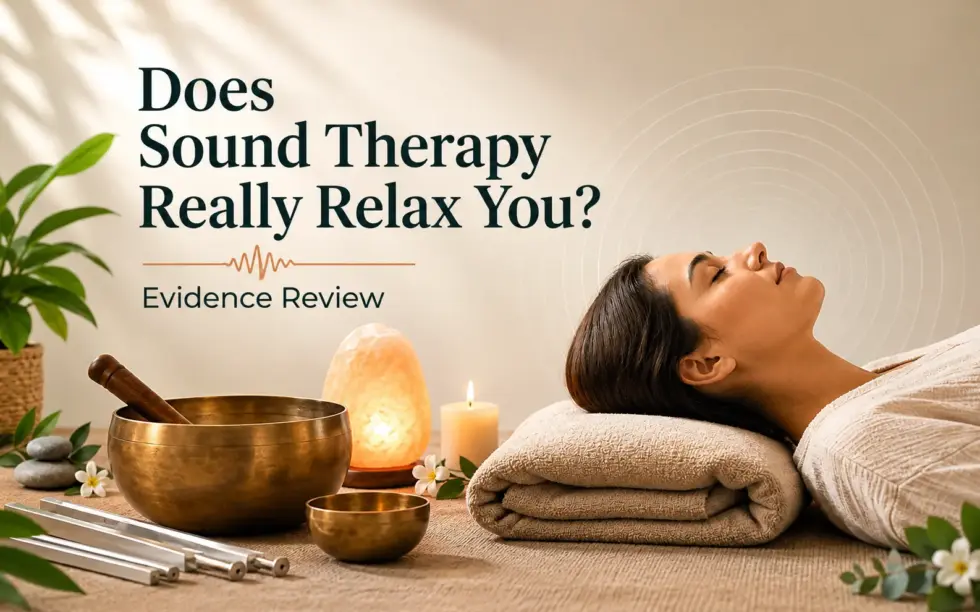
- Sound baths / sound meditation: Gongs, singing bowls, chimes. You lie down, the practitioner plays sustained tones.
- Binaural beats / brainwave entrainment: Two slightly different tones in each ear, allegedly nudging your brain into certain frequency patterns.
- White noise / pink noise: Often used for sleep or concentration.
- Tinnitus retraining and sound masking: A more medical adjacent use of sound.
When someone asks “does sound therapy relax you”, we have to say: which one?
The strongest evidence tends to be for music therapy, and structured music listening. The evidence gets thinner as you move toward claims like “this frequency repairs trauma stored in your cells”. That’s where things start floating away.
Still, people can feel relaxed from lots of these methods. Feeling relaxed is real. The question is whether the mechanism is specific and reliable.
What “relaxation” even means in studies
Researchers don’t just ask “did you feel chill” (though they do measure self report). They often look at:
- Anxiety scores (state anxiety scales, hospital anxiety scales)
- Stress markers like cortisol (saliva or blood, though results vary)
- Heart rate and blood pressure
- Heart rate variability (HRV), a rough proxy for parasympathetic nervous system activity
- Pain scores (because stress and pain are linked)
- Sleep measures (subjective sleep quality, sleep onset latency)
If sound therapy reliably shifts these markers, especially in controlled trials, that’s meaningful.
The short answer from the evidence: yes, often, but not magically
Across a lot of clinical contexts, music based interventions tend to reduce anxiety and perceived stress, and sometimes lower heart rate and blood pressure. This shows up in hospitals, pre surgery waiting rooms, dental clinics, ICU settings, cancer treatment, pregnancy, and general stress studies.
But. Big but.
- Effects are moderate, not life changing for everyone.
- The impact depends on the type of sound, the person, the setting, and whether you actually like what you’re hearing.
- A lot of benefits can come from attention, expectation, and enforced rest. Which still counts, but it changes how you should think about it.
If you want a grounded take: sound therapy is best viewed as a low risk relaxation tool with decent evidence in certain forms, especially music listening and music therapy. It is not a substitute for treating an anxiety disorder, trauma, insomnia, or depression, but it can be a helpful layer.
What the research tends to show (without pretending it’s perfect)
1. Music listening can reduce anxiety in medical settings
One of the most consistent findings is that listening to calming music before or during stressful medical procedures can reduce anxiety. This has been studied in settings like surgery prep, colonoscopy, dental work, chemotherapy.
Why it matters: these are high stress moments where anxiety is measurable and not just “I had a busy day”.
Common outcomes reported:
- lower self reported anxiety
- reduced heart rate
- slightly lower blood pressure
- sometimes reduced need for sedatives or pain meds, depending on the context
Not every study finds strong effects, and protocols vary wildly. But overall, the pattern is there often enough that many hospitals now use music interventions as part of comfort care.
2. Music therapy (with a therapist) tends to outperform passive listening for complex issues
If the goal is simple relaxation, passive listening can be enough.
But if the goal is broader, like managing chronic stress, trauma responses, depression, emotional regulation, the evidence base for music therapy is better than for random “healing sound” content.
Because it’s not just the sound. It’s the process. The relationship. The tailored approach. The way a therapist adjusts pacing, engagement, breathing, imagery, grounding.
Sound baths can be soothing. But they’re not the same thing as clinical music therapy, even if the marketing sometimes blurs it.
3. Nature sounds and ambient sound can help, but it’s context dependent
Nature sounds, rain, waves, forest ambience. Many people find them relaxing, and some research suggests they can reduce perceived stress and help with sleep onset. Often this works by:
- masking disruptive noise
- creating a predictable auditory environment
- supporting a calming mental image
But if you hate ocean sounds, you won’t relax. Simple as that.
4. Binaural beats: mixed evidence, small effects if any
Binaural beats are one of the most overpromised sound tools on the internet.
Some small studies suggest binaural beats may influence mood or anxiety in certain conditions, but the evidence is inconsistent. Effects, when present, are usually modest. Also, lots of binaural beat content includes music layered on top, which confounds the results. Is it the beats or the music?
If you enjoy binaural beats and they help you settle, great. Just don’t treat them like a neurological remote control.
5. Singing bowls and sound baths: plausible, but under researched
Sound baths and singing bowl sessions are popular, and there are some studies and observational reports suggesting reductions in tension, anger, fatigue, and anxiety right after sessions.
The issue is that many studies have limitations:
- small sample sizes
- lack of control groups
- participants self selecting because they already like the idea
- the session includes lying down, dim lighting, guided relaxation, breath cues, group setting. Lots of calming variables.
So, do sound baths relax people. Yes, often.
Do we know if the bowls themselves are doing something unique beyond inducing a meditative rest state. Not really, not conclusively.
Still, if something reliably gets you into a calm state without harming you, that has value. We just have to be honest about what we know.
Why sound can relax you (the realistic mechanisms)
Here’s what is most likely going on when sound therapy works.
It shifts your attention away from rumination
A lot of stress is mental looping. Music gives your brain something else to track.
Even simple tones can act like a cognitive anchor. It’s basically, here, hold this.
It supports breathing and pacing
Slow tempo music and sustained sounds can encourage slower breathing without you explicitly trying. Slower breathing is one of the most direct ways to nudge your body toward parasympathetic activation. The “rest and digest” side.
Not always. But often.
It modulates arousal through expectation and pattern
Predictable, gentle sound patterns can reduce startle responses. Harsh, sudden sound changes do the opposite.
This is one reason why “relaxation music” often has:
- slow tempo
- stable volume
- minimal surprise
- simple harmonic structure
It helps with noise masking and perceived safety
If your environment is unpredictable or noisy, adding consistent sound can help you feel safer. It’s a weird thing, but safety is a huge part of relaxation. Your nervous system relaxes when it decides the environment is not a threat.
White noise machines exist for a reason.
It gives you permission to stop
This is underrated and also kind of funny.
People don’t relax because they don’t allow it. A sound bath appointment or a 20 minute playlist creates a container. You did a thing. You’re allowed to be still. That permission effect is real.
And no, that doesn’t make it “fake”. Placebo is not nothing. Expectation and ritual can change physiology.
When sound therapy is most likely to help
Sound therapy tends to work best when the problem is:
- everyday stress and tension
- situational anxiety (before an appointment, while traveling)
- difficulty winding down at night
- mild to moderate sleep onset trouble
- stress related muscle tightness
- background noise sensitivity (when used as masking)
It’s also useful when you’re too wired to meditate. Because sometimes silence makes people more anxious. Sound gives you a focus point.
When it might not help, or might backfire
This part gets skipped in most blog posts, but it matters.
If you have sound sensitivity or migraines
Certain tones, frequencies, or repetitive patterns can trigger headaches or irritability. What relaxes one person can agitate another.
If you have trauma related hypervigilance
For some people, closing their eyes in a room with loud gongs is not relaxing. It’s the opposite. They might feel trapped or overwhelmed.
This doesn’t mean they’re “doing it wrong”. It means their nervous system is trying to protect them.
If you’re using it to avoid treating a bigger issue
Sound can be supportive, but it’s not going to resolve panic disorder, PTSD, severe insomnia, major depression, or chronic burnout by itself.
If sound therapy is the only tool you’re using, and you’re still barely functioning, it might be time to bring in other supports.
If the practitioner makes medical claims
Be cautious when you hear claims like:
- cures anxiety
- balances hormones
- detoxes trauma
- aligns your vagus nerve
- repairs DNA via frequencies
Relaxation is plausible. Modest stress reduction is plausible. Treating complex medical conditions via a frequency track is… not supported.
What kind of sound should you use for relaxation?
This is the practical part. Because the best evidence in the world doesn’t matter if you pick something you hate.
A decent starting framework:
Option A: music you actually like, but calmer
If you like it, your brain is more likely to settle. Personal preference is a huge variable in research outcomes too.
Try:
- acoustic
- ambient
- soft classical
- piano
- lo fi (some people find it calming, others find it distracting)
Option B: slow, steady, low surprise sound
If you want something more “neutral”, try:
- nature soundscapes
- brown noise or pink noise (many people prefer these over white noise)
- drones, soft synth pads
- singing bowl recordings at a gentle volume
Option C: guided relaxation with sound
If your mind races, use a guided body scan or breathing track with soft background audio. The voice gives structure, the sound gives comfort.
How to use sound therapy so it has a real chance of working
Here’s a simple protocol you can actually do without turning it into a project.
- Set a time container: 10 to 30 minutes. Not “until I feel better”.
- Lower the volume: Louder is not more therapeutic. Keep it comfortable.
- Pair it with a posture: lying down, feet up on a couch, or sitting with back support. Make your body believe you mean it.
- One job: breathe, listen. That’s it. If you drift, you drift.
- Do a quick before and after check: rate tension 1 to 10. Not for perfection. Just to see if it’s doing anything.
If you want to be a bit more systematic, try the same track for a week at the same time of day. Your brain learns associations. That’s part of the benefit.
What to look for if you’re paying for a session
If you’re going to a sound bath or a practitioner:
- They should explain what will happen and how loud it may get.
- You should be allowed to leave, sit up, or opt out of certain instruments.
- They should not pressure you with spiritual or medical claims.
- The space should feel physically safe and comfortable.
- Bonus if they understand trauma informed facilitation, because group relaxation spaces can be surprisingly intense for some people.
And if you leave feeling worse, headachey, or emotionally raw, that can happen. It doesn’t automatically mean it was harmful, but it’s feedback. Adjust volume, duration, and style next time.
So… does sound therapy really relax you?
Often, yes.
The best supported version is simple: listening to calming, preferred music or sound in a way that helps your body downshift. There’s decent evidence this can reduce anxiety and stress in many contexts, especially when stress is acute or situational.
Sound baths and singing bowls can absolutely feel relaxing too, and many people report real benefits. The research is just not as strong or as clean yet, partly because it’s hard to control the full experience. And because the experience itself is the intervention, not just the sound waves.
If you want the most honest conclusion, it’s this:
Sound therapy can be a reliable relaxation aid. It is not a cure. But if it gets you to unclench your jaw, slow your breathing, and feel safe in your body for 20 minutes, that’s not nothing. That’s practice. And practice adds up.
FAQs (Frequently Asked Questions)
What is sound therapy and what types does it include?
Sound therapy is an umbrella term that refers to various practices using sound to promote relaxation and mental health. Common types include clinical music therapy by trained therapists, non-clinical music listening interventions like playlists for sleep or relaxation, sound baths featuring gongs and singing bowls, binaural beats aimed at brainwave entrainment, white or pink noise for sleep or concentration, and tinnitus retraining or sound masking.
Does sound therapy really help reduce anxiety and stress?
Yes, especially in clinical settings, music-based interventions often reduce anxiety and perceived stress. Studies show moderate effects such as lower self-reported anxiety, reduced heart rate, and sometimes lower blood pressure during stressful medical procedures. However, the benefits depend on the type of sound, individual preferences, setting, and whether the listener enjoys the sounds.
How does clinical music therapy differ from other forms of sound therapy?
Clinical music therapy involves a trained therapist who uses personalized music interventions targeting goals like anxiety reduction, pain management, trauma support, and emotional regulation. It is an evidence-based healthcare profession. In contrast, other forms like passive music listening or sound baths are generally self-guided and may lack tailored therapeutic processes.
What does research say about the effectiveness of sound baths or healing frequencies?
The scientific evidence supporting claims that specific frequencies can repair trauma or have magical healing properties is limited. While many people find sound baths soothing and relaxing, these effects may stem more from enforced rest and attention rather than specific mechanisms. Sound baths are not equivalent to clinical music therapy in terms of evidence-based outcomes.
Can sound therapy replace treatment for anxiety disorders or depression?
No, sound therapy should not be considered a substitute for professional treatment of anxiety disorders, trauma, insomnia, or depression. It can serve as a helpful complementary tool for relaxation and stress reduction but does not replace evidence-based medical or psychological interventions.
What physiological markers do studies measure to assess relaxation from sound therapy?
Researchers assess relaxation through multiple markers including self-reported anxiety scores (like state anxiety scales), stress hormones such as cortisol levels in saliva or blood, heart rate and blood pressure measurements, heart rate variability (a proxy for parasympathetic nervous system activity), pain scores due to the link between stress and pain, and subjective sleep quality metrics.