
I used to think “cut sugar” meant one of two miserable options.
Option one, you live on sad salads and plain chicken and you never feel satisfied again. Option two, you do a 7 day detox, brag about it, then somehow end up eating three donuts on day eight because your brain is basically screaming.
Turns out there’s a third option. The boring one. The one that actually works.
You keep eating normal food, you just swap a few things. Not perfectly. Not forever. Just enough that your daily sugar drops without you having to white knuckle your way through the afternoon.
And before we go any further, quick clarification because this trips people up.
When most of us say “sugar,” we mean added sugar. The stuff that gets dumped into cereal, bread, coffee drinks, sauces, and snacks. Not the sugar that naturally exists in fruit, plain yogurt, or milk. Those foods come with water, fiber, protein, micronutrients. Added sugar is basically the opposite, calories that don’t help you stay full.
So the goal is simple.
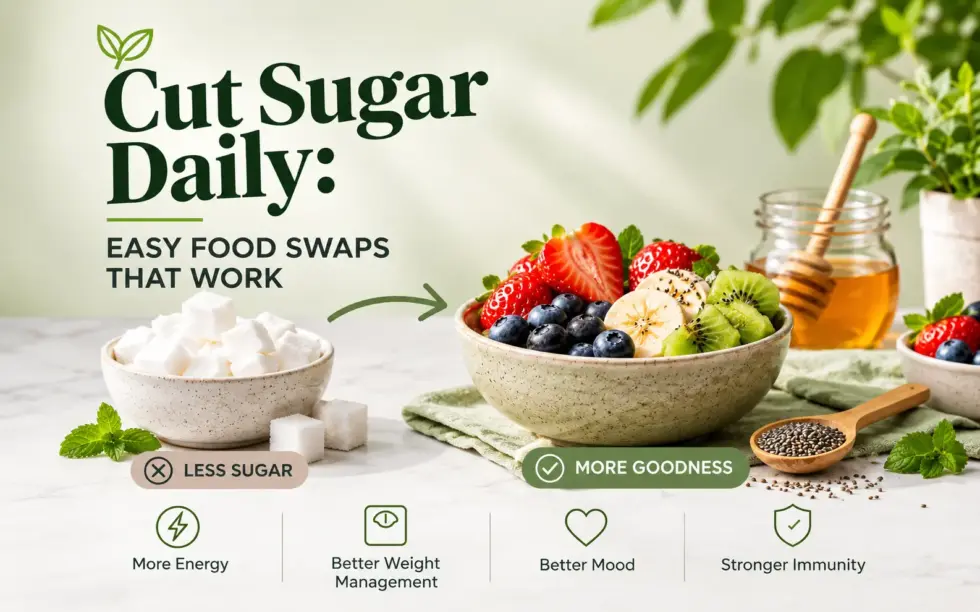
Cut added sugar daily by using easy swaps you can repeat on autopilot.
Why cutting sugar daily feels hard (even when you “don’t eat sweets”)
A lot of people don’t even eat candy. They don’t consider themselves a dessert person. Yet they still feel like they’re stuck in the cycle.
Energy dip after lunch. Cravings at 3 pm. “I need something” at night.
Because sugar is hiding in places you do not emotionally register as sugar.
Bread. Pasta sauce. Granola. Yogurt. Protein bars. Salad dressing. “Healthy” smoothies. Coffee creamers. Even some deli meats.
And it’s not just the sugar, it’s the combo.
Added sugar plus refined starch plus low fiber equals you get hungry again way too fast. Then you chase that quick hit again. Not because you’re weak. Because your body is doing what bodies do.
So let’s make this practical.
Below are the swaps that make the biggest difference for most people, without asking you to live like a monk.
Start with the easiest win: drinks
If you change nothing else but what you drink, you can cut a shocking amount of sugar with almost zero effort.
Swap 1: Soda to sparkling water (with a crutch flavor at first)
Instead of: regular soda, sweet tea, lemonade
Try: sparkling water, flavored seltzer, or club soda with citrus
If you’re used to sweetness, plain sparkling water can taste like punishment. That’s fine. Use training wheels.
Add lime. Add a splash of 100 percent juice. Use flavored seltzer. You can taper later.
A “small” soda habit can easily be 30 to 60 grams of added sugar per day. That’s a whole day’s worth for many people, gone.
Swap 2: Coffee dessert drinks to “real coffee plus something”
Instead of: flavored latte, bottled frappes, sweetened cold brew cans
Try: coffee with milk or half and half, cinnamon, vanilla extract, or unsweetened syrup
This is where sugar gets sneaky because it feels like a drink, but it hits like dessert.
If you love sweet coffee, don’t do the jump to black coffee if you hate it. Do this:
- Order the smaller size.
- Ask for half the syrup.
- Choose an unsweetened base and add your own sweetener if needed so you control the dose.
- Or switch to a cappuccino or latte with milk and cinnamon. Milk has natural sugar, yes. But it’s not the same as pumping flavored syrup into it.
Swap 3: Fruit juice to whole fruit (or “diluted juice” if you’re not ready)
Instead of: juice, even “no sugar added” juice
Try: whole fruit, or half juice and half water/sparkling water
Juice skips the fiber. It’s easy to drink the sugar of three oranges in thirty seconds. Whole fruit is slower, more filling, and your blood sugar response is typically gentler because fiber matters.
If juice is your ritual, cut it with water first. Still tastes like juice. Half the sugar.
Breakfast swaps (the ones that stop the 10 am crash)
Breakfast is where a lot of people accidentally start the day with dessert. Not because they’re doing something wrong. Because breakfast food marketing is basically one long sugar festival.
Swap 4: Sweet cereal to higher protein cereal or oats
Instead of: sweetened cereal, granola clusters
Try: unsweetened oats, plain shredded wheat, or a higher protein lower sugar cereal
If you love cereal, keep cereal. Just change the type and how you build it.
- Pick a cereal with low added sugar and higher fiber.
- Add berries or banana slices for sweetness.
- Add nuts or seeds for fat and crunch.
- Use milk or unsweetened soy milk for protein.
Oats are another easy one. Plain oats taste like nothing, which is kind of the point because you can make them taste like whatever you want.
Cinnamon, frozen berries, a spoon of peanut butter. Suddenly it’s good. And it doesn’t send you into snack mode an hour later.
Swap 5: Flavored yogurt to plain Greek yogurt with mix ins
Instead of: flavored yogurt cups
Try: plain Greek yogurt, then add fruit and a tiny drizzle of honey if you need it
Flavored yogurt often has dessert level sugar. Plain Greek yogurt has protein, which helps you stay full, and it’s a perfect base.
Add:
- berries
- chopped apple and cinnamon
- a spoon of chia seeds
- a small handful of granola (not half the bag)
If plain yogurt tastes too tangy, do half plain and half flavored for a week. Then shift the ratio.
Swap 6: Pastry breakfast to “savory plus fruit”
Instead of: muffin, donut, toaster pastries
Try: eggs, cheese, avocado toast, or a breakfast sandwich plus fruit
This is not about banning pastries. It’s about not making them your default fuel.
A savory breakfast with protein and fat steadies you. Add fruit on the side and you still get sweetness, but with fiber and volume.
If you want a muffin, have it after you eat something with protein. It changes the whole experience. You’ll likely eat less of it and not crave another snack immediately.
Snack swaps (where most daily sugar hides)
Snacks are usually where “I don’t eat sugar” turns into “oh… I do.”
Because snack food is engineered to be easy to overeat and hard to stop.
Swap 7: Candy or gummies to fruit plus something salty
Instead of: candy, gummies, fruit snacks
Try: an apple plus peanut butter, grapes plus cheese, berries plus nuts
This is the simplest trick I know.
If you want something sweet, pair it with protein or fat. You still get the sweet taste, but you don’t get that empty free fall afterward.
Swap 8: Granola bars to nuts, jerky, or a lower sugar bar
Instead of: chewy granola bars, “breakfast bars”
Try: almonds, pistachios, beef jerky, boiled eggs, or a genuinely lower sugar bar
A lot of bars are basically cookies wearing gym clothes.
If you need convenience, look for bars that are:
- higher protein (as a general rule)
- low in added sugar
- not mostly syrup holding oats together
Or skip bars and do the unsexy snacks.
Nuts. Cheese sticks. Hard boiled eggs. Tuna packet. Not thrilling. But effective.
Swap 9: Ice cream at night to yogurt bowl, frozen fruit, or “smaller real dessert”
Nighttime sugar is often emotional. Or it’s habit. Or you’re just underfed during the day and your body is making up for it.
You’ve got options that don’t feel like punishment:
- Greek yogurt with cocoa powder and berries
- frozen berries with a splash of milk
- banana slices frozen, blended into “nice cream”
- a smaller portion of the real dessert, plated, eaten slowly
Sometimes the swap is not “healthy dessert.” It’s “less dessert, but on purpose.”
That alone is huge.
Lunch and dinner swaps (the stealth sugar zone)
Main meals don’t always taste sweet, but they can still carry a lot of added sugar, especially in sauces and packaged meals.
Swap 10: Bottled salad dressing to olive oil and vinegar (or a lower sugar dressing)
Instead of: sweet dressings like honey mustard, many “fat free” dressings
Try: olive oil plus vinegar, lemon juice, mustard, salt and pepper
“Fat free” dressings often replace fat with sugar. Which is… a choice.
A basic dressing takes 30 seconds and tastes better:
- 2 to 3 parts olive oil
- 1 part vinegar or lemon juice
- mustard
- salt and pepper
Or buy a dressing with low added sugar. Just check the label.
Swap 11: Pasta sauce and ketchup overload to lower sugar versions (or less)
Instead of: sugary pasta sauce, lots of ketchup, sweet BBQ sauce
Try: no sugar added sauce, crushed tomatoes, mustard, hot sauce, salsa
You don’t have to eliminate condiments. Just pick smarter defaults.
Ketchup and BBQ sauce are classic sugar bombs. If you use them daily, it adds up fast.
Try:
- mustard
- salsa
- vinegar based hot sauce
- sugar free or low sugar ketchup
- tomato sauce with herbs and olive oil
Same food. Different sugar total.
Swap 12: “Teriyaki everything” to savory marinades you control
Instead of: bottled teriyaki, sweet stir fry sauces
Try: soy sauce, garlic, ginger, sesame oil, rice vinegar, chili flakes
Asian style sauces are delicious, but many bottled versions are basically sugar plus sodium.
Make a quick stir fry sauce:
- soy sauce or tamari
- garlic and ginger
- rice vinegar or lime
- a little sesame oil
- chili paste
If you want a touch of sweetness, add a small amount of honey or maple syrup yourself. You’ll end up using way less than the bottled stuff.
Swap 13: White bread to “bread with a point”
Instead of: white bread, sweet sandwich bread
Try: whole grain bread, sourdough, or lower sugar bread
Bread can have added sugar, and some “wheat” bread is basically white bread in disguise.
Look for:
- higher fiber
- lower added sugar
- shorter ingredient list
You don’t have to go full keto. Just stop eating bread that tastes like cake.
And yeah, some bread does.
The “healthy food” traps (the ones that get you)
These are the foods that sound like they should be fine. But if you eat them daily, they quietly keep your added sugar high.
Trap 1: Smoothies that are basically liquid sugar
Smoothies can be great. Or they can be a milkshake with a wellness label.
Common smoothie sugar stack:
- fruit juice base
- multiple bananas
- sweetened yogurt
- honey
- granola topping
You end up with a calorie dense, low chew drink that doesn’t fill you up.
Swap to: build smoothies with protein and fiber
Try:
- unsweetened milk or water as base
- one serving of fruit
- a protein source (Greek yogurt, protein powder, tofu)
- add fiber (chia, flax, spinach, oats)
Still tastes good. Just less of a sugar hit.
Trap 2: Flavored oatmeal packets
Those little packets can have added sugar that you would never put into your own bowl.
Swap to: plain oats plus your own flavor
Cinnamon. Frozen berries. A pinch of salt. A spoon of nut butter. You get the idea.
Trap 3: Açaí bowls and “healthy dessert bowls”
Açaí bowls are delicious. Also often loaded with honey, granola, chocolate drizzle, plus a sweet base.
Swap to: make it smaller, reduce toppings, add protein
Or treat it like dessert. Not breakfast you eat every day.
A simple daily swap plan (so you don’t overthink it)
If you want this to actually stick, do not try to fix your entire diet on Monday.
Pick one swap per meal category. Let it get boring. Boring is good. Boring is automatic.
Here’s a sample plan that works for a lot of people.
Week 1: Drinks first
- Replace one sugary drink per day with sparkling water or unsweetened tea.
- Keep everything else the same.
Week 2: Breakfast default
- Choose one lower sugar breakfast you can repeat 4 to 5 days a week.
- Example: eggs plus fruit, or Greek yogurt bowl, or oats.
Week 3: Snack upgrade
- Swap one snack you eat most days.
- Example: bar to nuts, candy to fruit plus cheese.
Week 4: Sauces and condiments
- Pick two condiments and swap them.
- Example: low sugar ketchup, olive oil and vinegar dressing.
By the end of a month you have a totally different sugar intake, but you didn’t “diet.” You just redesigned your defaults.
What to do when cravings hit anyway (because they will)
Even with perfect swaps, cravings can still show up. Especially the first week or two.
A few things help, and none of them require willpower speeches.
1) Eat enough at meals
Most sugar cravings are louder when you’re underfed. If your lunch is tiny, your body is going to demand quick energy later. Sugar is the fastest negotiation tactic it has.
Add protein. Add fiber. Add a real portion.
2) Don’t keep trigger foods in the house for “balance”
Some people can. Some people can’t.
If you know you will eat the whole box of cookies once it’s open, stop trying to prove a point. Make your environment support you. Buy a single serving when you want it, eat it, move on.
3) Use the “delay and pair” trick
If you want something sweet, delay 10 minutes, drink water, then have it paired with something.
Chocolate? Have it after dinner, not as a standalone snack at 4 pm. Or pair it with nuts. It changes the blood sugar swing.
4) Sleep, honestly
Bad sleep makes sugar cravings worse. This is not motivational, it’s biology. If your sleep is off, your hunger and satiety hormones get weird, and your brain wants quick energy.
Sometimes “cut sugar” starts with bedtime.
How to read labels without losing your mind
You don’t have to become a label detective, but a couple of checks save you from the biggest traps.
Check 1: Added sugars line
In many places, labels list Added Sugars. That is the number that matters most for this goal.
If you see 10 to 20 grams added sugar in something you eat daily, that’s a big lever.
Check 2: Serving size games
A cereal might say 6 grams added sugar, but the serving size is basically air. If you eat double, you’re at 12. This is common.
Check 3: Sneaky sugar names
Sugar shows up as:
- cane sugar
- corn syrup, high fructose corn syrup
- rice syrup
- dextrose
- maltose
- “nectar”
- fruit concentrate (in some contexts)
If you see multiple forms of sugar in the ingredients list, it usually means they split it up so it doesn’t look like “sugar” is the first ingredient. Fun.
But what about fruit, honey, and “natural” sugars?
This is where people spiral.
Here’s the practical version.
- Fruit is generally fine for most people. It comes with fiber and water. It’s hard to binge apples the way you can binge cookies.
- Honey, maple syrup, coconut sugar, agave are still added sugars. They can be part of your diet, but they count.
- Dried fruit is easy to overeat. It’s not evil. It’s just concentrated. Treat it like candy that happens to have minerals.
- Juice is the one that fools people most. It’s not “bad,” it’s just not filling. If you drink it daily, it can keep your sugar high without you feeling like you’re doing anything sweet.
If you want a simple rule: chew your sweetness more often than you drink it.
Easy swaps list you can screenshot (mentally, at least)
Here are the biggest daily sugar cutters in one place.
Drinks
- Soda -> flavored seltzer
- Sweet coffee drinks -> coffee with milk, cinnamon, less syrup
- Juice -> whole fruit or diluted juice
- Sports drinks -> water with electrolytes (low sugar) if needed
Breakfast
- Sweet cereal -> higher fiber cereal or oats
- Flavored yogurt -> plain Greek yogurt plus fruit
- Pastries -> savory breakfast plus fruit
Snacks
- Candy -> fruit plus nuts or cheese
- Granola bars -> nuts, eggs, jerky, lower sugar bars
- Ice cream nightly -> yogurt bowl or smaller portion, less often
Meals
- Sweet dressings -> olive oil and vinegar
- Sugary sauces -> soy, vinegar, herbs, spices, low sugar versions
- Sweet bread -> lower sugar higher fiber bread
What results to expect (and when)
People ask this a lot because they want reassurance they’re not suffering for nothing.
What you might notice first, often within 7 to 14 days:
- fewer intense cravings
- more stable energy in the afternoon
- less “snack panic”
- less bloating for some people
- easier time stopping at one serving of sweet stuff
Weight loss can happen, but it’s not guaranteed instantly because your body is not a calculator and life is messy. The bigger win is control. Once cravings calm down, everything else gets easier.
Also, and this matters, if you cut sugar and replace it with nothing, you can end up eating less overall and feeling awful. Headaches, low energy, irritability.
So make sure you are replacing sugar calories with actual food. Protein, fiber, healthy fats. Real meals.
The mindset that makes this stick
This is the part I wish someone told me earlier.
Cutting sugar daily is not a purity challenge.
You are not trying to win by never eating cake again. You are trying to lower your baseline. Your default day. The regular Tuesday.
If 80 percent of your days are lower sugar and steady, then the birthday cake is just birthday cake. Not a relapse. Not a spiral. Just cake.
So pick swaps you can repeat. Ones you like enough. Ones that don’t make you feel like you’re being punished.
Because if the plan feels like punishment, your brain will eventually rebel. Every time.
A realistic “day of eating” with lower sugar (no weird food)
Just to show what this can look like without becoming a diet personality.
Breakfast: Greek yogurt, berries, chia seeds, a few crushed walnuts
Coffee: latte with milk, cinnamon, no flavored syrup
Lunch: turkey sandwich on whole grain bread, side salad with olive oil and vinegar
Snack: apple with peanut butter
Dinner: stir fry with chicken, vegetables, rice, quick soy garlic ginger sauce
Dessert (optional): a couple squares of dark chocolate or a small bowl of berries
Nothing fancy. No detox tea. No sadness.
Just a day where added sugar is naturally lower because you removed the biggest sources.
Let’s wrap this up
If you want to cut sugar daily, don’t start by hunting for the perfect sugar free life.
Start with the obvious swaps that don’t feel like a sacrifice.
Change what you drink. Fix breakfast. Upgrade snacks. Then clean up sauces and condiments. That sequence works because it doesn’t rely on willpower all day long.
And when you mess up, which you will, you just go back to your defaults the next meal. No drama.
That’s the whole game, honestly.
FAQs (Frequently Asked Questions)
What does ‘cutting sugar’ really mean and why is it not about extreme diets?
Cutting sugar means reducing your daily intake of added sugars by making simple swaps in your diet, not living on sad salads or doing short detoxes. It’s about replacing high-sugar items with healthier alternatives without feeling deprived or having to be perfect forever.
What is the difference between added sugar and natural sugar?
Added sugar is sugar that manufacturers put into foods like cereal, bread, coffee drinks, sauces, and snacks. Natural sugar occurs naturally in foods like fruit, plain yogurt, and milk, which also provide beneficial nutrients such as fiber, protein, and micronutrients.
Why do I still experience energy dips and cravings even if I don’t eat sweets?
Sugar often hides in everyday foods like bread, pasta sauce, granola, yogurt, protein bars, salad dressings, and coffee creamers. Combined with refined starches and low fiber content, these can cause rapid hunger and cravings because your body quickly burns through these calories.
What are easy drink swaps to reduce added sugar intake?
Swap soda, sweet tea, or lemonade for sparkling water with a splash of citrus or flavored seltzer. Replace sugary coffee drinks with real coffee plus milk or half-and-half and natural flavorings like cinnamon or vanilla extract. Also, swap fruit juice for whole fruit or dilute juice with water to cut sugar while maintaining flavor.
How can I make my breakfast lower in added sugar but still satisfying?
Choose unsweetened oats or low-added-sugar cereals with higher fiber instead of sweetened cereals or granola clusters. Add natural sweetness like berries or banana slices and include nuts or seeds for healthy fats and crunch. Use milk or unsweetened soy milk for protein to keep you full longer.
What is a good alternative to flavored yogurt to reduce added sugar at breakfast?
Switch from flavored yogurts to plain Greek yogurt and add your own mix-ins like fresh fruit or a sprinkle of cinnamon. This way you control the amount of added sugar while still enjoying a tasty and protein-rich breakfast option.