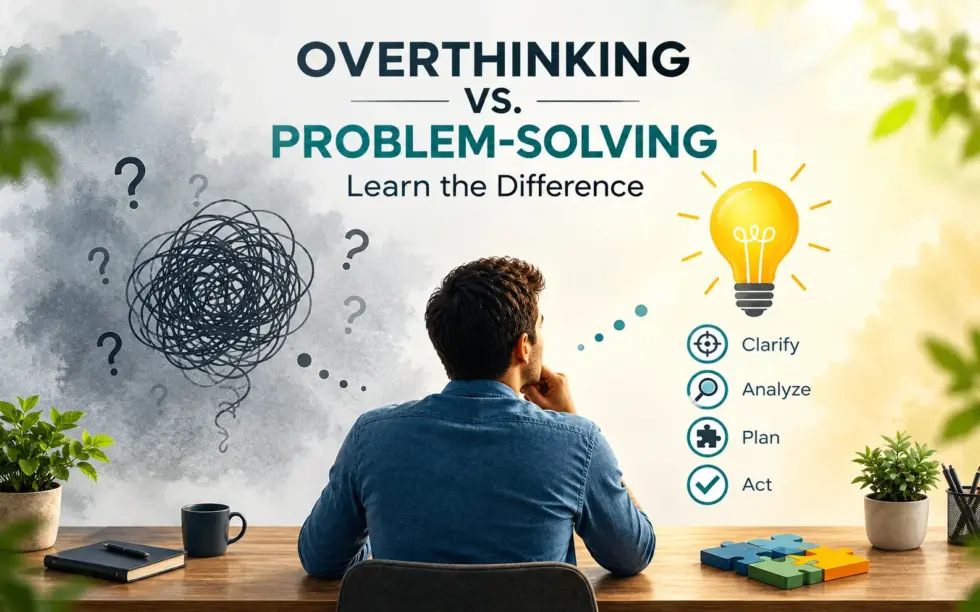

I used to tell myself I was just being “thorough”.
Double checking. Running scenarios. Thinking things through. Being responsible.
But if I’m honest, a lot of it was just me spiraling in my own head. Same thoughts. Same worries. Same mental loops. And somehow, after all that “thinking”, I’d feel more stuck, not more clear.
That’s the weird part. Overthinking feels like work. It feels productive. It can even feel like problem-solving.
But it’s not the same thing.
Problem-solving tends to move you forward. Overthinking tends to keep you in place, while draining you like you ran a marathon.
So this is what we’re doing here. We’re going to separate the two. Cleanly. In plain language. With examples that actually match real life.
Because once you can tell the difference, it gets easier to stop burning hours on mental noise and start making decisions that help.
The simple definition (that actually holds up)
Let’s make it almost annoyingly simple.
Problem-solving is thinking that leads to action.
Overthinking is thinking that replaces action.
Problem-solving looks like:
- Clarifying what the problem is
- Collecting the minimum useful information
- Considering a few realistic options
- Choosing one
- Testing it
- Adjusting as you learn
Overthinking looks like:
- Replaying the same info you already have
- Asking “what if” questions with no endpoint
- Trying to eliminate all risk and uncertainty
- Imagining every possible outcome
- Getting emotionally exhausted, then doing nothing
And sometimes you do take action after overthinking, sure. But usually it’s delayed action. Forced action. Panic action. The kind where you pick something just to stop the mental pain.
Problem-solving tends to feel… grounded. Even if the problem is stressful.
Overthinking tends to feel like being mentally trapped in a room with your own anxious narrator.
Why overthinking feels so convincing
Overthinking is sneaky because it borrows the language of problem-solving.
It says things like:
- “I just need to be sure.”
- “I’m trying to make the right decision.”
- “Let me think about it one more time.”
- “I don’t want to mess this up.”
- “If I can predict what happens, I’ll be safe.”
Underneath all that is usually one thing:
Overthinking is an attempt to control uncertainty.
But uncertainty is part of life. It’s part of every decision that matters. Jobs, relationships, money, health, moving cities, starting something new. None of that comes with guarantees.
So overthinking becomes a coping mechanism. A way to feel like you’re doing something, when what you’re really doing is trying to get relief from not knowing.
And here’s the kicker.
Problem-solving accepts uncertainty and moves anyway.
Overthinking demands certainty before moving.
That’s the split.
What’s really driving your overthinking
Most overthinking isn’t about the problem. It’s about what the problem means.
You’re not just thinking about the presentation. You’re thinking:
- “If I mess up, they’ll see I’m not good enough.”
You’re not just thinking about texting someone back. You’re thinking:
- “If I say the wrong thing, I’ll look stupid or needy.”
You’re not just thinking about whether to quit your job. You’re thinking:
- “If I choose wrong, I’ll ruin my life.”
So the mind goes into this intense scanning mode, trying to prevent shame, rejection, regret, or failure.
A lot of overthinking is fear management.
Not solution finding.
And that’s why you can spend three hours thinking and still not feel any closer to an answer. Because you weren’t actually answering a practical question. You were trying to eliminate emotional risk.
The clearest signs you are overthinking (not problem-solving)
Here are some dead giveaways. If you see yourself in these, it’s not a moral failure. It’s just a pattern.
1. You keep returning to the same conclusion, but you don’t act
You “know” what you should do. Or at least you know the next step.
But you keep revisiting it like the answer will change if you stare at it longer.
That’s overthinking.
2. You’re researching to avoid deciding
Research is useful. Research is smart.
But there’s a point where research turns into a hiding place.
If you’re on tab 37, reading the same opinions from different strangers, hoping someone will give you permission to choose, you’re not problem-solving anymore.
3. You’re trying to pick the option with zero downsides
Problem-solving is choosing the best tradeoff.
Overthinking is trying to find the option that has no risk, no discomfort, no awkward conversations, no chance of regret.
That option usually doesn’t exist. So you stay stuck.
4. You feel worse the longer you “think”
Problem-solving can be tiring, yes. But it usually creates some clarity, some forward motion.
Overthinking tends to create more tension, more confusion, more urgency.
It makes your brain loud.
5. You’re focusing on imagined scenarios more than reality
This is a big one.
If most of your mental energy goes into what might happen, what people might think, how you might feel, you’re probably not dealing with the real variables anymore.
You’re dealing with fear projections.
What problem-solving actually looks like (in real life)
Problem-solving is often boring. It’s not dramatic. It doesn’t have to be perfect. It’s basically:
- What’s happening?
- What do I want to change?
- What’s within my control?
- What’s the next small step?
- How will I know if it worked?
That’s it.
It’s structured, but not rigid. It’s meant to reduce confusion and force movement.
Overthinking is unstructured movement in your mind. Like pacing in circles.
Problem-solving is a path. Even if it’s a rough one.
A quick example: “Should I switch careers?”
Let’s use a classic situation that triggers spirals.
Overthinking version
You think:
- What if I hate the new field?
- What if I’m too old to start over?
- What if I take a pay cut and can’t recover?
- What if I disappoint my parents?
- What if I’m not talented enough?
- What if AI replaces the job I choose?
- What if I move and regret it?
- What if I stay and regret it?
- What if I’m just being dramatic?
You keep running mental simulations. You talk to five people. You watch career videos. You make lists. You sleep badly. You don’t decide.
Months go by.
Problem-solving version
You work through it step by step:
- Problem: I’m unhappy in my current role and I don’t see growth here.
- Goal: Find a path that fits my strengths and pays at least X within Y months.
- Constraints: I can’t quit instantly. I have bills. I have 10 hours a week to explore.
- Options (pick 3): UX, data analytics, project management.
- Review: In 30 days, assess interest, energy, and feasibility.
Next steps — small and testable
- Talk to 2 people in each field
- Take one beginner course
- Do one small project
- Apply to 5 low-stakes roles as practice
Notice the difference?
The problem-solving version doesn’t try to guarantee a perfect future. It tries to create data. Real-world feedback.
Overthinking wants certainty without experiments.
Problem-solving gets certainty through experiments.
The hidden difference: overthinking is inward, problem-solving is outward
This might be the most helpful frame of all.
Overthinking stays in your head.
Problem-solving touches reality.
Overthinking:
- rehearses conversations
- imagines outcomes
- tries to predict emotions
- replays the past
- argues with itself
Problem-solving:
- asks a person
- writes the email
- tries the small version
- gets the feedback
- adjusts
If you want a quick self check, ask:
Have I done anything in the real world yet, or am I still thinking?
You don’t have to jump off a cliff. But you do need some contact with reality. Otherwise your brain is just guessing and scaring itself with its own guesses.
Why “just stop overthinking” never works
People love saying that. As if you can just flick a switch.
Most overthinking is your nervous system trying to protect you. It’s trying to avoid:
- embarrassment
- rejection
- loss
- discomfort
- uncertainty
- feeling out of control
So if you try to force stop it without replacing it with something else, your brain panics. It’s like taking away a coping tool.
What works better is this:
Replace overthinking with a process.
Not a vibe. Not “positive thinking”. A process.
Something your brain can do instead.
That’s where problem-solving frameworks help.
A practical framework: the 10 minute clarity reset
This is what I use when I catch myself looping. It’s simple, but it interrupts the spiral.
Set a timer for 10 minutes and write answers to these questions.
- What is the actual problem, in one sentence?
- Not the story. Not the fear. The problem.
- What part of this is in my control?
- Be honest. If the answer is “not much”, okay. Still list what you can control.
- What is one next step that takes less than 20 minutes?
- One email. One call. One tiny draft. One calendar invite.
- What is the worst realistic outcome if I do that step?
- Not apocalyptic. Realistic.
- If that worst outcome happens, what would I do next?
- This is how you take your brain’s favorite weapon, fear, and disarm it.
When you finish, do the next step immediately if you can.
That last part matters. Otherwise you’ll turn the framework into another overthinking ritual. Which happens. Easily.
Another framework: decision making when you can’t know for sure
Some decisions are genuinely uncertain. You can’t research your way to a guarantee. So you need a different approach.
Try this.
1. Pick the decision deadline
If you give yourself infinite time, your brain will take it.
Pick a date. Even if it’s self-imposed.
2. Define what “good enough” means
Not perfect. Good enough.
Example: “If this job pays at least X, has decent management, and teaches me Y, it’s good enough.”
3. Limit options to three
Overthinking loves infinite options. It feeds on them.
Three options forces prioritization.
4. Choose based on values, not fear
Ask: “Which option matches the person I’m trying to become?”
That question tends to cut through mental noise.
5. Make it reversible when possible
A lot of decisions are not permanent. But we treat them like they are.
You can often design a smaller commitment:
- test the relationship by having a hard conversation
- test the business idea with a weekend project
- test the move with a sublet
- test the new role by contracting first
Overthinking makes everything feel final. Problem-solving looks for a pilot version.
The “replay loop” and how to break it
One of the most common forms of overthinking is replaying something you said or did.
You cringe. You analyze. You rewrite the scene. You imagine how you should have acted. You try to figure out what it means about you.
A few things that help, practically.
Name the loop
Literally say: “I’m replaying.”
It creates distance.
Ask: “Is there any new information here?”
Usually the answer is no. It’s just self punishment disguised as reflection.
If there’s something to learn, extract the lesson once
Write one sentence:
- “Next time, I’ll pause before responding.”
- “Next time, I won’t over explain.”
- “Next time, I’ll ask a clarifying question.”
Then stop. You got the lesson. The rest is rumination.
Do something physical, quickly
Walk. Stretch. Wash dishes. Anything that shifts you out of the mental trance.
Overthinking is often a stuck body as much as a stuck mind.
Overthinking vs. problem-solving in relationships
Relationships are overthinking fuel because people are unpredictable. You can’t control how someone feels. You can’t guarantee they’ll choose you. You can’t force clarity.
So people try to “think” their way into safety.
Examples.
Overthinking in relationships
- Reading tone into texts.
- Checking timestamps, response times, punctuation.
- Rewriting messages five times.
- Imagining what they’re thinking.
- Avoiding direct questions because the answer might hurt.
Problem-solving in relationships
- Saying: “Hey, I noticed we’ve been talking less. Are we okay?”
- Asking for what you want clearly.
- Setting a boundary when something feels off.
- Looking at patterns, not moments.
- Deciding based on behavior, not potential.
Overthinking tries to decode. Problem-solving communicates.
And yes, direct communication can feel terrifying. But it’s reality based. It gives you data.
Most spirals die the moment you ask the straightforward question you’ve been avoiding.
Overthinking vs. problem-solving at work
Work overthinking is usually about perceived threat.
Looking incompetent. Getting fired. Being judged. Missing an opportunity.
Overthinking at work looks like
- Polishing a doc forever.
- Avoiding sending the email because it’s “not ready”.
- Rechecking simple tasks repeatedly.
- Reading between the lines of a manager’s message.
- Waiting for motivation or confidence before starting.
Problem-solving at work looks like
- Clarifying the goal of the task.
- Getting quick feedback early.
- Shipping a version 1.
- Documenting assumptions.
- Asking: “What’s the smallest deliverable that works?”
This is a big mindset shift: most work rewards iteration, not perfection.
Overthinking wants the perfect output on the first try.
Problem-solvers move in drafts.
The confidence myth that keeps people stuck
A lot of people overthink because they believe:
“I’ll act when I feel confident.”
But confidence is often a result, not a prerequisite.
Problem-solving builds confidence because you gather proof. You do things. You survive outcomes. You adjust.
Overthinking delays proof. So confidence never arrives.
If you’re waiting to feel ready, you might be waiting forever.
A better rule:
Act at 60 percent clarity. Learn the remaining 40 percent on the way.
That’s how most capable people operate, even if they don’t admit it.
When overthinking is actually useful (rare, but real)
Not all deep thinking is bad. Sometimes you do need to slow down and reflect.
Overthinking becomes harmful when it’s repetitive, unproductive, and anxiety driven.
But thoughtful thinking can be useful when:
- you’re reviewing a meaningful mistake once, to learn
- you’re planning something complex with real constraints
- you’re considering ethical implications
- you’re preparing for a tough conversation and you actually intend to have it
- you’re doing strategy work with a clear output and deadline
The difference is still the same.
Useful thinking creates a decision, a plan, or an action.
If the thinking doesn’t cash out into something real, it’s probably just mental churn.
The “action bias” trick: move first, think second
This is a little messy, but it works.
When you feel stuck, take a tiny action before your brain agrees.
Examples:
- Open the doc and write the bad first paragraph.
- Send the short version of the text.
- Book the appointment.
- Put the shoes on and step outside.
- Create the folder, name the project, start the outline.
Motion creates clarity.
And weirdly, action often lowers anxiety more than thinking does. Because your brain stops treating the problem as hypothetical doom and starts treating it like a task.
A quick self test: overthinking or problem-solving?
If you want a fast diagnostic, answer these honestly.
- Do I have a written next step?
- If not, you might be looping.
- Have I set a decision deadline?
- If not, overthinking has room to expand.
- Am I trying to reduce uncertainty, or make progress?
- Be real. Which one is it.
- Have I talked to the person involved, or am I guessing?
- Guessing is a spiral generator.
- What would “version 1” look like here?
- If you can’t tolerate version 1, you’ll likely overthink.
How to shift from overthinking into problem-solving (a simple plan)
If you want something you can actually follow, try this three step shift.
Step 1: Capture the thoughts, don’t wrestle them
Open notes. Write the messy fears. All of them.
Not to indulge them. Just to get them out of your head and onto a page.
Your brain calms down when it feels “heard”.
Step 2: Convert fears into questions you can answer
Fear: “What if I fail and everyone judges me?”
Question: “What is the smallest way to test this with low stakes?”
Fear: “What if I choose wrong?”
Question: “What would choosing ‘wrong’ actually cost me, and can I recover?”
Fear: “What if they leave?”
Question: “What conversation have I been avoiding that would give me clarity?”
Questions are solvable. Vague fear is endless.
Step 3: Pick one action and schedule it
Not “I’ll do it later”.
Put it on a calendar. Or do it now, if it takes under 10 minutes.
Overthinking thrives in the unscheduled space.
Let’s wrap this up (without pretending it’s easy)
Overthinking and problem-solving can look similar at first glance. Both involve thinking hard. Both can feel intense.
But they’re not the same.
Problem-solving is structured and reality based. It moves you toward a next step. It accepts uncertainty and works with it.
Overthinking is circular. It tries to eliminate uncertainty before you move. It often disguises fear as analysis. It keeps you busy, but stuck.
If you take one thing from this, let it be this:
If your thinking is not producing a next action, it’s probably not problem-solving.
Start small. A 10 minute clarity reset. A tiny experiment. One direct question. One draft.
Not because you’ll suddenly become a person who never overthinks.
But because you can become the kind of person who notices the loop faster. And steps out of it sooner.
That changes everything, quietly. Over time.
FAQs (Frequently Asked Questions)
What is the difference between problem-solving and overthinking?
Problem-solving is thinking that leads to action, involving clarifying the problem, collecting minimum useful information, considering realistic options, choosing one, testing it, and adjusting as you learn. Overthinking is thinking that replaces action, characterized by replaying the same info, asking endless ‘what if’ questions, trying to eliminate all risk, imagining every possible outcome, and getting emotionally exhausted without moving forward.
Why does overthinking feel like productive work even though it isn’t?
Overthinking feels productive because it borrows the language of problem-solving—phrases like ‘I just need to be sure’ or ‘Let me think about it one more time.’ It gives a sense of control over uncertainty by trying to predict outcomes and avoid mistakes. However, unlike problem-solving which moves you forward despite uncertainty, overthinking keeps you stuck and mentally drained without leading to effective action.
What drives people to overthink instead of solve problems?
Most overthinking isn’t about solving the practical problem but about managing fear and emotional risk. People worry about what the problem means—fear of failure, shame, rejection, or regret—which triggers intense scanning for ways to prevent these feelings. This fear management leads to mental loops that don’t produce solutions but instead keep individuals stuck in anxiety.
What are common signs that indicate you are overthinking rather than problem-solving?
Signs include repeatedly returning to the same conclusion without acting; excessive researching used as avoidance; trying to find options with zero downsides (which rarely exist); feeling worse or more anxious the longer you think; and focusing more on imagined scenarios than on reality. Recognizing these patterns can help differentiate overthinking from productive problem-solving.
How does overthinking affect decision-making and action?
Overthinking tends to delay decisions and actions. Even when action occurs after overthinking, it’s often forced or panic-driven just to stop mental distress. It demands certainty before moving forward—a certainty that’s impossible in most meaningful decisions—thus keeping people stuck rather than progressing through thoughtful choices.
How can understanding the difference between overthinking and problem-solving help improve decision-making?
By clearly distinguishing between thinking that leads to actionable steps (problem-solving) and thinking that replaces action (overthinking), individuals can stop wasting time in mental loops. Accepting uncertainty as part of life allows for making decisions with imperfect information and moving forward confidently, reducing anxiety and increasing productivity in personal and professional contexts.



Genius isn’t just about IQ — it’s about how intentionally we use our minds. When we learn to think more clearly and tap both logic and creativity, everything in life becomes easier. If you want to increase creativity, intelligence, and whole‑brain performance, visit https://voti1.com/Genius-Switch.