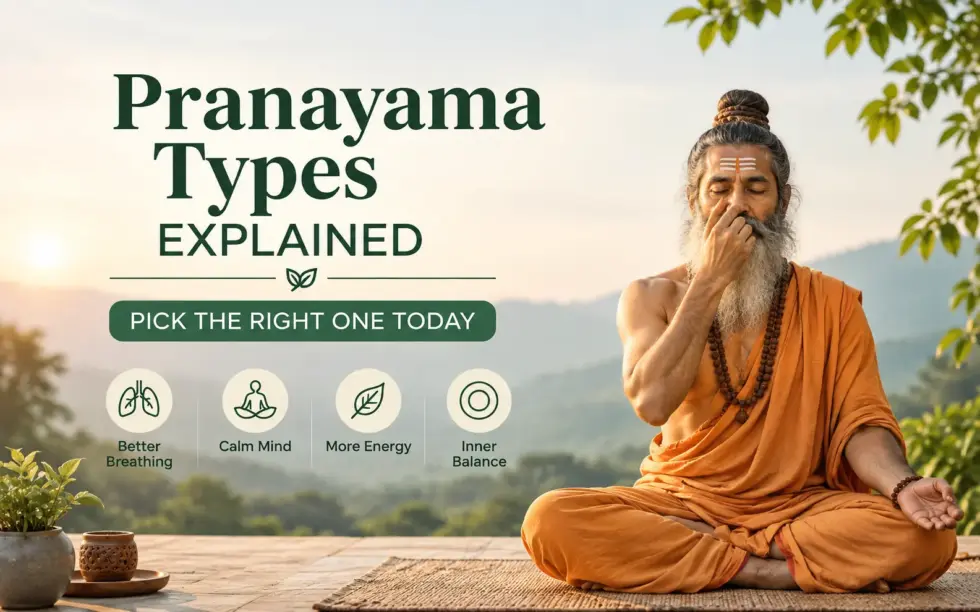

I used to think pranayama was basically just “breathing exercises”. Like, inhale, exhale, feel calm, done.
Then I actually tried a few types consistently and realized two things pretty fast.
First, different pranayama techniques do very different stuff. Some wake you up. Some knock you down into the most grounded, quiet state. Some feel cleansing. Some feel… spicy, honestly.
Second, the “best” pranayama is usually the one that fits your current state, not your personality, not your zodiac sign, not what that one YouTube video said is the most powerful breath on Earth.
So this guide is exactly that. A practical explanation of common pranayama types, what they’re for, how to do them without overcomplicating it, and how to pick the right one today.
Quick note before we start: I’m not your doctor. If you’re pregnant, have uncontrolled high blood pressure, heart rhythm issues, glaucoma, seizures, panic disorder, or any respiratory condition that flares easily, get medical guidance and stick to gentle practices. And if any technique makes you dizzy, panicky, or weirdly “wired” in a bad way, stop. That’s your signal.
What pranayama actually is (in plain language)
Pranayama is yogic breath training. Not just slow breathing, not just breath awareness, but intentionally shaping the breath to influence your nervous system, attention, and energy.
In modern terms, pranayama can shift:
- Arousal level (sleepy vs alert)
- Stress response (sympathetic vs parasympathetic bias)
- CO2 tolerance and breath efficiency
- Attention (scattered vs steady)
- Emotional tone (agitated vs settled)
Some techniques are gentle and basically safe for most people. Others are intense and should be treated like strong coffee or a heavy workout. You do not start with the hardest one because you want “results”.
The 2 big categories you should know
This makes choosing a technique way easier.
1) Calming pranayama (downshifts the system)
Usually slower, smoother, longer exhales, less effort.
Good for:
- anxiety, stress spirals
- insomnia or pre sleep
- cooling down after work
- recovery days
2) Energizing pranayama (upshifts the system)
Usually faster, more active, stronger inhalations, sometimes forceful pumping.
Good for:
- morning grogginess
- mental fog
- low mood lethargy
- prepping for a workout (lightly)
Most people mess up by doing energizing pranayama when they’re already stressed. Then they’re like, “why am I more jittery?” Yeah. Because you hit the gas pedal.
How to pick the right pranayama today (a simple decision tree)
Ask yourself: what do I need right now?
If you feel anxious, edgy, overwhelmed
Pick:
- Nadi Shodhana (alternate nostril)
- Bhramari (humming bee)
- Slow diaphragmatic breathing with long exhale
- Sitali or Sitkari (cooling breath) if you feel hot or irritated
Avoid (for now):
- Kapalabhati
- Bhastrika
- long breath retentions
If you feel tired, dull, unmotivated
Pick:
- Kapalabhati (if appropriate)
- Bhastrika (advanced, strong)
- Surya Bhedana (right nostril breathing)
- A short round of Ujjayi (gentle energizing)
Avoid:
- very long slow exhale practices if you’re already struggling to stay awake
If you feel scattered, unfocused, “too many tabs open”
Pick:
- Box breathing (simple, steady)
- Nadi Shodhana
- Ujjayi (soft, steady sound)
If you want sleep or deep relaxation
Pick:
- Bhramari
- Chandra Bhedana (left nostril)
- extended exhale breathing (like 4 in, 6 to 8 out)
- very gentle Nadi Shodhana
Now let’s get into the actual pranayama types. I’ll keep each one practical: what it’s for, how to do it, when to use it, and common mistakes.
1. Nadi Shodhana (Alternate Nostril Breathing)
This is the “if you only learn one” technique for a lot of people.
It’s balancing, centering, surprisingly effective for stress, and not too stimulating. It can also be boring, in a good way. Like brushing your nervous system’s teeth.
What it’s good for
- calming anxiety without getting sleepy
- steadying attention
- emotional regulation
- transition moments (after work, before meditation, before bed)
How to do it (basic version)
- Sit comfortably. Spine tall but not rigid.
- Use your right hand. Fold index and middle finger down (traditional Vishnu mudra) or just use thumb and ring finger, whatever works.
- Close the right nostril with your thumb. Inhale through the left.
- Close left nostril with ring finger. Exhale through the right.
- Inhale through the right.
- Close right, exhale through left.
That’s one full cycle.
Start with 5 to 10 cycles, smooth and unforced.
Common mistakes
- breathing too hard like you’re trying to “win”
- collapsing posture and compressing the belly
- rushing the switches and turning it into a fidgety hand workout
- adding retention too early
Quick routine
- 2 to 5 minutes, no retention
- keep it quiet, soft, even
2. Ujjayi Pranayama (Victorious Breath)
Ujjayi is that soft ocean sound breath you hear in yoga classes. But as pranayama, it becomes a focus tool. Almost like giving the mind a simple anchor.
What it’s good for
- steady energy, not too up or down
- focus during movement or meditation
- soothing the nervous system
- building breath control gently
How to do it
- Inhale through the nose.
- Slightly constrict the throat (like you’re fogging a mirror but with mouth closed).
- Exhale through the nose with that same gentle throat constriction.
It should sound like quiet waves. If it sounds like Darth Vader, it’s probably too intense.
When to use it
- during yoga asana
- when you’re scattered
- when you want calm focus
Common mistakes
- forcing the throat and creating tension
- making it loud to feel “powerful”
- tightening jaw and face
Quick routine
- 3 to 5 minutes, slow and steady
- equal inhale and exhale is a good start (like 4 in, 4 out)
3. Bhramari (Humming Bee Breath)
This one is weirdly underrated. It’s calming fast. If your mind is loud, humming can feel like turning down the volume knob.
Also, it’s simple. No complicated ratios. No counting that makes you more stressed.
What it’s good for
- anxiety and agitation
- anger and irritability
- pre sleep relaxation
- headache tension (for some people)
How to do it
- Inhale through the nose.
- Exhale slowly while making a steady hum (like “mmm”).
- Feel the vibration in the face and skull.
Optional: gently close your ears with your fingers (Shanmukhi mudra style) but you don’t have to.
Do 5 to 10 humming exhales.
Common mistakes
- humming too forcefully and straining the throat
- rushing the exhale
- trying to make the vibration happen instead of letting it happen
Quick routine
- 2 minutes of humming, then sit quietly for 1 minute It’s a nice mini reset.
4. Kapalabhati (Skull Shining Breath)
This is energizing. It’s also the one people overdo because it feels productive. Like, “I’m purifying my system”. And then they get dizzy and blame pranayama.
Kapalabhati is basically active, forceful exhales with passive inhales. Pumping from the belly.
What it’s good for
- morning energy
- clearing mental fog
- building heat (some people)
- prepping for practice when done lightly
Who should be cautious or avoid
- pregnancy
- uncontrolled high blood pressure
- hernia
- recent abdominal surgery
- panic tendencies (can feel triggering)
- severe acid reflux (sometimes)
How to do it (beginner friendly)
- Sit tall.
- Take a normal inhale.
- Exhale sharply by contracting the lower belly. The inhale happens naturally as the belly releases.
- Keep the rhythm steady.
Start with 20 to 30 pumps, then rest. Do 1 to 3 rounds.
Common mistakes
- pumping from the chest instead of the belly
- tightening shoulders and face
- going too fast too soon
- doing huge rounds and getting lightheaded
If you get dizzy, stop, breathe normally, and next time cut it in half.
5. Bhastrika (Bellows Breath)
Bhastrika is like Kapalabhati’s intense cousin. Both inhale and exhale are active and forceful. It can feel like stoking a fire.
It can also be too much, especially if you live in a stressed body already.
What it’s good for
- strong energizing
- breaking through lethargy
- building heat
- short “wake up” sessions
Caution
Same cautions as Kapalabhati, and arguably more so. This is not the first pranayama you master.
How to do it (basic)
- Sit tall.
- Inhale forcefully through the nose, expand the belly and chest.
- Exhale forcefully through the nose.
- Repeat in a steady rhythm.
Start with 10 to 15 breaths, then rest. Do 1 to 3 rounds only.
Common mistakes
- pushing past comfort because it feels hardcore
- getting dizzy and continuing anyway
- clenching the jaw
Think “controlled power”, not frantic.
6. Sitali (Cooling Breath)
Sitali is cooling and calming. Great for heat, irritability, that feeling where your patience is gone and everything is annoying.
Traditionally you curl the tongue into a tube and inhale through it. Not everyone can curl their tongue. If you can’t, do Sitkari (next section).
What it’s good for
- cooling down physically and emotionally
- soothing agitation
- post workout cooldown (gentle)
- hot flashes for some people (not medical advice, just anecdotal)
How to do it
- Curl the tongue into a tube.
- Inhale through the curled tongue, feeling cool air.
- Close the mouth and exhale through the nose.
Do 5 to 15 rounds, slow.
Common mistakes
- inhaling too aggressively and drying the mouth
- doing it in cold weather and then wondering why you feel chilled
7. Sitkari (Hissing Breath)
Sitkari is basically the alternative to Sitali when tongue curling is not happening.
What it’s good for
Same general benefits as Sitali. Cooling, calming.
How to do it
- Lightly bring teeth together.
- Part the lips slightly.
- Inhale through the teeth with a soft “sss” sound.
- Exhale through the nose.
Do 5 to 15 rounds.
Common mistakes
- clenching teeth hard
- inhaling too fast and drying out the mouth
8. Surya Bhedana (Right Nostril Breathing)
This is an energizing one. In traditional terms, right nostril is linked with warming, activating qualities.
What it’s good for
- low energy mornings
- sluggishness
- getting moving when you feel stuck
How to do it (simple)
- Close the left nostril.
- Inhale through the right.
- Close the right nostril.
- Exhale through the left.
That’s one round.
Do 5 to 10 rounds. Keep it smooth, no strain.
Avoid if
- you run hot easily
- you’re already anxious, irritated, or overstimulated
- high blood pressure issues
9. Chandra Bhedana (Left Nostril Breathing)
This is the cooling, settling counterpart to Surya Bhedana.
What it’s good for
- winding down
- irritability
- pre sleep routines
- cooling heat in the body
How to do it
- Close the right nostril.
- Inhale through the left.
- Close the left nostril.
- Exhale through the right.
Do 5 to 10 rounds.
Common mistake
Doing it when you’re already too low energy and then wondering why you feel flatter. Use it when you need to calm, not when you need motivation.
10. Sama Vritti (Equal Breathing)
This is simple and surprisingly powerful. Inhale for a count, exhale for the same count. That’s it.
It’s like smoothing out bumps in your internal rhythm.
What it’s good for
- focus
- mild anxiety
- building breath control gently
- meditation prep
How to do it
Pick a comfortable count, like:
- inhale 4
- exhale 4
Do that for 3 to 5 minutes.
If 4 feels short, try 5. If 4 feels hard, drop to 3. No heroics.
Common mistakes
- choosing a count that’s too long and creating strain
- turning it into a test instead of a practice
11. Vishama Vritti (Unequal Breathing, usually longer exhale)
This is where you start playing with ratios, typically longer exhale than inhale, which tends to be calming for many people.
What it’s good for
- anxiety regulation
- downshifting before sleep
- calming the body after stress
How to do it (easy ratio)
Try:
- inhale 4
- exhale 6
Or:
- inhale 4
- exhale 8 (only if it feels smooth)
Do 3 to 7 minutes.
Common mistakes
- making the exhale so long you gasp on the next inhale
- holding tension in the chest to “stretch” the breath
The breath should feel like it’s lengthening itself, not being dragged.
12. Box Breathing (Square Breathing)
Not traditional yoga only, but it’s used everywhere now, and it overlaps with pranayama style breath control. Equal sides, often with holds.
It’s structured, grounding, and good when your mind wants something concrete.
What it’s good for
- stress spirals
- performance nerves
- focus before meetings or tasks
- creating steadiness fast
How to do it (no strain version)
Try:
- inhale 4
- hold 4
- exhale 4
- hold 4
Repeat 4 to 8 cycles.
If holds feel stressful, shorten them or remove them. You can do “rectangle breathing” and keep it gentler.
Common mistakes
- forcing the breath holds and getting more tense
- using it as a punishment like “calm down right now”
13. Dirga Pranayama (Three Part Breath)
This is a foundational breath. It teaches you to breathe into belly, ribs, upper chest in a smooth wave. It’s not flashy, but it fixes a lot of shallow breathing patterns.
What it’s good for
- building basic breath awareness
- calming without complicated technique
- posture and rib mobility awareness
- recovery days
How to do it
- Inhale into the belly first.
- Continue inhaling into the ribs (side expansion).
- Finish inhaling into the upper chest gently.
- Exhale in reverse, chest softens, ribs soften, belly softens.
Do 5 to 10 slow breaths.
Common mistakes
- forcing the upper chest and lifting shoulders
- breathing so big it becomes stressful
It should feel nourishing, not like inflating a balloon to its limit.
What about breath retention (Kumbhaka)?
Retention is powerful. Also, it’s where a lot of people get into trouble because they jump in too soon.
There are two common types:
- Antar kumbhaka: hold after inhale
- Bahir kumbhaka: hold after exhale
Why people use retention
- deeper concentration
- training CO2 tolerance
- strong energetic effects (traditional view)
- a sense of internal stillness
Why to be cautious
Retention can spike anxiety in some people. It can also increase pressure responses. If you have cardiovascular concerns, skip it unless guided by a qualified teacher and cleared medically.
Beginner approach
If you want to explore it safely, do it lightly:
- inhale 4
- exhale 4
- then pause after exhale for 1 to 2 seconds only
That tiny pause is enough to start learning without forcing.
The most common pranayama mistakes (so you don’t waste weeks)
1) Doing the strongest technique because it sounds advanced
Advanced isn’t better. Appropriate is better.
2) Chasing sensations
Tingling, heat, dizziness, emotional waves. These can happen. But they’re not the goal. If you chase them, you usually over-breathe.
3) Over breathing (especially on calming days)
Ironically, trying to relax by taking huge breaths can make you feel worse. Calm breathing is often smaller, quieter, slower.
4) Bad posture
If you slump, the diaphragm and ribs can’t move well. Sit on a cushion. Keep the spine long. Relax the belly.
5) No “after”
Pranayama works better when you pause afterward. Even 60 seconds of sitting quietly lets the nervous system integrate.
Simple pranayama routines you can steal
No fancy schedules. Just plug and play.
A 5 minute “I’m stressed” routine
- Nadi Shodhana: 3 minutes
- Bhramari: 1 minute
- Sit quietly: 1 minute
A 6 minute “I can’t focus” routine
- Sama Vritti (4 in, 4 out): 4 minutes
- Ujjayi: 1 minute
- Sit quietly: 1 minute
A 4 minute “I’m tired but I don’t want jitters” routine
- Ujjayi: 2 minutes
- Gentle Kapalabhati: 1 round of 20 to 30 pumps
- Normal breathing: 1 minute
A 7 minute “help me sleep” routine
- Longer exhale breathing (4 in, 6 out): 5 minutes
- Bhramari: 1 minute
- Quiet sitting: 1 minute
FAQ style stuff people worry about
Should I do pranayama before or after yoga asana?
Often, gentle pranayama can be done before asana to settle. More intense pranayama is frequently taught after asana when the body is warm and open.
But honestly, for most modern schedules:
- calming pranayama fits well anytime
- energizing pranayama is best earlier in the day
How long until I notice benefits?
Sometimes immediately. Sometimes it’s subtle. The bigger shift usually comes from consistency, like 5 minutes a day for a couple weeks.
Can pranayama cause anxiety?
Yes, especially fast, forceful techniques or long retentions, and especially if you already have anxiety. Start with calming techniques and keep the breath smooth and not huge.
Is it normal to feel emotional after?
It can be. Breath practices can release tension and bring stuff up. If it’s intense or destabilizing, scale back and choose gentler methods.
Let’s wrap this up (and help you choose right now)
If you want the simplest “pick the right one today” cheat sheet, here you go.
- For calm and balance: Nadi Shodhana
- For anxiety or racing thoughts: Bhramari, longer exhales
- For focus without stress: Sama Vritti, Ujjayi
- For cooling anger and heat: Sitali or Sitkari, Chandra Bhedana
- For energy and wakefulness: Kapalabhati (light), Surya Bhedana
- For strong heat and activation (advanced): Bhastrika
And if you’re still unsure, pick this default: Nadi Shodhana for 3 minutes. It’s the safest “middle path” for most days.
Do it today, keep it gentle, and stop while it still feels good. That’s the secret, kind of. You want to finish pranayama feeling more like yourself, not like you fought your lungs and won.
FAQs (Frequently Asked Questions)
What is pranayama and how does it differ from simple breathing exercises?
Pranayama is yogic breath training that involves intentionally shaping the breath to influence your nervous system, attention, and energy. Unlike simple breathing exercises, it can shift arousal level, stress response, CO2 tolerance, attention, and emotional tone.
What are the two main categories of pranayama and their effects?
The two big categories are calming pranayama, which downshifts the system with slower, smoother breaths to reduce anxiety and promote relaxation; and energizing pranayama, which upshifts the system with faster, stronger breaths to boost alertness and energy.
How do I choose the right pranayama technique based on how I feel?
Assess your current state: if anxious or overwhelmed, choose calming techniques like Nadi Shodhana or Bhramari; if tired or unmotivated, select energizing practices like Kapalabhati or Bhastrika; for scattered focus, try box breathing or gentle Ujjayi; for sleep or deep relaxation, opt for Bhramari or extended exhale breathing.
Are there any precautions I should take before practicing pranayama?
Yes. If you are pregnant or have conditions like uncontrolled high blood pressure, heart rhythm issues, glaucoma, seizures, panic disorder, or sensitive respiratory conditions, seek medical guidance and stick to gentle practices. Stop any technique that causes dizziness, panic, or unpleasant sensations.
What is Nadi Shodhana (Alternate Nostril Breathing) good for and how do I practice it?
Nadi Shodhana balances and centers the mind without overstimulation. It’s good for calming anxiety and steadying attention. To practice: sit comfortably with a tall spine; use your right hand to alternate closing nostrils while inhaling and exhaling smoothly for 5 to 10 cycles without retention.
Why shouldn’t I start pranayama with the most intense techniques?
Intense pranayama practices act like strong coffee or heavy workouts—they can be overwhelming if you’re new. Starting with gentler techniques helps build breath efficiency safely without causing adverse effects like jitteriness or discomfort.