
I am going to guess something.
You sit a lot. Work. Commute. Couch. Phone. Then you stand up and your back feels stiff, your neck feels like it is holding a bowling ball, and your hips… weirdly tight. And if you are like most people, you start thinking, I need a better chair. Or I need a standing desk. Or maybe I am just getting older.
Some of that might be true. But the bigger thing is simpler and more annoying.
Your body is adapting to the shape you keep putting it in.
And the good news is, you can reverse a lot of it. Not with perfect posture 24 7, not with some military shoulders back thing. Just a few practical changes that actually stick. And some small strength and mobility work that tells your body, hey, we are not a folded laptop anymore.
This is a real world guide. No mystical stuff. Just what helps.
What sitting all day is really doing to you
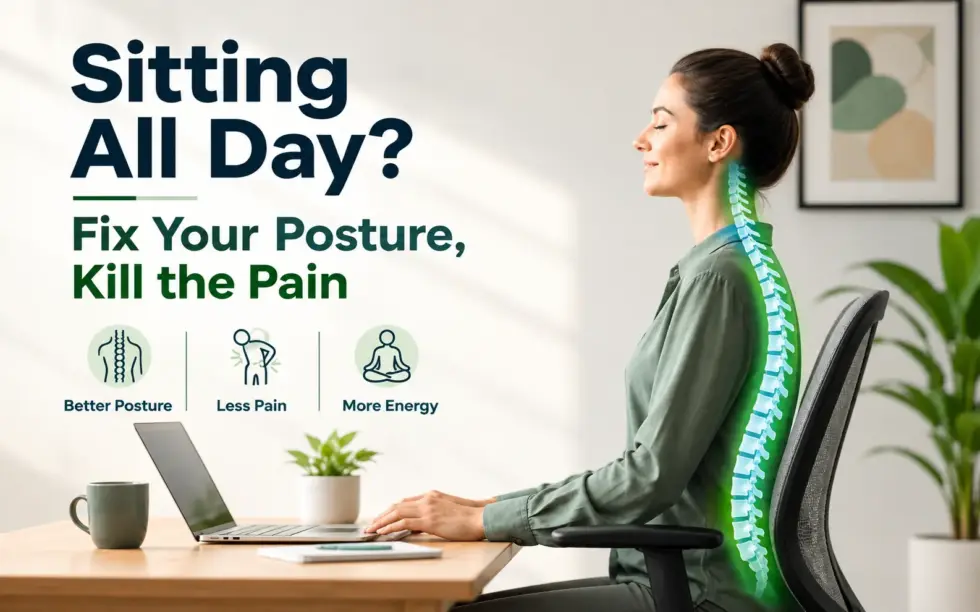
Sitting is not evil. It is just… specific. It locks you into hip flexion, rounds you forward, and turns off a bunch of muscles that are supposed to help you stay upright.
Over time, a few patterns show up:
1. Forward head and cranky neck
Your head drifts forward toward the screen. It does not feel dramatic while you are doing it. But even a small forward shift increases the load on your neck muscles.
So your upper traps and the little muscles at the base of your skull work overtime. That can feel like:
- tight neck
- headaches
- shoulder tension that never fully goes away
2. Rounded upper back and irritated shoulders
When your upper back rounds, your shoulder blades slide apart and tip forward. Then reaching overhead feels pinchy. Your chest feels tight. Your shoulders feel “rolled in.”
3. Tight hip flexors, lazy glutes
Your hip flexors shorten in the seated position. Your glutes are basically on vacation. Then you stand up and your low back tries to do the work your hips should have been doing. That is one of the most common “why does my lower back ache after sitting” explanations.
4. Low back stiffness
A lot of people think low back pain is a low back problem. Often it is a hip problem, a bracing problem, a movement problem, or just a “you have been in one position too long” problem.
Your spine likes variety. Sitting removes variety.
The posture myth that keeps people stuck
Let’s clear this up because it matters.
Perfect posture is not the goal. You are not a statue. If you try to hold a rigid “correct” posture all day, you will last 12 minutes, get tired, and then slump even harder.
What you want is:
- a setup that makes a decent posture the default
- frequent position changes
- enough strength and mobility that your body can sit and stand without complaining
Posture is less about holding and more about switching.
First, fix your desk setup (this is the fastest win)
If your workstation is forcing you into a bad position, you will lose this fight all day. So do the boring stuff first. It is boring because it works.
Chair and hips
- Sit back so your butt is against the back of the chair.
- Hips roughly level with knees or slightly higher than knees.
- Feet flat on the floor (or on a footrest if you need it).
If your chair is high and your feet dangle, your hips roll back and your low back rounds. That alone can create a ton of “mystery” back pain.
Back support
If your chair has lumbar support, use it, but do not crank it so hard it feels like a fist in your spine. If your chair has zero support, a small rolled towel behind your low back can help.
Not huge. Small.
Screen height
Top of your monitor roughly at eye level. If you are using a laptop, you basically need a stand or a stack of books plus an external keyboard and mouse.
Because otherwise you are choosing between:
- neck bent down all day
- shoulders shrugged up all day
Both are terrible.
Keyboard and mouse position
Keep them close enough that your elbows can stay by your sides. If you are reaching forward, your shoulders round and your neck creeps forward.
The 2 second posture reset (use this constantly)
Not a big ritual. Just this:
- Exhale, let your ribs drop a little.
- Lightly lift your chest without flaring your ribs.
- Think “back of head tall” not “chin up.”
That is it.
You will do it 30 times a day. It adds up.
The real posture hack: change positions like it is your job
Your body hates being trapped. Even “good posture” gets uncomfortable if you freeze in it.
So use this rule:
Every 30 to 45 minutes, change something.
Not necessarily a full break. Just change.
- stand up for 30 seconds
- walk to refill water
- do 5 slow breaths and roll your shoulders
- switch from sitting to standing if you have that option
If you want a simple target, do this:
- 2 to 5 minutes of movement per hour
That is enough to reduce stiffness for most people.
Now the important part: the pain-killing routine (10 to 12 minutes)
This is the part people skip. They buy a chair, they buy a cushion, they buy a standing desk, and they never teach their body how to hold itself again.
Do this routine 4 to 6 days a week. At home. No fancy equipment. A mini band helps, but not required.
Step 1: Breathing to “stack” your ribcage over your pelvis (2 minutes)
If your ribs are flared up and your pelvis is tipped forward, your low back stays compressed. A lot. All day.
Do this:
90 90 breathing (on your back)
- Lie on your back with knees bent, feet on a wall or chair.
- Flatten your low back gently into the floor (not forced).
- Inhale through your nose, expand your ribs sideways.
- Exhale slowly and feel your ribs come down.
Do 5 to 8 slow breaths.
This is not meditation. This is alignment. It sets the rest of the routine up.
Step 2: Open your upper back, not your low back (2 minutes)
Most people try to “stretch their back” by yanking on their low back. But the stiffness is often higher, in the thoracic spine.
Open book stretch
- Lie on your side, knees bent.
- Arms straight out in front, palms together.
- Rotate the top arm and open your chest toward the other side.
- Keep knees together.
Do 6 reps per side, slow.
If this feels tight, good. That is the point.
Step 3: Release the hip flexors the right way (2 minutes)
Hip flexors get blamed for everything. Sometimes they are tight, sometimes they are weak, sometimes both. But a basic stretch helps.
Half kneeling hip flexor stretch
- One knee down, other foot forward.
- Tuck your pelvis slightly (think tailbone down).
- Squeeze the glute on the kneeling side.
- Shift forward a little until you feel the stretch in the front of that hip.
Hold 30 to 45 seconds each side.
Important detail. If you do not squeeze the glute, you will just hang on your low back and think you are stretching your hip. You are not.
Step 4: Turn your glutes back on (2 minutes)
If your glutes do not fire, your low back and hamstrings pick up the slack. Then everything feels tight and achy.
Glute bridge
- Lie on your back, knees bent.
- Ribs down (do not flare).
- Push through your heels.
- Lift hips until your body forms a straight line from shoulders to knees.
Do 2 sets of 8 to 12 reps. Pause 1 second at the top.
You should feel glutes. If you feel mostly hamstrings, move your feet a bit closer to your butt and try again.
Step 5: Strengthen the upper back so “good posture” is easy (2 to 4 minutes)
You do not need to force your shoulders back. You need the muscles that keep your shoulder blades stable.
Wall slides
- Stand with back against a wall.
- Low back gently against the wall (no huge arch).
- Forearms on the wall.
- Slide arms up without shrugging.
Do 2 sets of 6 to 10 slow reps.
If wall slides are too hard, do this instead:
Band pull aparts (with a light band)
- Arms straight out in front.
- Pull band apart, squeeze shoulder blades gently down and back.
2 sets of 12 to 15.
That is the routine. It is not magical. But it covers the big sitting issues:
- ribs and pelvis alignment
- thoracic mobility
- hip flexor length and control
- glute strength
- upper back strength
What to do during the workday (micro moves that actually help)
You do not need to do yoga at your desk. You just need to interrupt the pattern.
Pick 3 of these and rotate them:
1. Chin tuck (30 seconds)
Gently pull your chin straight back, like you are making a double chin. Hold 2 seconds. Repeat 8 times.
This strengthens deep neck flexors and counters forward head posture.
2. Shoulder blade squeezes (20 seconds)
Squeeze shoulder blades down and together, lightly. Hold 2 seconds. Do 8 reps.
Do not overdo it. If you pinch too hard you will feel more tension.
3. Hip flexor stand up reset (30 seconds)
Stand up, squeeze glutes for 5 seconds, relax. Repeat 3 times.
This reminds your body that hips extend. Not just bend.
4. Doorway pec stretch (45 seconds)
Forearm on door frame, step through gently. Feel stretch across chest. Switch sides.
5. Calf raises (30 seconds)
Do 15 slow calf raises. Gets blood moving, wakes up ankles, helps circulation.
Little stuff. But consistent.
Standing desk? Helpful, but do not make it your whole personality
Standing desks are fine. But standing all day can create its own pain pattern. Low back compression, sore feet, tight calves.
If you use a standing desk, do this instead of “standing all morning”:
- 30 to 45 minutes sit
- 15 to 20 minutes stand
- repeat
While standing, keep screen and keyboard height correct. And shift weight sometimes, but do not hang on one hip like you are waiting for a bus.
Also. Wear decent shoes. Standing in socks on hard floors for 3 hours is not a flex. It is a foot pain plan.
Why your stretches might not be working
This is a sneaky one.
If you stretch the same tight area all the time and it keeps coming back, it might not be a “short muscle” issue. It might be a “weak and overloaded” issue.
Common example:
- tight upper traps
- tight hip flexors
- tight low back
Sometimes those areas are tight because they are doing too much, not because they are too short.
So yes, stretch. But pair it with strength. Especially glutes and upper back. That is where a lot of relief comes from.
A simple weekly plan (so you actually do it)
Here is what I would do if I wanted this to be realistic.
Daily (workdays)
- Fix desk basics once.
- 2 to 5 minutes movement per hour (even if it is split up).
- One posture reset every time you notice you are slumping.
4 to 6 days a week
- Do the 10 to 12 minute routine above.
2 days a week (optional but powerful)
Add a little more strength. Nothing complicated.
- bodyweight squats 2 x 10
- rows (band or dumbbell) 2 x 12
- dead bug 2 x 8 per side
Strength makes posture automatic. Mobility without strength is temporary.
The red flags (when to stop guessing and get checked)
Most sitting related pain is annoying, not dangerous. But some symptoms need a real medical assessment.
Get checked by a qualified clinician if you have:
- numbness or tingling that persists or worsens
- weakness in a limb
- pain shooting below the knee with progressive symptoms
- loss of bowel or bladder control (urgent)
- night pain that does not change with position
- unexplained weight loss, fever, or recent trauma
Also, if pain is getting worse week after week even with better movement habits, do not keep grinding through it.
Quick posture cues that do not make you tense
A lot of posture tips make people stiff. Try these instead:
- “Grow tall through the back of your head.”
- “Ribs down, breathe wide.”
- “Shoulder blades heavy, not squeezed.”
- “Feet grounded.”
- “Jaw unclenched.” (seriously)
And remember. Neutral is a range. You are allowed to move.
Let’s wrap this up (because you have to go sit again)
If you sit all day and your body hurts, you do not need to obsess over posture. You need a better setup, more movement variety, and a small routine that restores what sitting takes away.
Do these three things and you will feel a difference fast:
- Fix your screen and keyboard position so your neck and shoulders stop fighting your desk.
- Change positions every 30 to 45 minutes even briefly.
- Do the 10 to 12 minute routine most days to open your upper back, unlock hips, and strengthen glutes and upper back.
That is it. Not glamorous. Not trendy.
But if you stick with it for two weeks, you will stand up from your chair and go, oh. That is what my body is supposed to feel like.
FAQs (Frequently Asked Questions)
What are the common physical effects of sitting all day?
Sitting all day can cause your body to adapt into a specific shape, leading to forward head posture, stiff neck, rounded upper back, irritated shoulders, tight hip flexors, lazy glutes, and low back stiffness. These changes result from muscles being turned off or overworked due to prolonged seated positions.
Is perfect posture necessary to avoid back and neck pain?
No, perfect posture is not the goal. Holding a rigid ‘correct’ posture all day is unrealistic and can lead to fatigue and slumping. Instead, aim for a setup that encourages decent posture as the default, frequent position changes, and sufficient strength and mobility to sit and stand comfortably without pain.
How can I optimize my desk setup to reduce discomfort from sitting?
To optimize your desk setup: sit with your butt against the back of the chair; keep hips level with or slightly higher than knees; feet flat on the floor or footrest; use lumbar support if available without overdoing it; position your monitor top at eye level; use an external keyboard and mouse close enough so elbows stay by your sides to prevent reaching forward.
What simple techniques can help reset my posture throughout the day?
A quick 2-second posture reset can help: exhale and let your ribs drop slightly; lightly lift your chest without flaring ribs; think ‘back of head tall’ rather than ‘chin up.’ Doing this multiple times a day adds up to better posture habits without strain.
How often should I change positions during work to prevent stiffness?
You should change something about your position every 30 to 45 minutes. This could be standing up for 30 seconds, walking to refill water, doing slow breaths with shoulder rolls, or switching between sitting and standing if possible. Aim for 2 to 5 minutes of movement per hour to reduce stiffness effectively.
What is a recommended routine to alleviate pain caused by prolonged sitting?
A pain-killing routine of 10 to 12 minutes done 4 to 6 days a week at home helps retrain your body. It includes breathing exercises like 90/90 breathing on your back to stack your ribcage over your pelvis properly. No fancy equipment is needed—just consistent practice improves strength, mobility, and reduces discomfort from sitting.