
Prediabetes is one of those words that lands weird.
It sounds like a warning, but not an emergency. Like your body is tapping you on the shoulder saying, hey… maybe pay attention now, before it gets loud.
And the tricky part is that prediabetes is mostly a numbers game at first. You can feel totally fine. No dramatic symptoms. No obvious “something is wrong.” Just lab values quietly creeping up.
So let’s make this simple and actually useful.
This article is about the blood sugar numbers that matter for prediabetes, what they mean, how they’re measured, and how to think about them in real life. Not in a perfect world where everyone eats flawlessly and sleeps eight hours. In your life.
What “prediabetes” actually means (in plain English)
Prediabetes is when your blood sugar is higher than normal, but not high enough to meet the criteria for diabetes.
That’s it.
But under the hood, what’s happening is usually some mix of:
- Insulin resistance (your cells stop responding well to insulin)
- Your pancreas working harder to keep blood sugar normal
- Post meal spikes getting higher and lasting longer
- And over time, the system gets tired. Numbers rise. Then diabetes.
Prediabetes is basically the middle zone. Not fine, not yet diabetes.
And yes, it’s serious. But also yes, it’s a moment where a lot of people can turn things around.
The prediabetes blood sugar ranges (the numbers)
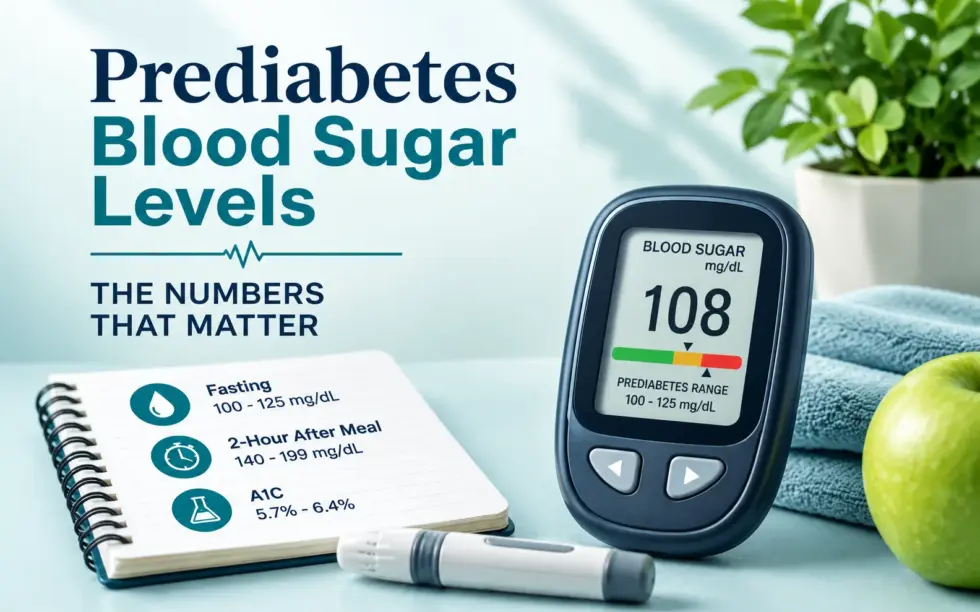
Here are the most commonly used diagnostic tests and the cutoffs that define prediabetes.
1) Fasting plasma glucose (FPG)
This is your blood sugar after not eating for at least 8 hours.
Normal:
- Below 100 mg/dL (below 5.6 mmol/L)
Prediabetes:
- 100 to 125 mg/dL (5.6 to 6.9 mmol/L)
Diabetes:
- 126 mg/dL or higher (7.0 mmol/L or higher) on two separate tests, typically
This one is popular because it’s easy. One blood draw in the morning.
But it doesn’t catch everything, because some people have normal fasting numbers and still spike hard after meals.
2) A1C (HbA1c)
A1C is not a “today” number. It estimates your average blood sugar over the last roughly 2 to 3 months (weighted more toward recent weeks).
Normal:
- Below 5.7%
Prediabetes:
- 5.7% to 6.4%
Diabetes:
- 6.5% or higher
A1C is the one people remember because it’s a single percent. It feels like a grade.
But it’s not perfect either. Things like anemia, certain blood disorders, kidney disease, pregnancy, and even differences in red blood cell turnover can make A1C less reliable for some people.
3) Oral glucose tolerance test (OGTT), 2 hour value
This is the most “stress test” like option.
You come in fasting, drink a glucose solution (usually 75 grams), and they measure your blood sugar after two hours.
Normal (2 hour):
- Below 140 mg/dL (below 7.8 mmol/L)
Prediabetes (2 hour):
- 140 to 199 mg/dL (7.8 to 11.0 mmol/L)
Diabetes (2 hour):
- 200 mg/dL or higher (11.1 mmol/L or higher)
OGTT is great at catching impaired glucose tolerance, the people whose fasting looks okay but whose post meal handling is… not great.
It’s more time and more annoying, so it’s not always offered first. But it’s very telling.
Quick summary table (because you’ll want it)
| Test | Normal | Prediabetes | Diabetes |
| Fasting glucose | <100 mg/dL | 100 to 125 mg/dL | ≥126 mg/dL |
| A1C | <5.7% | 5.7 to 6.4% | ≥6.5% |
| OGTT 2 hour | <140 mg/dL | 140 to 199 mg/dL | ≥200 mg/dL |
If you only take one thing from this article, take that.
But the real value is understanding what these numbers mean day to day.
Which number matters most?
Honestly. It depends on how your body is misbehaving.
If your fasting glucose is high
That often points to overnight and liver glucose output issues. Your liver releases glucose while you sleep, and insulin is supposed to keep that in check. With insulin resistance, it can run a bit wild.
If your A1C is high but fasting looks normal
You might be spiking after meals, and those spikes are raising your average.
If your OGTT is high
That’s classic impaired glucose tolerance. Post meal control is the problem.
Many people have a mix, but one tends to show up first.
That’s why two people can both have “prediabetes” and have totally different patterns.
Prediabetes numbers: mg/dL vs mmol/L (so you don’t get confused)
If you’re in the US, you usually see mg/dL.
In many other countries, you’ll see mmol/L.
For glucose, the quick conversion is:
- mmol/L = mg/dL ÷ 18
- mg/dL = mmol/L × 18
So 100 mg/dL is about 5.6 mmol/L.
This comes up a lot when you’re reading anything online and wondering why the numbers look “smaller” somewhere else.
The “hidden” numbers that still matter (even if they’re not used to diagnose)
Here’s where things get practical.
A diagnosis is one thing. Your daily blood sugar behavior is another.
Post meal blood sugar (1 to 2 hours after eating)
A lot of people with early insulin resistance look fine fasting and then spike after meals.
There isn’t one universal official target for everyone without diabetes, but generally speaking, if you’re frequently seeing:
- 140+ mg/dL at 2 hours after meals, that’s a sign your glucose handling is strained.
- 160 to 180+ mg/dL after meals consistently, that’s more concerning.
Some clinicians use tighter targets, especially for people trying to reverse prediabetes. Context matters. What you ate matters too.
The point is: post meal spikes are not “free.” They add up. They push A1C up over time.
“Time in range” if you use a CGM
A CGM (continuous glucose monitor) tracks your glucose all day and night.
Even if you don’t have diabetes, a CGM can show patterns like:
- morning rise
- big spikes after cereal or rice
- nighttime glucose staying elevated
- stress spikes (yes, stress)
For people with diabetes, “time in range” usually means 70 to 180 mg/dL. For prediabetes, some people aim for a tighter personal range, but that’s more of a coaching tool than an official medical target.
If you do use one, don’t get obsessed with single readings. Look for patterns across days.
Why your numbers can bounce around (and still be real)
People get a lab result and go, wait, I was good last time.
Yeah. That happens.
Blood sugar is sensitive to things that have nothing to do with willpower.
A few big ones:
- Sleep (bad sleep can raise insulin resistance quickly)
- Stress (cortisol pushes glucose up)
- Illness (your body raises glucose to fight infection)
- Medications (like steroids, some antipsychotics, etc.)
- Menstrual cycle / menopause
- Recent exercise (can lower glucose, but intense exercise can temporarily raise it in some people)
- Alcohol (can lower glucose short term, worsen metabolism long term depending on patterns)
- What you ate the day before a fasting test (especially high carb late meals)
So if one number is off, the best next step is usually confirmation, more context, or a repeat. Not panic.
Prediabetes vs diabetes: the line is sharp on paper, softer in real life
On paper, the cutoff is clean.
In real life, risk increases gradually as glucose rises. The jump from 99 to 101 mg/dL is not some magical cliff, but it is a signal that the trend is moving in the wrong direction.
Same with A1C. Someone at 6.4% is very close to diabetes range. Someone at 5.7% is early. That difference matters for urgency.
So yeah, it’s a range. But where you fall in the range changes how hard you probably need to push.
What’s the “most dangerous” prediabetes number?
Not a fun question, but an honest one.
- A1C near 6.4% is usually a bigger red flag, because it suggests sustained elevation.
- Fasting glucose near 125 mg/dL is also close to the diabetes threshold.
- OGTT 2 hour** near 199 mg/dL** means post meal control is significantly impaired.
Any of these at the high end means you’re not in mild territory anymore. It’s time to get serious, not with fear, but with action.
How doctors confirm prediabetes (and why you might get different tests)
Typically, a clinician will diagnose prediabetes based on:
- one of the tests meeting criteria, sometimes repeated to confirm
- your risk factors
- and whether results make sense together
Sometimes results don’t match, like:
- A1C says prediabetes, fasting is normal
- fasting says prediabetes, A1C is normal
This can happen. And it doesn’t automatically mean one is wrong. It might mean your glucose is spiking at certain times, or that A1C is skewed by another condition.
If there’s a mismatch, an OGTT or CGM trial can clarify what’s going on.
A quick reality check: home glucometer vs lab test
If you’re checking at home with a fingerstick meter, great. But know this:
- Home meters can have a meaningful margin of error.
- Lab plasma glucose tests are more standardized.
So don’t treat a single home reading as a diagnosis. Use it as information.
Trends matter more than one random number.
Prediabetes numbers and symptoms (why you might feel nothing)
Most people with prediabetes feel fine.
When symptoms do show up, they can be vague:
- fatigue after meals
- intense cravings
- brain fog
- feeling shaky if you swing from high to low
- frequent hunger
- slow weight changes
- darkened skin in folds (acanthosis nigricans) in some cases
But symptoms are not a reliable indicator. Numbers are.
That’s why prediabetes is usually found on routine labs, or after someone checks because of family history or weight gain or pregnancy screening.
What numbers should you aim for if you’re trying to reverse prediabetes?
This is where people want a clean target. I get it.
Clinically, “reversal” often means returning to normal range:
- A1C below 5.7%
- fasting glucose below 100 mg/dL
- and/or normal OGTT
But a better way to think is: you want numbers moving down, steadily, while your habits feel sustainable.
If you’re at:
- A1C 6.3% and you get to 5.9% in 3 to 6 months, that’s a big win.
- fasting 115 and you get to 103, also a big win.
Progress counts. A lot.
And for many people, the biggest leverage comes from what happens after meals, because that’s where spikes live.
The “why” behind the numbers (insulin resistance, simplified)
Here’s a basic model that helps:
- You eat carbs (and some protein).
- Glucose enters the bloodstream.
- Insulin rises to push glucose into muscle and liver cells.
- If cells resist insulin, glucose stays higher for longer.
- Pancreas produces more insulin to compensate.
- Eventually, pancreas can’t keep up. Glucose rises. A1C rises.
Prediabetes is often the “compensation” stage. Insulin may be high, but glucose is just starting to slip.
Which is also why prediabetes is a huge opportunity. Your body is still fighting for normal.
What to do if your numbers say prediabetes (a grounded checklist)
Not medical advice, just the practical sequence most people actually need.
1) Confirm which test flagged you
Was it A1C? fasting glucose? OGTT?
Ask for the actual lab report and keep it. You want to track this.
2) Ask what else was measured
Helpful add ons:
- Lipids (triglycerides and HDL can reflect insulin resistance patterns)
- Liver enzymes (fatty liver is common alongside insulin resistance)
- Blood pressure
- Weight and waist circumference trend
- Sometimes fasting insulin (not always standard, interpretation varies)
3) Pick a retest window
Common is 3 months for A1C because it reflects a roughly 3 month average. Sometimes 6 months depending on severity and changes made.
4) Start with the biggest drivers
For most people, these move numbers the fastest:
- Weight loss if overweight (even 5 to 10% of body weight can change glucose significantly)
- Walking after meals (seriously underrated)
- Strength training (muscle is a glucose sink)
- Protein and fiber at meals (slows glucose rise)
- Sleep improvement (boring but real)
- Reducing sugary drinks and refined carbs (liquid sugar especially)
You do not need a perfect diet to improve prediabetes labs. You need consistent changes you can repeat.
These lifestyle changes are supported by research, such as this study which highlights effective strategies for managing insulin resistance and improving overall metabolic health.
5) Discuss medication if you’re high risk
Some people benefit from medication like metformin, especially if:
- A1C is near the upper range
- BMI is higher
- history of gestational diabetes
- strong family history
- lifestyle changes aren’t enough
That’s a conversation with your clinician. Not a failure. Not a moral thing.
Common misunderstandings (that mess people up)
“My A1C is prediabetes but my fasting is normal so it’s fine.”
Not necessarily. That can mean your spikes are frequent.
“I only eat healthy carbs, so my sugar won’t spike.”
“Healthy” doesn’t always mean low spike. Oats, brown rice, bananas, smoothies. These can still spike some people. Your body’s response matters.
“If I skip breakfast, my blood sugar will fix itself.”
Intermittent fasting helps some people. Others overeat later, sleep worse, or spike harder after the first meal. It’s a tool, not a guarantee.
“I feel fine, so the numbers must be wrong.”
Prediabetes is famous for feeling like nothing.
“Once you have prediabetes, diabetes is inevitable.”
Not true. Risk is real, but progression is not guaranteed. Many people bring numbers down.
A few example scenarios (so you can place yourself)
Scenario A: Fasting 108 mg/dL, A1C 5.5%
That’s fasting prediabetes range, but A1C still normal. Could be early insulin resistance, sleep stress, late night eating, or just early trend.
Next step: repeat fasting, consider post meal checks or CGM trial, improve sleep and evening meal habits.
Scenario B: Fasting 92 mg/dL, A1C 6.1%
Fasting looks fine, A1C is clearly prediabetes. That often suggests post meal spikes.
Next step: look at meal composition, especially breakfast and dinner, add post meal walks, consider OGTT or CGM to identify spike foods.
Scenario C: OGTT 2 hour 178 mg/dL, fasting 97 mg/dL
Classic impaired glucose tolerance. You handle fasting okay but meals push you too high.
Next step: strength training and post meal activity are usually very effective here, plus reducing refined carbs and portion sizing.
Scenario D: A1C 6.4%, fasting 124 mg/dL
High end prediabetes. Close to diabetes thresholds.
Next step: work with a clinician, consider medication support, and make lifestyle changes immediately. Also rule out secondary causes, review meds, sleep apnea risk, etc.
When to worry, and when not to spiral
Worry is not very useful. Urgency is.
A single borderline number is not a life sentence. But it is a reason to stop hoping it will just go away.
If you’re in the lower prediabetes range, you probably have time to experiment, learn what works, and build habits.
If you’re in the upper range, it’s time to treat this like a real project. Not “I’ll try to eat better.” More like, I’m going to change the trend, and I’m going to measure it.
The bottom line (the numbers that matter)
If you want the clean takeaway, here it is.
Prediabetes is typically diagnosed by any of these:
- Fasting glucose: 100 to 125 mg/dL
- A1C: 5.7% to 6.4%
- OGTT 2 hour: 140 to 199 mg/dL
And beyond diagnosis, the “numbers that matter” are the ones that show your pattern:
- fasting trend over time
- A1C trend over time
- post meal spikes (especially if fasting looks normal)
- and how your body responds to sleep, stress, exercise, and meals
If you’ve been told you’re in prediabetes range, don’t let the word sit there like a vague threat.
Get the exact numbers. Pick a retest date. Make a few changes you can actually stick with. Then measure again.
That’s how this becomes reversible, instead of inevitable.
FAQs (Frequently Asked Questions)
What does prediabetes mean in simple terms?
Prediabetes means your blood sugar is higher than normal but not high enough to be classified as diabetes. It’s a warning sign indicating insulin resistance and increased pancreatic effort to manage blood sugar, often without obvious symptoms.
What are the key blood sugar numbers that define prediabetes?
Prediabetes is diagnosed based on specific blood sugar ranges: Fasting plasma glucose between 100-125 mg/dL (5.6-6.9 mmol/L), A1C levels from 5.7% to 6.4%, or a 2-hour Oral Glucose Tolerance Test (OGTT) result between 140-199 mg/dL (7.8-11.0 mmol/L).
How are fasting plasma glucose, A1C, and OGTT tests different for diagnosing prediabetes?
Fasting plasma glucose measures blood sugar after an 8-hour fast, A1C reflects average blood sugar over 2-3 months, and OGTT measures blood sugar two hours after drinking a glucose solution. Each test captures different aspects of glucose metabolism and helps identify various patterns of prediabetes.
Which blood sugar number matters most in prediabetes diagnosis?
It depends on individual glucose patterns: High fasting glucose often indicates liver glucose output issues overnight; elevated A1C with normal fasting suggests post-meal spikes; a high OGTT points to impaired glucose tolerance after meals. Many people have a mix, so multiple tests provide a fuller picture.
How do mg/dL and mmol/L units compare for blood sugar measurements?
In the US, blood sugar is measured in mg/dL, while many other countries use mmol/L. To convert: mmol/L = mg/dL ÷ 18, and mg/dL = mmol/L × 18. For example, 100 mg/dL equals about 5.6 mmol/L.
Why is prediabetes considered serious even without symptoms?
Prediabetes quietly signals that your body’s insulin response is weakening and blood sugar control is deteriorating. Without action, this can progress to type 2 diabetes with serious health consequences. Early detection offers a crucial chance to reverse or delay progression through lifestyle changes.