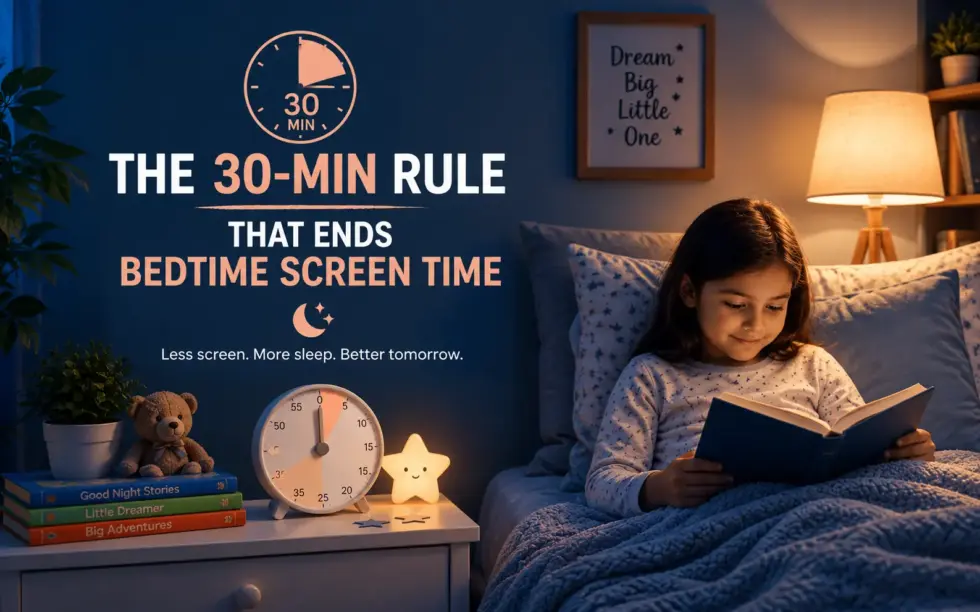

I used to do that thing where you crawl into bed with good intentions.
Phone goes on the nightstand. You feel kind of proud. Like, look at me. I am an adult with boundaries.
Then you remember one small thing you meant to check. A text. The weather. Tomorrow’s first meeting. A quick reel. A quick anything.
And suddenly it is 11:47, your eyes feel weirdly dry, your brain is buzzing, and you are bargaining with yourself like a toddler.
Just five more minutes.
I have tried a lot of the usual advice. Put the phone in another room. Use an app blocker. Buy an alarm clock. Meditate. Read a book. Take magnesium. Become a new person entirely.
Some of it helped. None of it felt simple enough to stick when I was tired and my willpower was basically gone.
Then I landed on a rule that is almost annoyingly straightforward.
The 30 minute rule.
It is not a productivity hack. It is not a detox. It is not a “never use your phone again” thing. It is just a clean line you can draw, even on messy days, and it tends to work because it is realistic.
This is that rule. How to do it. And how to make it feel normal in your house instead of like nightly punishment.
What the 30-Min Rule is (and what it is not)
The rule is simple:
No screens for the last 30 minutes before you try to fall asleep.
That is it.
Not no screens after 7 pm. Not no phone in the bedroom ever again. Not a moral stance about technology.
Just. The last 30 minutes.
If you normally go to sleep at 11:30, screens stop at 11:00.
If you aim for 10:45, screens stop at 10:15.
And if you are thinking, I don’t even know when I go to sleep. Fair. Most people don’t. We aim for a time and then we kind of… slide.
So we will handle that too.
A couple clarifications because people love loopholes.
What counts as a screen?
A screen is a screen.
Phone, tablet, laptop, TV, Nintendo, Kindle app, doomscrolling on your fridge if you have one of those. If it lights up and pulls your attention, it counts.
Is reading on an e-reader a screen?
Technically, yes. Practically, it depends.
If it is a backlit tablet, it tends to keep your brain in that alert mode.
If it is an e-ink reader with no social apps and you are genuinely just reading, it can be closer to a book. Still, I would start by treating it as a screen and see if your sleep improves. Then you can reintroduce it.
What if I use TV to fall asleep?
A lot of people do. And it can feel like it “helps” because it distracts you from your thoughts.
But it also trains your brain to need stimulation to drift off. So you fall asleep to the TV, then you wake up at 3:00 am and your brain is like… where is my noise.
The 30 minute rule doesn’t require you to quit TV forever. It just says the last 30 minutes are different.
What if I use my phone for calming stuff?
Breathwork app, guided meditation, sleep story, rain sounds.
This is the one exception I think is worth allowing at first.
If you can turn on audio and put the phone face down, great. Airplane mode, even better. The goal is to stop the scroll, stop the bright, stop the “just one more thing” loop.
You do not have to be perfect. You just have to stop feeding the machine right before sleep.
Why 30 minutes actually changes things
This part matters because if you understand what is happening, you stop blaming yourself for being “weak” at night.
Nighttime screen time is not a character flaw. It is a predictable outcome of how our brains respond to novelty, light, and unfinished emotional business from the day.
Here is what the last 30 minutes usually does to you.
1. It keeps your brain in “input mode”
Your phone is pure input.
Messages. News. Videos. Other people’s lives. Random facts. A surprise email from work that you should not be reading. A comment that annoys you.
Your brain does not interpret this as harmless entertainment. It interprets it as information it might need to survive. So it stays alert.
Even if your eyes feel heavy, some part of your mind is still “on.”
The 30 minute gap is basically you telling your brain, we are done collecting data now.
2. It spikes emotion right before bed
You can be totally fine, then you see something that hits.
An argument. A tragedy. A hot take. Someone’s highlight reel. A reminder you are behind.
Now you are not just awake. You are emotionally awake.
And emotions do not clock out politely. They linger. They replay. They get processed when the lights are off. In the dark. When you are trying to sleep.
That is why a calm day can turn into an anxious night, and the only obvious difference was what you watched or read in bed.
3. It messes with “sleep pressure”
Sleep pressure is that natural buildup that makes you want to sleep. The longer you are awake, the more it builds.
Screens delay it in two ways.
One, you stay mentally stimulated.
Two, you keep doing micro hits of novelty. Refresh. Next video. Another message. Another topic.
So your body might be tired but your brain is like, no, no, we are hunting.
Thirty minutes of screen free time lets sleep pressure do its job without interference.
4. It trains the bed to be a scrolling spot, not a sleeping spot
Your bed is a cue.
If you repeatedly pair bed with scrolling, your brain learns: bed equals content.
Then you try to lie down and suddenly you feel restless. Because the bed is not a rest cue anymore. It is a consumption cue.
The 30 minute rule rebuilds that association slowly. Bed becomes boring again. In the best way.
The rule is easy. The hard part is the transition
Most people can stop scrolling.
What they cannot tolerate is the moment right after they stop.
That little empty pocket of time. The quiet. The thoughts that show up. The weird itch to check one more thing.
So the rule lives or dies on what you do instead of screens.
You need a replacement. Not a perfect routine. Just a replacement that is easy enough to do when you are tired.
Here are a few that actually work, without turning your evening into a self improvement project.
The 30 minutes, broken into a simple script
If you want this to stick, don’t wing it. Give those 30 minutes a default shape.
Here is a script you can copy, adjust, and repeat.
Minute 0 to 5: The “close the loops” sweep
This is where most bedtime scrolling starts. You remember stuff.
So instead of grabbing your phone, you do a tiny sweep on paper.
Keep a notepad and pen somewhere near your bed. Old school.
Write down:
- Anything you are worried you will forget tomorrow
- One to three tasks you need to do
- Any thought that keeps repeating
That is it.
Your brain is trying to keep you awake so you do not forget something important. When you write it down, it relaxes a little. Like. Fine. Someone is handling it.
Minute 5 to 20: One low stimulation activity
Pick one thing and make it your default.
Options:
- Read a physical book, not the most thrilling thing you have ever read, just a book
- Shower or wash your face slowly, like you are not being chased
- Stretch gently, nothing intense, more like loosening knots
- Prep tomorrow in a simple way, clothes, coffee, bag by the door
- Sit and do literally nothing for two minutes, which feels hard and is kind of the point
- Journal, but keep it light, one page max
If you have kids, this is often when you clean up toys or pack lunches. Fine. That counts. The main thing is you are not feeding your brain bright fast content.
Minute 20 to 30: The sleep cue
You need one thing that tells your brain, we are landing the plane now.
Pick a cue and repeat it every night.
- Brush teeth, floss, face wash, in the same order
- Turn on a specific lamp, warm light only
- Put on the same calming playlist
- Read two pages of a book, not two chapters, two pages
- Do a breathing pattern, like 4 seconds in, 6 seconds out, ten times
The cue matters more than the method. Repetition is what trains your body.
How to set your “screen stop time” when bedtime is messy
Lots of people do not have a consistent bedtime. Shift work, babies, insomnia, ADHD nights, unpredictable evenings.
You can still do this.
Use one of these two approaches.
Option A: Anchor to the time you get into bed
If you typically get into bed around 11, screens stop at 10:30.
Even if you do not fall asleep until later. The point is you have a buffer before bed becomes a scroll cave.
Option B: Use a “first yawn” rule
This sounds silly but it works.
When you notice the first real sleepy signal, yawn, heavy eyelids, drifting, you start the 30 minute countdown.
Screens go off right then.
This is better than forcing a bedtime you are not ready for. You are working with your body.
How to actually make yourself stop (without relying on willpower)
Willpower at night is a joke. You are tired. Your brain wants easy dopamine. Your phone is designed to deliver it.
So you make stopping automatic.
Here are the easiest levers to pull.
1. Put your phone to charge in a different spot
Not another room necessarily. Just not within arm reach of bed.
Across the bedroom is enough for most people.
If you are thinking, but my alarm. Buy a cheap alarm clock or use a smart speaker. Or keep your phone across the room. You will hear it. You will survive.
The goal is to remove frictionless access.
2. Make your bedroom lighting screen unfriendly
If your room is bright and you are wide awake, screens feel natural.
Switch to warm, dim lighting at night. One lamp. Lower watt bulbs. No overhead lights.
It sounds like interior decorating advice but it is actually nervous system advice.
3. Set a nightly “screens off” automation
This one is boring. It works anyway.
- Set a daily alarm called “screens off” at your screen stop time
- Put it somewhere you have to stand up to turn it off
- Pair it with an action: plug in phone, wash face, whatever
You are basically building a habit loop.
4. Change the default of your phone
Make it less tempting at night.
- Put social apps in a folder on the second page
- Log out of the ones you always scroll
- Turn on grayscale after a certain hour
- Use Focus mode at night so only calls from important people come through
You are not trying to become a monk. You are trying to reduce bait.
5. Decide your “allowed” exception ahead of time
If you do not choose an exception, you will create one in the moment.
Pick one.
Examples:
- If my kid’s school calls, I answer
- If my partner texts something urgent, I respond
- If I need audio for sleep, I turn it on and put the phone down
When you decide ahead, you do not negotiate with yourself in bed.
What to do if you have racing thoughts (the thing screens are covering up)
This is the big one.
A lot of bedtime screen time is not about entertainment. It is avoidance. You finally stop moving and your brain starts processing the day.
So when you remove screens, thoughts come rushing in. That can feel worse at first.
Here are a few ways to handle it that do not require becoming a meditation expert.
The brain dump, but with a limit
Set a timer for 3 minutes. Write whatever is in your head.
When the timer ends, stop. Close the notebook. You are done for tonight.
This keeps you from turning journaling into another spiral.
The “name the worry” technique
If a thought keeps looping, label it plainly.
- “This is money worry.”
- “This is conflict worry.”
- “This is health worry.”
- “This is tomorrow worry.”
Labeling creates distance. Your brain goes from being inside the worry to observing it. That tiny shift can be enough to let sleep happen.
The next step list
If the thought is practical, give it one next step.
Example: “I am worried about that email.”
Next step: “Tomorrow at 9:30 I will reply with X.”
Write that down. Done.
Your brain often just wants a plan, not a solution at midnight.
If anxiety spikes
Do not fight it aggressively. That tends to backfire.
Try:
- Feet on the floor for a minute, feel the ground
- Slow exhale, longer than inhale
- Cool water on wrists or face
- A boring book, genuinely boring
You are signaling safety. That is the job.
How this looks in real life (because life is not a wellness ad)
Here are a few common situations and how the 30 minute rule fits without falling apart.
“I work late and my only free time is in bed”
Totally common.
Do not take away your only decompression time. Just move it earlier.
If you want to scroll, scroll. But do it on the couch. Or in a chair. Not in bed, not in the last 30.
It sounds minor. It is not. You are separating relaxation from sleep.
“I live with someone who watches TV in bed”
This is tricky. Also solvable.
Option 1: Headphones and a book. You do your 30 minutes screen free while they watch.
Option 2: Compromise on a stop time. Even 15 minutes helps, but stick to 30 if you can.
Option 3: If the TV is the issue, ask if they can switch to audio, like a podcast, after your screen stop time.
Try not to frame it as “you are ruining my sleep.” Frame it as “I am trying this experiment for a week.”
“I have kids and my night is chaos”
Then the 30 minute rule is even more valuable, because your nervous system is probably fried.
But you might not get a peaceful 30 minutes. Fine.
Your 30 minutes might be:
- picking up the kitchen slowly
- showering
- laying out school stuff
- sitting on the couch in silence for 5 minutes
The rule is not about being cozy. It is about not blasting your brain with content right at the end.
“I fall asleep fine but wake up at 2 am and scroll”
That is still bedtime screen time, just delayed.
Use the same rule in the middle of the night.
If you wake up, do not grab the phone.
Keep a book by the bed, keep lights low, do the boring thing.
If you need to check the time, use a clock, not your phone. Phone time checks are never just time checks.
“I use my phone to connect with people at night”
I get it. Night is when it is quiet enough to finally respond.
Two options:
- Move connection earlier, like after dinner. Send voice notes then.
- Or set a hard stop for messaging only, then switch to airplane mode.
You can still have relationships. You just stop letting your brain get yanked around by the internet right before sleep.
The first week is the hardest week
Expect it to feel a little off.
You are removing a sedative that also happens to be a stimulant. Which is a weird combo, but that is what scrolling is. It numbs and revs you up at the same time.
So the first few nights you might feel:
- bored
- restless
- slightly anxious
- like time is moving too slowly
That is normal. You are re learning how to wind down without being entertained.
This is why people quit. They assume discomfort means the rule is not working.
It is the opposite. The discomfort is your brain noticing the silence.
If you stick with it for 7 nights, the silence starts to feel like relief.
How to get buy in if you are doing this as a family
If you have kids or a partner, you already know. If one person changes the household rhythm, everyone notices.
Here is what I would do if I wanted this to work without turning into the Screen Police.
Use a shared phrase
Something simple like:
“Thirty minute landing.”
Or:
“Phones down in 10.”
Make it neutral. Not judgmental. Not dramatic.
Create a charging spot outside bedrooms
A basket in the kitchen. A shelf in the hallway. A small table.
Everyone plugs in there. Even adults. Especially adults.
If you have teens, do not pretend this will be instantly loved. But it helps if the rule is consistent and not targeted.
Replace, do not remove
If you tell kids “no screens” and offer nothing else, you will get chaos.
Offer:
- a stack of comics
- coloring stuff
- a puzzle
- audio stories
- a bedtime routine that includes talking, even five minutes
Kids do not just need screens removed. They need connection and downshift.
Be honest about why
Not “screens are bad.”
More like:
“My brain doesn’t sleep well when I’m on my phone right before bed. I’m trying something new.”
Kids respond better to real reasons than vague rules.
Troubleshooting: common ways the rule breaks (and how to fix it)
“I keep forgetting until I’m already scrolling”
Make the reminder external.
- alarm
- sticky note on your pillow
- phone charging cable placed across the bed so you physically see it
Also, do not shame yourself. Just stop when you notice. The moment you remember is the moment it starts.
“I stop screens, then I just lie there awake”
That means you need a better bridge activity. Something that gently occupies your mind.
Try:
- reading fiction
- a simple crossword
- knitting, sketching, anything repetitive
- guided audio with the phone face down
The goal is low stimulation, not zero stimulation.
“I need screens for work”
Then separate device and purpose.
If you must use a laptop late, do it outside the bedroom if possible.
If you must use your phone, use it standing up, lights on, then end it cleanly. Plug it in. Walk away. Even if it is two steps.
Do not do work from bed. Your bed should not be your office. Your brain hates that arrangement.
“I can do 30 minutes but then I ruin it by checking one thing”
Checking one thing is not neutral. It is a slot machine pull.
So you build a rule inside the rule.
If you must check something, check it earlier. Put it on the calendar.
Or write it down. “Check X tomorrow.”
Your brain will protest. Let it protest. Do not reward the protest with a scroll.
The quiet benefit nobody talks about
Yes, you sleep better. Usually.
But the bigger benefit is this.
You start ending your day as yourself, not as a consumer.
Most of us end our nights absorbing other people’s content, other people’s opinions, other people’s emergencies. Then we try to sleep.
The 30 minute rule gives you a small pocket where you belong to you again.
You might read. You might stretch. You might stare at the wall and feel your mind settle. You might talk to your partner. You might think about your life in a way that is not filtered through an algorithm.
It is not dramatic. It is just human.
And it adds up.
A simple 7-day plan (so you actually try it)
If you want to do this without overthinking, here is the plan.
Day 1 to 2: Just create distance
- Charge your phone across the room
- Stop screens 30 minutes before bed
- Replace with reading or a shower
That is all.
Day 3 to 4: Add the notebook
- Do a 3 minute brain dump
- Write tomorrow’s top 3 tasks
- Keep it short
Day 5 to 7: Add one sleep cue
- Same lamp
- Same music
- Same breathing
- Same order of getting ready
By the end of a week, your brain starts anticipating sleep instead of anticipating content.
Let’s wrap this up
If you only take one thing from this, make it this:
Stop screens 30 minutes before sleep, and decide in advance what you will do instead.
Not forever. Not perfectly. Just tonight.
Put the phone farther away than your arm can reach. Keep a pen and notebook nearby. Pick a boring book. Dim the lights. Give your brain a chance to power down without being dragged through one last feed.
You do not need a massive routine.
You need a line. A small one.
Thirty minutes. That is the whole rule.
FAQs (Frequently Asked Questions)
What is the 30-minute rule for better sleep?
The 30-minute rule means no screens for the last 30 minutes before you try to fall asleep. It’s a simple, realistic boundary where you stop using phones, tablets, TVs, or any screen that lights up and pulls your attention, allowing your brain to wind down naturally before bedtime.
Why should I avoid screens 30 minutes before bed?
Avoiding screens for the last 30 minutes helps your brain shift out of ‘input mode,’ reduces emotional spikes from content, allows natural sleep pressure to build without interference, and retrains your bed as a place for rest rather than scrolling or content consumption.
Does reading on an e-reader count as screen time before bed?
Technically yes, but it depends on the device. Backlit tablets tend to keep your brain alert like other screens. E-ink readers without social apps can be closer to reading a book. It’s best to start by treating all e-readers as screens and see if your sleep improves before reintroducing them.
Can I use my phone for calming apps like meditation or rain sounds during the 30-minute rule?
Yes, this is an exception worth allowing at first. Using breathwork apps, guided meditations, sleep stories, or rain sounds with the phone face down or in airplane mode can help calm you without the bright screen or endless scrolling that disrupts sleep.
What counts as a screen under the 30-minute rule?
A screen includes any device that lights up and pulls your attention: phones, tablets, laptops, TVs, gaming consoles like Nintendo, e-reader apps on devices with lighted screens—even smart fridges with displays. If it stimulates your brain visually or emotionally, it counts.
How can I make the transition to the 30-minute no-screen rule easier?
The hardest part is handling the moment right after you stop scrolling when your brain craves more stimulation. To ease this transition, prepare by having calming activities ready like reading a physical book or listening to soothing audio without looking at a screen. Remember, it’s about progress not perfection.