
If you’ve ever searched for “Indian ginseng” and felt like you fell into a swamp of hype, you’re not imagining it.
Some pages make it sound like one root will fix your sleep, hormones, anxiety, gym performance, fertility, skin, and your entire personality. Others say it does nothing. And then there’s the name confusion, because it’s called ginseng, but it’s not actually ginseng.
So let’s clean this up.
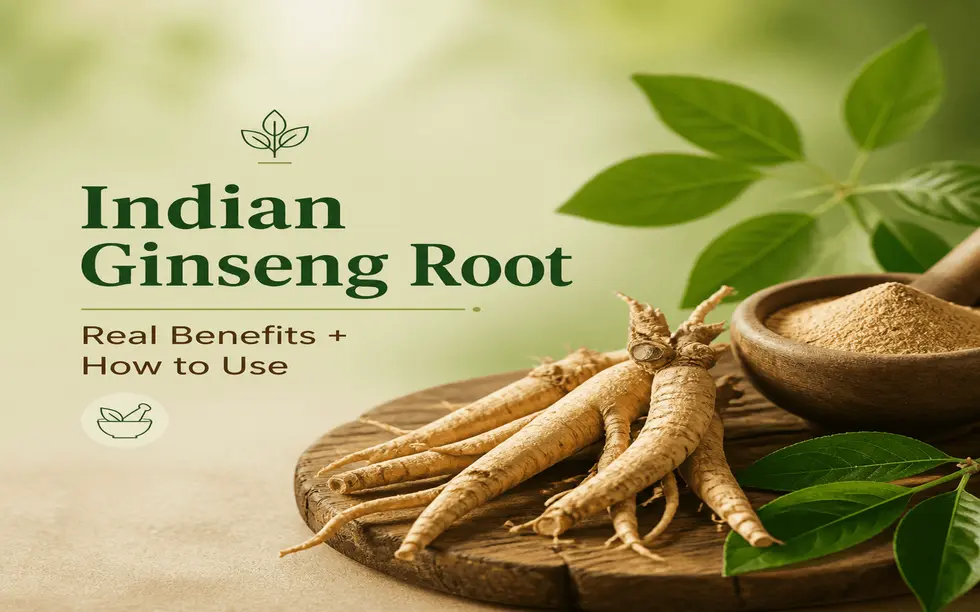
Indian ginseng root is ashwagandha (most commonly Withania somnifera). It’s a traditional Ayurvedic herb. The root is the classic part used for stress, sleep, and resilience. Not magic. Not instant. But yes, there are a few benefits that show up again and again in human studies.
This guide is the practical version.
What it actually does. What it probably doesn’t do. How to use it without guessing. And how to avoid the common mistakes that make people say “it didn’t work” or “it made me feel weird.”
What is Indian ginseng root, exactly?
Indian ginseng = ashwagandha, a shrub in the nightshade family (same general family as tomatoes, peppers, eggplant). The active compounds people usually care about are called withanolides.
A quick translation of why people love it:
- Adaptogen (a fuzzy term, but basically “helps the body handle stress”)
- Traditionally used for sleep, nerves, strength, recovery, and vitality
- In modern supplement world, it’s mostly sold for stress and cortisol, and secondarily for sleep, testosterone/fertility, and exercise performance
Also. The part matters.
- Root is the classic. More calming, more “grounding” for many people.
- Leaf can be stronger in withanolides, but also more likely to feel stimulating or cause side effects for some.
- Root + leaf extracts exist and can be fine, but the experience can be different.
When people say “Indian ginseng root,” they usually mean root powder or root extract.
The real benefits (what has decent evidence)
I’m going to stick to benefits that show up in multiple human studies or are at least consistent enough that you’re not gambling completely.
Not every study is perfect. Not every product matches the studies. But there are patterns.
1) Stress reduction and lower perceived anxiety
This is the biggest, most reliable reason people take ashwagandha.
In several clinical trials, ashwagandha (usually a root extract) improved stress scores and reduced anxiety symptoms compared to placebo. It’s not a benzo. It’s not a “knockout.” It’s more like… the volume dial on stress gets turned down a bit.
A lot of people describe it as:
- less overthinking at night
- less “wired but tired”
- less emotional reactivity
- a little more calm in the body
Not everyone feels it. But enough people do that it’s a thing.
Cortisol: Some studies show reductions in cortisol, especially in stressed individuals. But don’t get too literal about “lower cortisol” being automatically good. Cortisol is not the enemy. The goal is healthier rhythm and less chronic elevation, not “as low as possible.”
2) Better sleep quality (especially if stress is the problem)
Ashwagandha is not a classic sedative like valerian. It’s more like it helps some people stop fighting sleep.
In studies, people often report:
- improved sleep quality
- falling asleep a bit easier
- waking up less
- feeling more rested
This tends to work best if your sleep issues are stress related. If your issue is sleep apnea, late caffeine, doom scrolling, or a newborn. Different story.
Also important: some people get sleepy from ashwagandha, some feel a bit energized. That’s why timing and dose matter.
3) Small boost in strength, performance, and recovery (for some people)
There are trials where ashwagandha improved:
- strength gains (like bench press / leg extension)
- muscle size markers
- VO2 max or endurance related measures
- recovery and soreness perception
Is it a steroid? No. Is it creatine? No. But if you’re training consistently and sleeping decently, it might add a small edge.
This benefit seems more noticeable in:
- beginners or moderate lifters
- people under stress (since stress crushes training adaptations)
- people who actually take it consistently for at least a few weeks
4) Testosterone and male fertility (promising, but not universal)
This is where the internet goes off the rails.
Some studies, especially in stressed men or men with fertility issues, show improvements in:
- testosterone levels (modest increases)
- sperm count, motility, semen quality
- oxidative stress markers
But not every study shows huge changes, and effects can depend on baseline status. If your testosterone is normal and your lifestyle is solid, don’t expect dramatic hormone swings.
If you’re trying to conceive and you’re looking at ashwagandha, treat it as supportive, not primary treatment. And talk to a clinician if you’ve been trying for a while. Timing matters more than supplements sometimes.
5) Blood sugar, inflammation, and lipids (possible, but secondary)
There’s some evidence ashwagandha can help with:
- fasting glucose
- triglycerides / cholesterol
- inflammatory markers
But this is not the reason I’d start it. Consider this “maybe helps a bit” if everything else is already being handled (food, movement, sleep, stress, meds if needed).
Benefits people claim that are… overstated
Not saying impossible. Just saying the evidence isn’t as clean as TikTok makes it.
- “Cures depression”
- It may help mood in some people, especially through stress reduction and better sleep. But it’s not a substitute for proper treatment.
- “Fixes thyroid issues”
- There are hints it may increase thyroid hormone in some cases, which is exactly why people with thyroid disease need to be careful. This is not DIY territory.
- “Works like a benzo” / “works like Adderall”
- No. If you feel intensely sedated or intensely wired, that’s your sign to lower the dose, change the product, or stop.
- “Guaranteed libido booster for everyone”
- Some people notice libido improvements. Others feel flatter. Hormones, stress, relationship dynamics, sleep. It’s complicated.
Ashwagandha root forms: powder vs extract vs “KSM” and friends
This part matters more than people realize.
1) Root powder
This is literally ground root.
Pros:
- cheap
- closer to traditional use
- easier to “microdose” (small amounts)
Cons:
- potency varies
- you might need more grams to feel effects
- taste is… yeah. earthy, bitter, kind of like dirt tea
2) Root extract (standardized)
This is concentrated and usually standardized to a percentage of withanolides.
Pros:
- easier dosing (capsules)
- more consistent potency
- most studies use extracts, not plain powder
Cons:
- stronger isn’t always better
- quality varies a lot by brand
- some extracts include leaf, which can feel different
3) Branded extracts (examples you’ll see)
You might see names like:
- KSM-66 (typically a root-only extract, commonly standardized around ~5% withanolides)
- Sensoril (often higher withanolides and may include leaf, tends to feel more sedating for some but also more side effects for others)
I’m not endorsing a brand here, just explaining why two people taking “ashwagandha” can have totally different experiences.
How to use Indian ginseng root (actual practical dosing)
This is where most guides get weirdly vague, so here’s a simple framework.
Step 1: Pick your goal
Goal A: stress support during the day
You want calm, not sleepiness.
Goal B: sleep and nighttime rumination
You want “off switch” support.
Goal C: training, recovery, performance
You want consistency, maybe split doses.
Step 2: Start lower than you think
A common mistake is starting with a big dose, feeling off, and declaring it “not for me.” Sometimes it is not for you, sure. But often it’s just too much, too fast, or the wrong extract.
Typical studied doses (general ranges you’ll see)
- Extracts: often around 300 to 600 mg per day (commonly split into 1 or 2 doses)
- Root powder: often 1 to 3 grams per day (sometimes more traditionally, but start low)
Because extracts vary, always check:
- Is it root-only?
- What % withanolides?
- How many mg per capsule?
If your extract is very high in withanolides, you may need less.
Stress support (daytime)
- Start: 300 mg extract once daily, with breakfast or lunch
- If needed after 1 to 2 weeks: move to 300 mg twice daily
If you notice sleepiness, take it later in the day or lower the dose.
Sleep support (night)
- Start: 300 mg extract with dinner or 1 to 2 hours before bed
- If needed: try 600 mg total in the evening, or split 300 mg late afternoon + 300 mg evening
If you get vivid dreams, morning grogginess, or a heavy “hangover” feeling, pull the dose down.
Training and recovery
- Common approach: 300 mg twice daily
- Or: 600 mg once daily with a meal
Be patient here. Performance related benefits often show up after a few weeks, not in two days.
When will you feel it?
Depends on what you mean by “feel.”
- Sleep / calm at night: some people notice changes in a few days. Many need 1 to 2 weeks.
- Stress resilience: usually 2 to 4 weeks.
- Training / body comp markers: often 6 to 12 weeks in studies.
If you’ve taken it for 3 days and nothing happened, that’s normal.
If you’ve taken it for 6 weeks and nothing happened, either it’s not the right tool for you, or your product/dose/timing is off, or the main issue is elsewhere (caffeine, overtraining, poor sleep hygiene, etc).
For more detailed insights into the effects of stress on health and potential solutions, consider exploring this research article which discusses various aspects of stress and its management.
Best time to take it (and with or without food)
Most people do better taking it with food. It reduces nausea risk and smooths out the effect.
Timing options:
- Morning: if it makes you feel steady and calm, and not sleepy
- Afternoon: a sweet spot for many people, reduces evening stress spillover
- Evening: if your main goal is sleep
If you take it on an empty stomach and feel queasy or weirdly lightheaded, that’s a simple fix. Take it with a meal.
How to choose a good supplement (and avoid the sketchy ones)
There’s a lot of junk out there. Not always malicious. Just lazy.
Here’s what to look for:
Check the label for:
- Species: Withania somnifera
- Part used: root (if you specifically want Indian ginseng root benefits)
- Standardization: withanolides percentage or mg amount
- Dose per serving: clear, not hidden inside “proprietary blend”
Prefer:
- Third party testing (NSF, USP, Informed Choice, or at least a posted COA from the brand)
- Simple formulas (ashwagandha + capsule, not 18 “stress blend” ingredients)
- Reasonable withanolide levels (not automatically “the highest possible”)
If the product advertises something like “20% withanolides mega potency,” proceed carefully. Some people tolerate it fine. Others absolutely do not.
Side effects (yes, they happen)
Most people tolerate ashwagandha well. But side effects are real, and they’re not that rare if the dose is high.
Possible side effects include:
- stomach upset, nausea, diarrhea (often from taking too much or taking it empty stomach)
- sleepiness or grogginess
- headaches
- vivid dreams
- feeling emotionally flat or unmotivated (some people describe this)
- feeling wired or restless (more common with certain extracts, especially if leaf is involved)
If you feel off, the first move is not panic. It’s:
- cut the dose in half
- take with food
- change timing
- if still weird, stop
Who should avoid Indian ginseng root (or talk to a clinician first)
This part matters. Because “natural” can still hit hard.
Avoid or get medical advice first if you are:
- Pregnant or trying to become pregnant (commonly advised to avoid due to limited safety data and traditional cautions)
- Breastfeeding (safety data is limited)
- Have hyperthyroidism, thyroid nodules, Graves’, or are on thyroid meds (ashwagandha may affect thyroid hormone levels in some people)
- Have autoimmune disease (it may modulate immune activity, which can be good or not good depending on your condition)
- On sedatives, anti anxiety meds, antidepressants, or sleep meds (possible additive effects, not always, but it can happen)
- On diabetes meds or blood pressure meds (it may lower glucose or blood pressure in some people)
- Have liver disease or unexplained elevated liver enzymes (rare liver injury reports exist with ashwagandha supplements; rare, but serious when it happens)
Also, if you’ve had bad reactions to nightshades, that doesn’t automatically mean ashwagandha will be a problem. But it’s a reason to start extra low and pay attention.
How to actually use it in real life (simple routines)
This is the part people want. Not theory.
Routine 1: For stress and overthinking (the “I’m always on” person)
- 300 mg extract with lunch
- optional: add 300 mg with dinner if needed after 1 to 2 weeks
Track: irritability, chest tightness, afternoon crash, bedtime mind racing.
Routine 2: For sleep quality (but not as a knockout pill)
- 300 mg extract with dinner
- if needed: 300 mg again 60 to 90 minutes before bed
Add ons that pair well (if you tolerate them): magnesium glycinate, glycine, consistent wake time. Simple stuff.
Routine 3: For training and recovery
- 300 mg extract morning + 300 mg evening, with meals
- keep it boring, keep it consistent for 8 weeks
Track: training consistency, soreness, sleep, motivation. Not just “pump.”
Routine 4: Root powder “traditional-ish” approach
If you prefer powder:
- start with 1 gram mixed into warm milk or a milk alternative
- take at night
- if tolerated, move to 2 grams
Taste tip: mix with cocoa, cinnamon, honey. Otherwise it can be rough.
Should you cycle it?
You don’t have to, but some people prefer cycling because it keeps the effect noticeable and helps avoid emotional flatness.
Simple cycles people use:
- 8 to 12 weeks on, 2 to 4 weeks off
- 5 days on, 2 days off (gentler, but some like it)
If you’re taking it for sleep and it’s working, you can also just keep the dose minimal and steady.
How to tell if it’s working (without overthinking it)
Pick 2 or 3 markers and watch those. Otherwise you’ll convince yourself it’s doing everything or nothing.
Good markers:
- time to fall asleep
- number of nighttime wakeups
- morning rested feeling (1 to 10 score)
- “stress reactivity” (how fast you get annoyed)
- cravings and stress eating (many people see a link here)
- training recovery soreness
If you’re not seeing any movement after 4 to 6 weeks at a reasonable dose with a decent product, it’s fine to move on.
Common mistakes that make people hate ashwagandha
- Starting too high
- More is not always better. It’s the easiest way to get side effects.
- Using a random “mega potency” product
- Not all extracts feel the same. Root only vs root plus leaf can change the whole vibe.
- Expecting a first dose miracle
- Sometimes it’s subtle. Sometimes it’s slow.
- Taking it with five other calming supplements
- Then you don’t know what did what. Also you might end up too sedated.
- **Ignoring **sleep basics
- If your caffeine is high and late, and you’re scrolling in bed for an hour, ashwagandha is not going to overcome that every time.
FAQ (quick answers)
Is Indian ginseng the same as Panax ginseng?
No. Panax ginseng is true ginseng (Korean/Chinese ginseng). Indian ginseng is ashwagandha. Different plants, different effects. Panax tends to be more stimulating for many people.
Can I take it every day?
Many people do. If you feel emotionally flat or too sleepy after a while, reduce dose or cycle.
Does it help women too?
Yes, especially for stress and sleep. Hormone claims get messy, but stress resilience benefits apply to everyone.
Can I take it with coffee?
You can, but if you’re using ashwagandha to smooth stress and your coffee is spiking anxiety, you’re kind of fighting yourself. If you’re sensitive, take it with lunch instead.
Let’s wrap this up (the honest version)
Indian ginseng root, aka ashwagandha root, is one of the few herbs that actually has a decent amount of human evidence behind it. The most believable benefits are:
- reduced stress and anxiety symptoms
- improved sleep quality (especially stress related sleep issues)
- modest support for training performance and recovery
- possible support for male fertility and testosterone, mainly in specific groups
How to use it without making it complicated:
- start with 300 mg of a root extract, with food
- choose timing based on your goal (day for stress, night for sleep)
- give it 2 to 4 weeks before judging
- lower the dose if you feel off, don’t just push through
And if you have thyroid issues, autoimmune conditions, are pregnant, or take medications that could interact. don’t guess. Ask a clinician who will actually look at your situation.
If you want, tell me what your goal is (sleep, stress, gym, fertility), what product you’re considering, and your caffeine schedule. I can help you set up a simple plan and a “how to know it’s working” checklist.
FAQs (Frequently Asked Questions)
What exactly is Indian ginseng root?
Indian ginseng root is another name for ashwagandha, scientifically known as Withania somnifera. It’s a traditional Ayurvedic herb from the nightshade family, primarily used for its root, which contains active compounds called withanolides. Despite the name, it’s not true ginseng.
What are the proven benefits of ashwagandha (Indian ginseng root)?
Ashwagandha has several benefits supported by multiple human studies, including reducing stress and anxiety by lowering perceived stress levels and cortisol, improving sleep quality especially when stress-related, providing a small boost in strength and exercise performance for some individuals, and offering modest improvements in testosterone and male fertility in stressed or infertile men.
How does ashwagandha help with stress and anxiety?
Ashwagandha acts as an adaptogen that helps the body manage stress by turning down the ‘volume dial’ on stress rather than acting like a sedative or benzodiazepine. It can reduce overthinking at night, decrease emotional reactivity, and promote a calmer body state. Some studies also show it can lower cortisol levels in stressed individuals.
Can ashwagandha improve sleep quality?
Yes, ashwagandha can improve sleep quality by helping people stop fighting sleep rather than acting as a classic sedative. It may help users fall asleep easier, wake up less during the night, and feel more rested overall—especially if their sleep issues are related to stress.
Is ashwagandha effective for boosting strength and exercise performance?
Ashwagandha may provide a small boost in strength gains, muscle size, endurance (VO2 max), and recovery perception for some people. This effect is typically more noticeable in beginners or moderate lifters who train consistently and manage stress well over several weeks of supplementation.
Does ashwagandha improve testosterone levels and male fertility?
Some studies indicate that ashwagandha can modestly increase testosterone levels and improve sperm count, motility, and semen quality in stressed men or those with fertility issues. However, results aren’t universal; it should be considered supportive rather than a primary treatment for fertility concerns.